

US to ease Pakistan travel advisory, enabling more investment — commerce minister

1 / 2
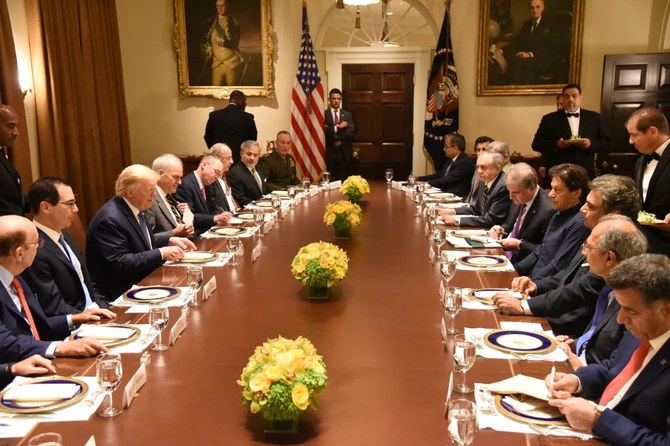
Prime Minister Imran Khan leading delegation-level talks with US President Donald Trump at White House on July 2019. (PID)
2 / 2
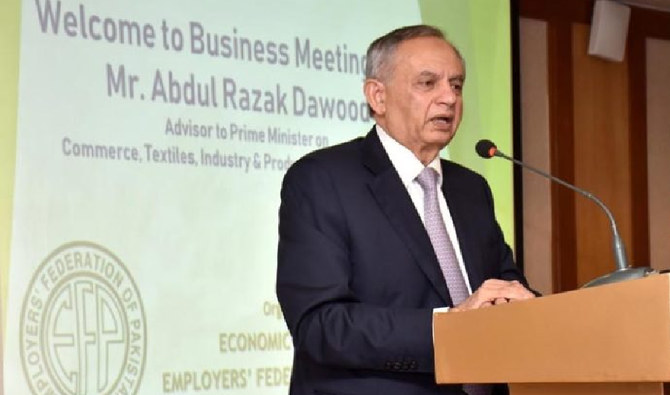
Adviser to the Pakistani Prime Minister on Commerce, Textile, Industry and Production and Investment, Abdul Razak Dawood, addresses a press conference in Islamabad on February 11, 2019 (APP photo)
Updated 28 July 2019
Follow

US to ease Pakistan travel advisory, enabling more investment — commerce minister

ISLAMABAD: The United States is considering a review of its “reconsider travel” advisory for Pakistan, leading to more investment in the country, a key Pakistani official said on Friday, days after Prime Minister Imran Khan returned home from a visit to the US that supporters have called a major success.
Khan’s visit included a one-on-one meeting with President Donald Trump and his offer that Pakistan would help seal a peace agreement with the Taliban to allow US troops to withdraw from Afghanistan has gone some way toward rebuilding Pakistan’s image in Washington after years of US suspicions.
“I have discussed this matter with my counterpart during the US visit and he has assured me that they will look into this matter,” a local Pakistani newspaper quoted de facto Commerce Minister Abdul Razak Dawood as telling reporters. “I came to know that they are going to be soft on this issue.”
The last US travel advisory for Pakistan came in April this year and urged US citizens to avoid visiting the country “due to terrorism.” 
Prior to Khan’s visit to the US, Pakistan arrested Hafiz Saeed, an accused militant leader with a $10 million US bounty on his head, in the hopes of a more favorable reception at the White House and the Pentagon.
Khan’s visit also had a strong investor tilt as the country, battling to stave off a balance of payments crisis, was forced to seek a bailout from the International Monetary Fund. 
Dawood said if the US withdrew its travel advisory, Pakistan would be able to initiate better business activities with the US, adding that six American delegations would visit Pakistan over the next five months. He said Khan had requested the US for increased investment in Pakistan and more bilateral trade rather than aid, like past governments. 
Currently, US and Pakistan have two-way goods trade worth $6.6 billion, according to the office of the US Trade Representative. 


Pakistan says 177 militants killed in Balochistan counteroffensive after wave of attacks

Updated 7 sec ago
Follow

Pakistan says 177 militants killed in Balochistan counteroffensive after wave of attacks

  • Authorities say coordinated attacks last weekend killed 31 civilians, 17 security personnel
  • Separatist BLA group claimed responsibility as operations expanded across multiple districts

ISLAMABAD: Pakistan’s security forces have killed 22 more militants in overnight counteroffensive operations in the southwestern province of Balochistan, state media reported on Monday, taking the total number of insurgents killed over the past three days to 177 following a wave of coordinated separatist attacks.

Militants launched simultaneous assaults across multiple districts in Balochistan on Friday and Saturday, targeting security installations and government facilities. The attacks marked one of the deadliest escalations in recent years in the resource-rich but restive province, with at least 31 civilians and 17 members of law enforcement agencies killed.

The banned separatist group, the Baloch Liberation Army, claimed responsibility for the attacks, saying it had launched a coordinated operation dubbed Herof, or “black storm,” targeting security forces across the province. The assault included pre-dawn strikes on high-security installations in the cities of Quetta, Gwadar, Dalbandin, Pasni, Nushki, Kalat, Turbat and Mastung.

Local residents look at a damaged bank on the outskirts of Quetta on February 1, 2026 a day after an attack by Baloch separatists. (AFP)

On Monday, state broadcaster Radio Pakistan said security forces carried out the latest “sanitization operations” against what it described as “Fitna-al-Hindustan” in Balochistan late Sunday night. Pakistan’s military and civilian authorities use the term to describe separatist militants in the province whom Islamabad alleges are supported by India, a charge New Delhi denies.

“According to security sources, 22 more terrorists were killed last night during pursuit operations,” Radio Pakistan said. “At least 177 terrorists have been eliminated in the operations conducted over the last three days.”

People gather as others collect recyclable items beside a burnt vehicle along a road on the outskirts of Quetta on February 1, 2026 a day after an attack by Baloch separatists. (AFP)

Balochistan, Pakistan’s largest province by area, has long been gripped by a separatist insurgency that has intensified in recent years. Militants frequently target security forces, government officials, infrastructure projects, foreigners and non-local workers.

Balochistan is strategically significant for Pakistan due to its vast reserves of minerals and hydrocarbons and its role as a transit hub for the multibillion-dollar China-Pakistan Economic Corridor (CPEC), a flagship component of China’s Belt and Road Initiative. The province is home to the deep-sea Gwadar Port on the Arabian Sea, which Islamabad views as critical to regional trade and energy routes linking China, Central Asia and the Middle East. 

Local residents look at a damaged bank on the outskirts of Quetta on February 1, 2026, a day after an attack by Baloch separatists. (AFP)

Separatist groups accuse the central government of exploiting the province’s natural resources while neglecting local communities. Islamabad rejects the allegations, saying it is investing in development and security to stabilize the province.