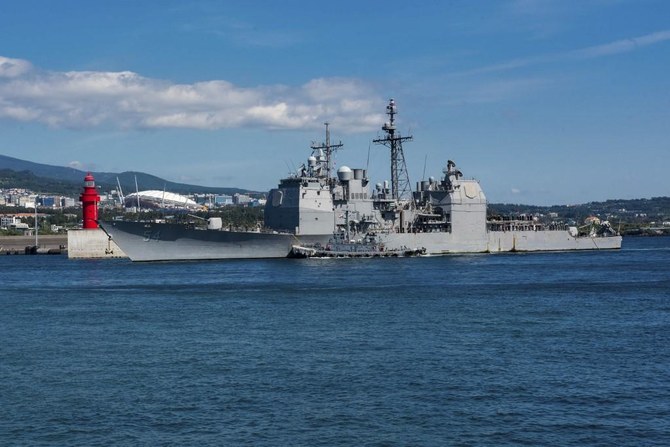
US warship sails through Taiwan strait amid China tensions

Joint Taiwanese intelligence, surveillance and reconnaissance statement said nothing out of the ordinary happened during the ship’s passage. (File/AFP)
Updated 25 July 2019
Follow

US warship sails through Taiwan strait amid China tensions

  • US Navy Seventh Fleet spokesman said it was a routine transit and legal under international law
  • China threatened to use force against those who stand in the way of them reuniting Taiwan

TAIPEI: Taiwan says the US Navy is free to sail through its strait after an American warship did so shortly following warnings from Beijing against foreign interference in its relationship with the island.
Taiwan’s Defense Ministry said Thursday the warship sailed northward through the Taiwan Strait. It said joint intelligence, surveillance and reconnaissance task force was monitoring surrounding waters from start to finish and nothing “unusual” took place.
Commander Clay Doss, a spokesman for the US Navy’s Seventh Fleet, said the “USS Antietam conducted a routine Taiwan Strait transit” Wednesday to Thursday “in accordance with international law.”
China on Wednesday warned that it could use force against anyone who intervenes in its efforts to reunify Taiwan, a democratically-governed island which China considers its territory.


Bulgarian parliament approves resignation of ruling coalition

Bulgaria’s Prime Minister Rossen Zhelyazkov delivers a speech following his government’s resignation in Sofia on Thursday. (AFP)
Updated 6 sec ago
Follow

Bulgarian parliament approves resignation of ruling coalition

  • The 240-seat chamber voted 127-0 to accept the resignation

SOFIA: Bulgarian parliament has approved the resignation of the coalition government of Prime Minister Rosen Zhelyazkov amid nationwide anti-corruption protests, and weeks ahead of the country’s scheduled euro zone entry.
Protesters, many of them young Bulgarians, have been protesting in the tens of thousands across the nation for weeks. 
The direct trigger was a proposed budget for next year that would have increased taxes and social security contributions to finance more state spending. 
The deeper cause, however, was rising anger over a perception of widespread corruption among the political elite and a sense that justice does not prevail for ordinary citizens.

BACKGROUND

The protests and the fall of the ninth government in five years underscored Bulgaria’s political instability.

The protests and the fall of the 9th government in five years underscored the country’s political instability as it plans to join the common European currency.
The 240-seat chamber voted 127-0 to accept the resignation. 
The Cabinet will continue performing its duties until a new government is elected.
Zhelyazkov’s minority government survived six votes of no confidence since it was appointed in January, but this time the large turnout of protesters on the streets changed the game.
The prime minister announced his resignation on Thursday, saying it was a direct response to the growing public pressure and that the demand for the government to step down had become impossible to ignore.
“Vox populi, vox Dei,” Zhelyazkov said, using a Latin expression meaning “the voice of the people is the voice of God.”
In the next step, President Rumen Radev must allow the largest parliamentary group to form a new government. If that fails, the second-largest grouping will get a chance before the president chooses a candidate.
If all attempts fail — which is likely — Radev will appoint a caretaker Cabinet until a new election is held. Political analysts expect that another election — the eighth since 2021 — will likely produce a deeply fragmented parliament, making it difficult to form a stable government.
The Balkan country of 6.4 million people is due to make the switch from its national currency, the lev, to the euro on Jan. 1, to become the euro zone’s 21st member. 
Bulgaria joined the EU in 2007.