

UK PM Johnson promises a bold new Brexit deal

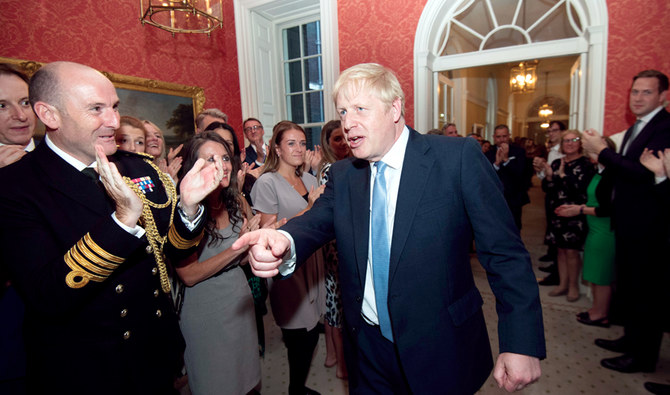
Prime Minister Boris Johnson is welcomed in 10 Downing Street on Wednesday by staff. (Reuters)
Updated 24 July 2019
Follow

UK PM Johnson promises a bold new Brexit deal

  • New leader: ‘The people who bet against Britain are going to lose their shirts’

LONDON: Boris Johnson launched his premiership with a bid to do a bold new Brexit deal with the EU by Oct. 31, rebuking “gloomsters” and the political class who he said had forgotten the people who they should serve.

Johnson took office on Wednesday, replacing Theresa May who stepped down having failed to deliver Brexit or implement many of the reforms she promised when taking office in 2016.

He comes to power at a time of national crisis, promising Britain will leave the EU at the end of October but with little sign that Brussels will bend to his demand to sweeten the terms of the country’s departure.

“We are going to fulfil the repeated promises of Parliament to the people and come out of the EU on Oct. 31. No ifs or buts,” he said.

“We will do a new deal, a better deal that will maximize the opportunities of Brexit while allowing us to develop a new and exciting partnership with the rest of Europe.”

But, in a 12-minute speech outside glossy black door to the prime minister’s residence at 10 Downing Street, Johnson delivered a thrusting rebuke to those who have criticized his planned approach as light on detail and heavy on rhetoric.

“The doubters, the doomsters, the gloomsters — they are going to get it wrong again,” Johnson said, rocking up on the balls of his feet as he spoke.

“The people who bet against Britain are going to lose their shirts.”

Casting aside his trademark clownish demeanor and rambling delivery, he followed a written script, setting out an ambitious agenda beyond Brexit — promising tax reform, a new social care system, and an economic stimulus package.

“I will tell you something else about my job. It is to be Prime Minister of the whole United Kingdom and that means uniting our country answering at last the plea of the forgotten people and the left behind towns,” he said.

Defense Secretary Penny Mordaunt was leaving the role and will not serve in new Johnson’s team of senior ministers, she said on Wednesday.

“I’m heading to the backbenches from where the PM will have my full support,” Mordaunt, a Brexit supporter who backed Johnson’s opponent Jeremy Hunt in the leadership race, said on Twitter. 

While Johnson has said he does not want an early election, some MPs have vowed to thwart any attempt to leave the EU without a divorce deal. 

Nigel Farage, whose Brexit Party trounced the Conservatives in May’s EU elections, said he was open to an electoral pact with the new prime minister.


Merz says Germany exploring shared nuclear umbrella with European allies

Updated 5 sec ago
Follow

Merz says Germany exploring shared nuclear umbrella with European allies

  • Germany is currently banned from developing a nuclear weapon
  • Britain and ‌France are the only European powers which ‍have a nuclear arsenal

BERLIN: European nations are starting to discuss ideas ​around a shared nuclear umbrella to complement existing security arrangements with the US, German Chancellor Friedrich Merz said, amid growing talk in Germany of developing its own nuclear defenses.
Merz, speaking at a time of increased transatlantic tensions as US President Donald Trump upends traditional alliances, said the talks were only at an initial stage and no decision was imminent.
“We know that we have ‌to reach ‌a number of strategic and military policy ‌decisions, ⁠but ​at ‌the moment, the time is not ripe,” he told reporters on Thursday.
Germany is currently banned from developing a nuclear weapon of its own under the so-called Four Plus Two agreement that opened the way for the country’s reunification in 1990 as well as under a landmark nuclear non-proliferation treaty that Germany signed in 1969.
Merz said Germany’s ⁠treaty obligations did not prevent it from discussing joint solutions with partners, including Britain and ‌France, the only European powers which ‍have a nuclear arsenal.
“These talks are ‍taking place. They are also not in conflict with nuclear-sharing ‍with the United States of America,” he said.
European nations have long relied heavily on the United States, including its large nuclear arsenal, for their defense but have been increasing military spending, partly in response to sharp criticism ​from the Trump administration.
Trump has rattled Washington’s European allies with his talk of acquiring Greenland from Denmark, a ⁠NATO ally, and his threat, later rescinded, to impose tariffs on countries that stood in his way.
He has also suggested in the past that the US would not help protect countries that failed to spend enough on their own defense.
Merz’s comments were echoed by the head of the parliamentary defense committee, Thomas Roewekamp, who said Germany had the technical capacity which could be used in developing a European nuclear weapon.
“We do not have missiles or warheads, but we do have a significant technological advantage that we could contribute ‌to a joint European initiative,” Roewekamp, from Merz’s center-right Christian Democratic Union party, told Germany’s Welt TV.