Saudi cabinet reviews, stresses commitment to Hajj services

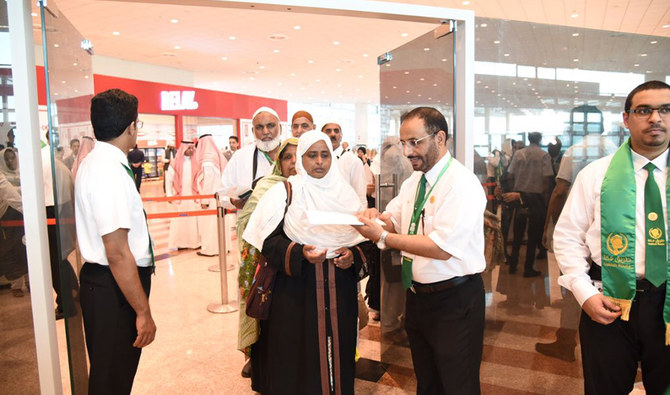
A team of Saudi officials check travel documents for Hajj pilgrims at Islamabad International Airport. The Saudi team installed a pre-immigration system at the airport to facilitate Pakistani travellers flying to Makkah and Madinah this year, under the Road to Makkah Project. July 4, 2019. (Photo Courtesy – Saudi Embassy)
Updated 24 July 2019
Follow

Saudi cabinet reviews, stresses commitment to Hajj services

  • Custodian of the Two Holy Mosques’ Guests Program has benefited over 52,000 pilgrims
  • ‘Road to Makkah’ project an extension of services for Pakistani Hajj pilgrims

ISLAMABAD: The Saudi cabinet on Tuesday reviewed topics related to the services provided to Hajj pilgrims, and to the service of the Two Holy Mosques, Saudi Press Agency (SPA) reported.
Chaired by King Salman, the cabinet discussed his directive to host thousands of pilgrims from all over the world each year as part of the Custodian of the Two Holy Mosques’ Guests Program for Hajj and Umrah.
The program has benefited more than 52,000 pilgrims since its inception in 1996.
Media Minister Turki Al-Shabanah said the opening of water projects in Makkah and the holy sites reflects the Saudi leadership’s care and attention, SPA reported.
The opening of the water projects, which cost a total of more than SR1.3 billion ($346.6 million), coincides with this year’s pilgrimage season, to the benefit of pilgrims from around the world.
As one of Saudi Arabia’s most long-standing allies, Pakistan has particularly benefitted from Saudi Arabia’s commitment to Hajj services.
As an extension of services provided to Pakistani Hajj pilgrims this year, the Road to Makkah project was initiated in the country and aims to facilitate the 200,000 people expected to perform the obligatory religious ritual. It was during Crown Prince Mohammad bin Salman’s February visit to Islamabad, that Prime Minister Imran Khan had requested him to include Pakistan in the project.
For this purpose, before the commencement of Hajj flights from Pakistan earlier this month, a team of Saudi officials arrived in the country to set up a pre-departure immigration system at Islamabad International Airport which significantly cuts down waiting times for pilgrims once they land in Saudi Arabia. The program is expected to be extended to other major airports in Pakistan in the years to come. 
This year alone, nearly 30,000 Pakistani pilgrims are expected to benefit from the facility. 
In addition to this, services to Pakistani pilgrims include a state-of-the-art Pakistan Hajj medical mission with 180 doctors, two hospitals and 18 ambulances. 


Pakistani economists flag debt sustainability risks as foreign loans surge in FY26

Updated 5 sec ago
Follow

Pakistani economists flag debt sustainability risks as foreign loans surge in FY26

  • Pakistan received $2.98 billion from bilateral, global lenders from July to November this year, official data shows
  • Economists urge government to take structural reforms to boost exports, cut energy costs, ensure rupee stability

KARACHI: Pakistani economists on Wednesday warned the government against debt sustainability risks as the country’s foreign loan receipts surged to nearly $3 billion in the first five months of the current fiscal year, data from the economic affairs ministry showed. 

Pakistan received 16 percent more financing, which is $2.98 billion, from bilateral and multilateral lenders during the July to November period of the current fiscal year compared to last year, the economic affairs’ ministry data showed. 

Pakistan, as per the data, seeks to raise $19.8 billion in loans this year through June, which include $16.7 billion non-project and $3.11 billion project loans from multilateral lenders such as the Asian Development Bank (ADB), Asian Infrastructure Investment Bank (AIIB), Islamic Development Bank (IsDB), European Union (EU), European Investment Bank (EIB), UNICEF and others. 

Pakistan’s bilateral lenders include the countries of China, Saudi Arabia, Kuwait, Oman, the US, Denmark, France, Germany, Italy, Japan and South Korea

“As long as you are utilizing the loan for economic recovery and growth, it is understood,” Sana Tawfik, head of research at the Karachi-based brokerage firm Arif Habib Limited, told Arab News.

“But in the long term, it is not sustainable to rely only on loans. Foreign reserves should be built on FDI [foreign direct investment] and not on loans,” she added. 

Pakistan’s finance adviser Khurram Schehzad and finance ministry spokesperson Qamar Sarwar Abbasi did not respond to requests for comment.

Cash-strapped Pakistan came close to a sovereign default in 2023 before a last-gasp financial bailout by the International Monetary Fund (IMF) averted the risk. 

While Pakistan has lowered inflation and registered other economic gains, the country’s $15.9 billion foreign reserves mostly come from the IMF in budgetary support and bank deposits from countries such as Saudi Arabia and China.

The cash-strapped country will seek $13.5 billion in budgetary support, $700 million in short-term loans from the IsDB, $1.44 billion as program loans, $1 billion worth of oil on deferred payments and $3.11 billion as project loans by June, the data said. 

Prime Minister Shehbaz Sharif’s government also plans to raise $400 million through issuing international bonds, $3.1 billion in loans from foreign commercial banks, $410 million from the IMF, $609 million through Naya Pakistan Certificates (NPCs) and $5 billion as time deposits from Saudi Arabia, and $4 billion as safe deposit from China.

“Long-term solution is not to take loans and this only adds up to the existing external account,” Tawfik said. 

She, however, appreciated the government’s ability to reduce its current account deficit in recent months. The economist noted that Pakistan, in the short run, could manage its current account deficit if it remains in the $1.5 billion range throughout the year.

She urged the government to focus on increasing exports, noting its debt servicing requirement was $25.8 billion this year.

Tawfik called for long-term reforms such as reducing the cost of doing business, cutting energy costs, clearing Pakistan’s longstanding power sector debt and keeping the rupee stable to attract increased remittances from Pakistanis working abroad.

“In the long run, we must focus on increasing Pakistan’s exports, remittances, and FDI,” the economist said. “FDI is the most important.”

‘OBVIOUSLY A RISK FACTOR’

However, neither are Pakistan’s exports on the rise nor is FDI. Pakistan’s current account deficit widened by 37 percent to $16 billion from July to November this year. This was due to a 6.4 percent decline in exports to $12.8 billion and a 13 percent hike in imports to $28 billion, data from the Pakistan Bureau of Statistics (PBS) showed. 

FDI dropped by more than 25 percent to $927 million during the same period and has never surged beyond $3 billion in nearly 20 years, data from Pakistan’s central bank shows. 

“Our debt sustainability will be questioned at any point if we, going forward, are not able to match these debt flows or counter these debt flows with growth and remittances and exports,” Muhammad Saad Ali, head of research at Lucky Investments Ltd, told Arab News. 

He noted that debt sustainability is “obviously a risk factor” as Pakistan has not increased its FDI nor exports during the period when its foreign debt has increased.

However, he said that there was a positive side to the 16 percent rise in foreign debt receipts as well, adding that recent macroeconomic improvements have enabled Islamabad to borrow more from global lenders. 

But the risks remain. 

“You (government) are increasing your debt and your debt sustainability will come into question again if global factors or global environment turn south,” he warned.