China says US criticism over South China Sea is slander

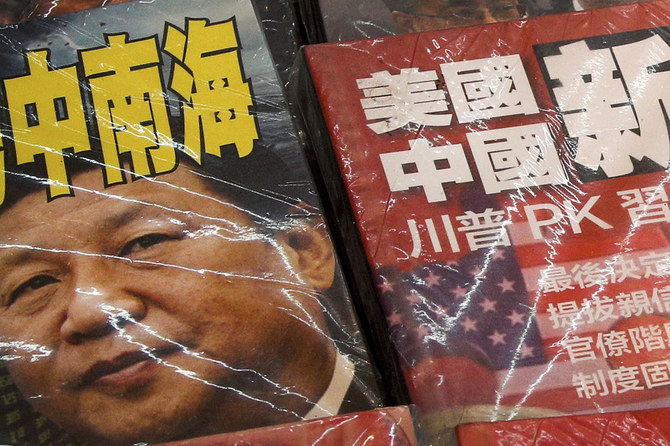
The US said it's concerned by reports of China's interference with oil and gas activities in the disputed waters of the South China Sea. (File/AP)
Updated 22 July 2019
Follow

China says US criticism over South China Sea is slander

  • China’s claims in the South China Sea are contested, all or in part, by Brunei, Malaysia, the Philippines, Taiwan and Vietnam
  • US State Department said China’s repeated provocative actions threatened regional energy security

BEIJING: Remarks by US officials on China’s role in the South China Sea are slanderous, its foreign ministry said on Monday, after the United States voiced concern over reports of Chinese interference with oil and gas activities in the disputed waters.
China’s claims in the South China Sea, through which about $5 trillion in shipborne trade passes each year, are contested, all or in part, by Brunei, Malaysia, the Philippines, Taiwan and Vietnam.
On Saturday, the US State Department said China’s repeated provocative actions aimed at the offshore oil and gas development of other claimant states threatened regional energy security and undermined the free and open Indo-Pacific energy market.
US President Donald Trump’s hawkish national security adviser John Bolton also said on Twitter that China’s coercive behavior toward its Southeast Asian neighbors was counterproductive and threatened regional peace and stability, echoing earlier comments by Secretary of State Mike Pompeo.
In Beijing, Foreign Ministry spokesman Geng Shuang said such comments by Bolton and Pompeo were baseless, adding that the United States and other “external forces” were stirring up trouble in the South China Sea.
“This is slander against Chinese and Southeast Asian countries’ efforts to uphold peace and stability in the South China Sea and properly manage differences,” Geng told a news briefing on Monday. “Countries and people in the region will not believe their words.”
He added, “We urge the United States to stop such irresponsible behavior and respect the efforts of China and ASEAN countries to resolve differences through dialogue and work for peace and stability in the South China Sea.”
US-based think tanks have reported that Chinese and Vietnamese vessels have engaged in a standoff for several weeks near an oil block in Vietnam’s exclusive economic zone.
Vietnam, which for years has been embroiled in a dispute with China over the potentially energy-rich region, on Friday accused a Chinese oil survey vessel and its escorts of violating its sovereignty and demanded that China remove the ships from Vietnamese waters.
The busy waterway of the South China Sea is one of a growing number of flashpoints in the US-China relationship.
The two countries have repeatedly traded barbs over what Washington calls Beijing’s militarization of the waters by building military installations on artificial islands and reefs.
China says the United States is to blame for tension by repeatedly sending warships close to Chinese-held islands, and that China’s sovereignty in the area is irrefutable.
ASEAN, or the Association of Southeast Asian Nations, groups Brunei, Cambodia, Indonesia, Laos, Malaysia, Myanmar, the Philippines, Singapore, Thailand and Vietnam.


Bangladesh’s Yunus announces resignation, end of interim govt

Bangladesh’s interim leader Muhammad Yunus stepped down on February 16, 2026 in a farewell broadcast to the nation.
Updated 7 sec ago
Follow

Bangladesh’s Yunus announces resignation, end of interim govt

  • Yunus handed over power after congratulating the Bangladesh Nationalist Party and its leader Tarique Rahman

DHAKA: Bangladesh’s interim leader Muhammad Yunus stepped down on Monday in a farewell broadcast to the nation before handing over to an elected government.
“Today, the interim government is stepping down,” the 85-year-old Nobel Peace Prize winner said.
“But let the practice of democracy, freedom of speech, and fundamental rights that has begun not be halted.”
Yunus returned from self-imposed exile in August 2024, days after the iron-fisted government of Sheikh Hasina was overthrown by a student-led uprising and she fled by helicopter to India.
“That was the day of great liberation,” he said. “What a day of joy it was! Bangladeshis across the world shed tears of happiness. The youth of our country freed it from the grip of a demon.”
He has led Bangladesh as its “chief adviser” since, and now hands over power after congratulating the Bangladesh Nationalist Party (BNP) and its leader Tarique Rahman on a “landslide victory” in elections last week.
“The people, voters, political parties, and stakeholder institutions linked to the election have set a commendable example,” Yunus said.
“This election has set a benchmark for future elections.”
Rahman, 60, chief of the BNP and scion of one of the country’s most powerful political dynasties, will lead the South Asian nation of 170 million.
Rebuilt institutions’
Bangladeshi voters endorsed sweeping democratic reforms in a national referendum, a key pillar of Yunus’s post-uprising transition agenda, on the same day as the elections.
The lengthy document, known as the “July Charter” after the month when the uprising that toppled Hasina began, proposes term limits for prime ministers, the creation of an upper house of parliament, stronger presidential powers and greater judicial independence.
“We did not start from zero — we started from a deficit,” he said.
“Sweeping away the ruins, we rebuilt institutions and set the course for reforms.”
The referendum noted that approval would make the charter “binding on the parties that win” the election, obliging them to endorse it.
However, several parties raised questions before the vote, and the reforms will still require ratification by the new parliament.
The BNP alliance won 212 seats, compared with 77 for the Jamaat-e-Islami-led alliance, according to the Election Commission.
Jamaat chief Shafiqur Rahman conceded on Saturday, saying his Islamist party would “serve as a vigilant, principled, and peaceful opposition.”
Newly elected lawmakers are expected to be sworn in on Tuesday, after which Tarique Rahman is set to become Bangladesh’s next prime minister.
Police records show that political clashes during the campaign period killed five people and injured more than 600.
However, despite weeks of turbulence ahead of the polls, voting day passed without major unrest and the country has responded to the results with relative calm.