



ISLAMABAD: Prime Minister Imran Khan has landed in Washington DC and will be meeting US President Donald Trump on Monday.
Reportedly, the agenda is packed full of different issues with a focus on strengthening bilateral ties. But a focus on neckties is also in order, without missing a sartorial beat.
The question is: What will Imran Khan wear on what is, arguably, going to be one of his most important diplomatic moments since taking office last year?
Traditionally, Khan leads toward tradition. He is a huge fan of Peshawari chappals (sandals), monochromatic kameez (tunics) and white shalwars (loose trousers), topped with a blazer or a structured waistcoat. For more official scenarios, like his swearing in ceremony, a sherwani- a formal, coat-like garment- is his go-to.
Khan has not wavered from his chosen minimalist aesthetic and seems quite unbothered by his predictable fashion choices on state visits, when receiving visitors to Pakistan or otherwise.
On state visits, such as that by Crown Prince Mohammed bin Salman of Saudi Arabia earlier this year, Khan stayed firm on his single-track sartorial course.
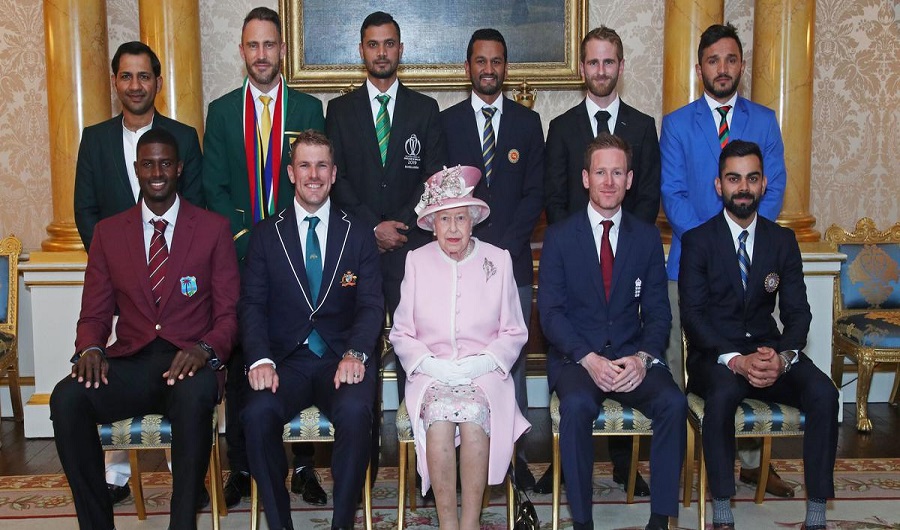
Sarfaraz Ahmed (second row, left) wearing a shalvar kameez with blazer while meeting the Queen in a pre-World Cup 2019 meet and greet on May 30th, 2019. Ahmed's outfit choice was trending on Pakistan Twitter and widely celebrated (YUI MOK / POOL / AFP)
In the hallways where history is made, this is for some, a cause for national pride. Whereas a tailored suit for men is generally considered top-brass for formal dressing, a push for symbolic culturalism has started gaining strength as a trend. In a sea of black suits and neckties at the G-20 summit in Osaka last month, Khan was one of only a handful of world leaders in traditional clothing.
Before the Cricket World Cup, a photo of Pakistan cricket captain Sarfaraz Ahmed went viral when the skipper took a cue from Khan and met Queen Elizabeth in the Pakistani Prime Minister’s signature shalvar kameez with blazer combination.
Ahmed faced some heavy criticism, since none of the other South Asian captains wore their traditional dress, but Pakistani Twitter rallied behind him for not going in for the royal handshake in western formal wear and sticking to representing Pakistan in clothes from Pakistan.
In the past, Pakistani heads of state and high-ranking officials meeting world leaders, particularly in the US, have opted for a suit and tie.
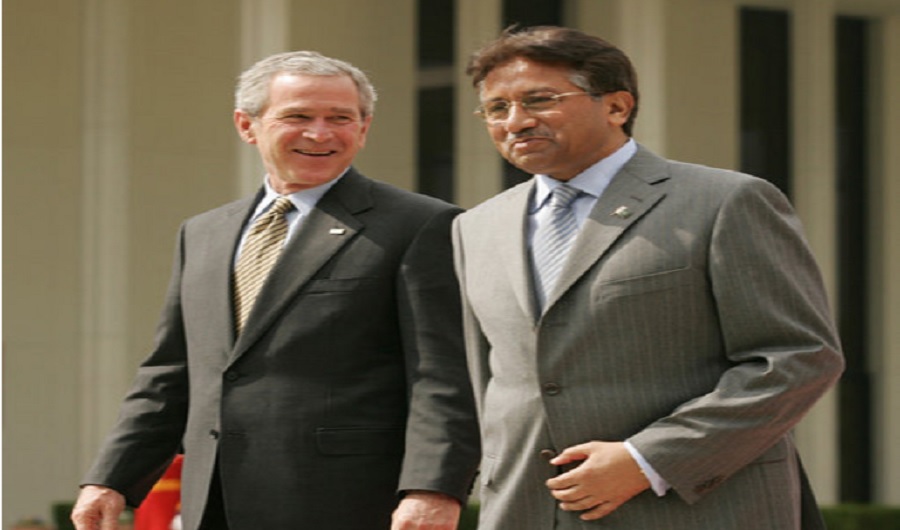
Former President Pervez Musharraf, in suit and tie, walking with former US President George Bush at the White House March 4th, 2006 (AFP)
Former President Pervez Musharraf wore a suit in 2006 when meeting with US President George Bush.
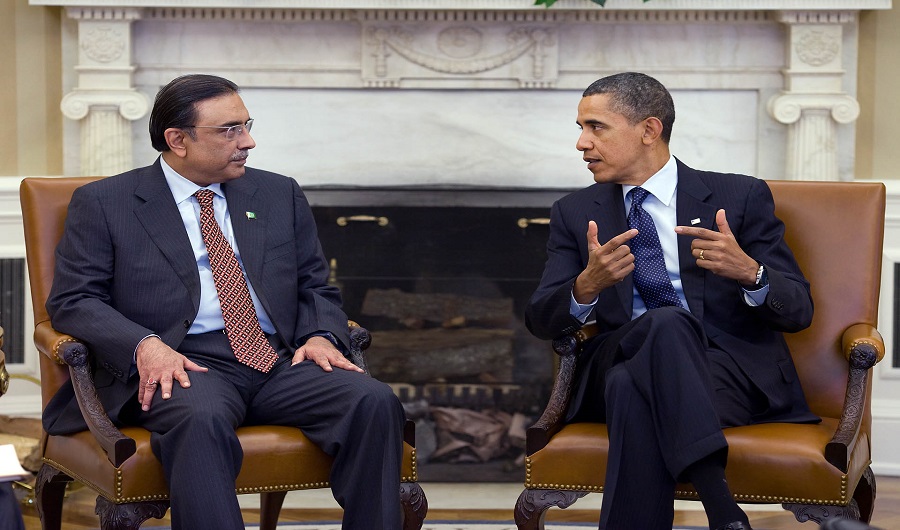
A suited former President Asif Zardari meeting Barack Obama at the Oval Office, January 14, 2011. (Official White House Photo/AFP)
In 2008, then Pakistani President Asif Zardari met with then President Bush in a suit and tie, and did so again the following year when meeting President Barack Obama.
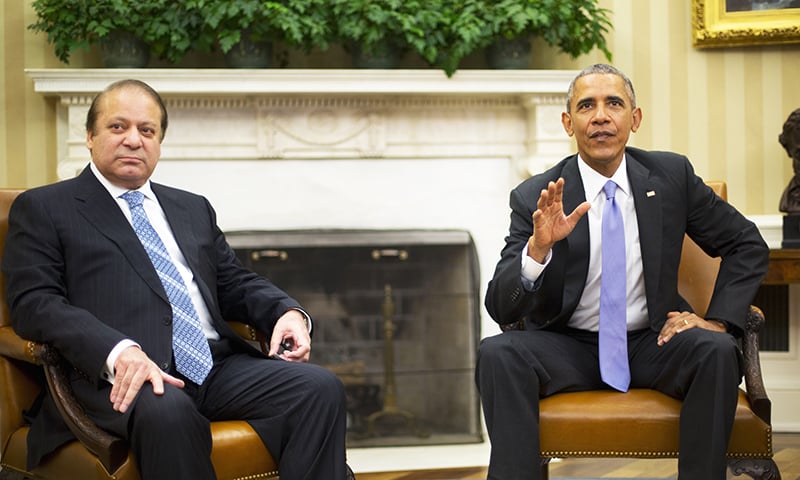
Former Prime Minister Nawaz Sharif with then US President Barack Obama replying to media queries in White House, USA on Oct 22, 2015. Photo Courtesy: AP
Former Prime Minister Nawaz Sharif also rocked the western suit look, complete with a festive blue tie, when meeting Obama in 2013.
Wearing traditional dress however is not unprecedented territory. A number of former Pakistani leaders have done that too.
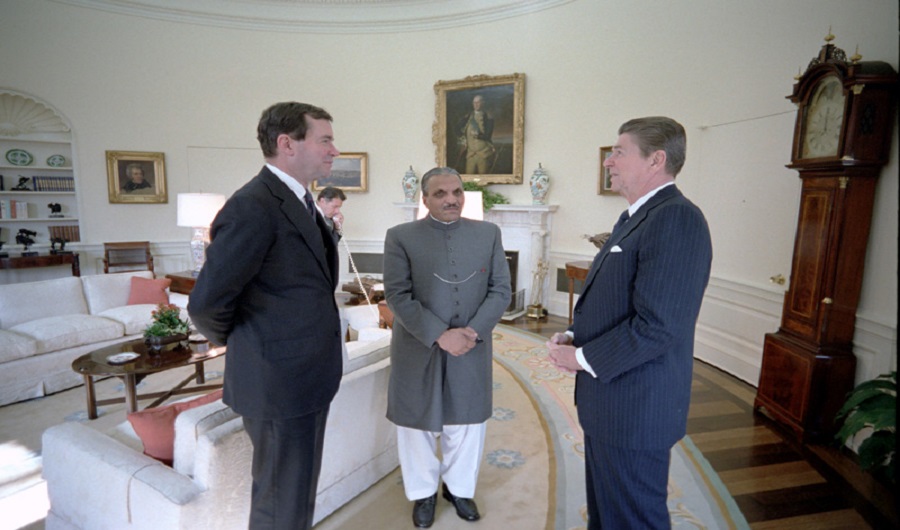
General Muhammad Zia-ul-Haq stands in a tailored sherwani with former US President Ronald Reagan at the Oval Office on 7 December, 1982 (NSA ARCHIVES)
The sherwani was the go-to choice for former Pakistan president General Muhammad Zia Ul Haq (1978-1988), who wore it when meeting US Presidents Carter and Reagan.
Even Sharif went the eastern route in a sherwani when meeting Bill Clinton at the UN in September 1998.
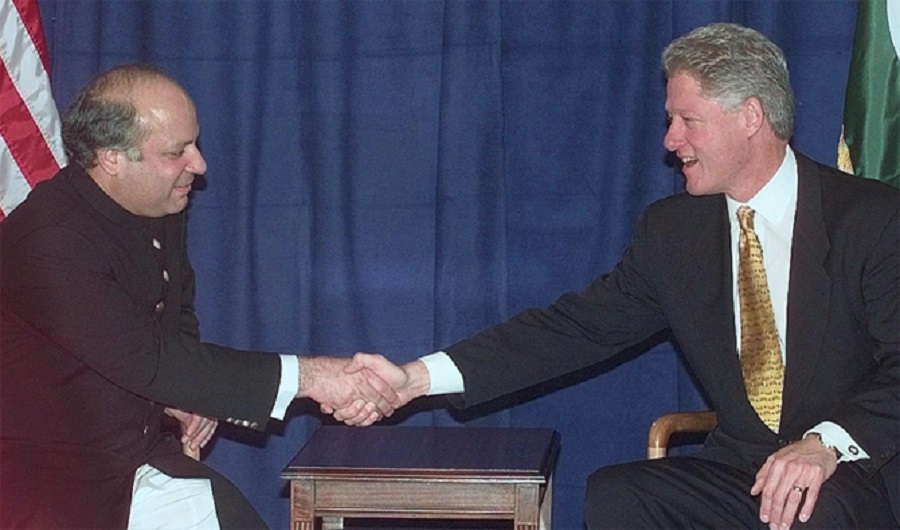
Former Pakistani Prime Minister Nawaz Sharif in a sherwani speaking with former US President Bill Clinton at the United Nations in New York, September 21st, 1998. (AFP)
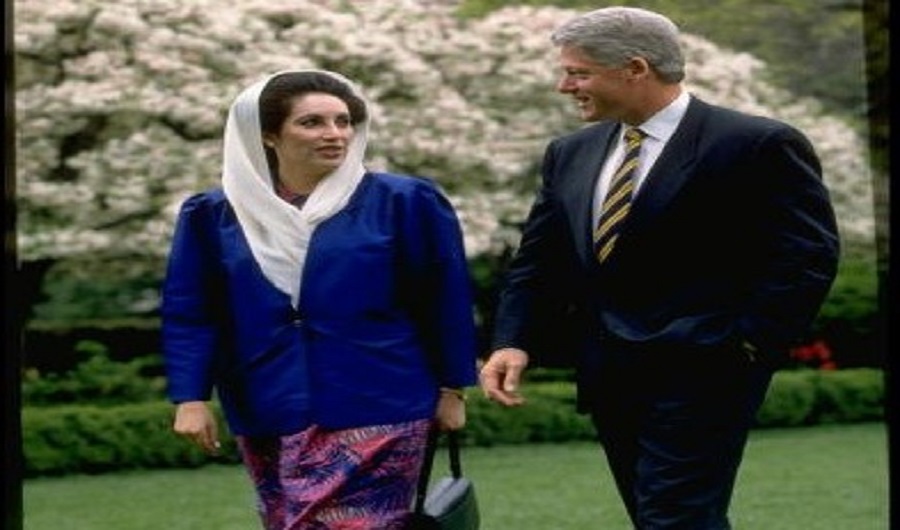
The late former Prime Minister Benazir Bhutto, in her signature shalvar kameez and blazer combination, takes a walk with US President Bill Clinton at the US Embassy in Islamabad on April 11th, 1995 (US Embassy Islamabad)
Whatever he chooses, Khan’s Monday mystery outfit for the White House will be watched very closely by the fashion hawks, and though it might not have any bearing on what comes out of the much anticipated meeting, at least the photograph will be one for the archives.


