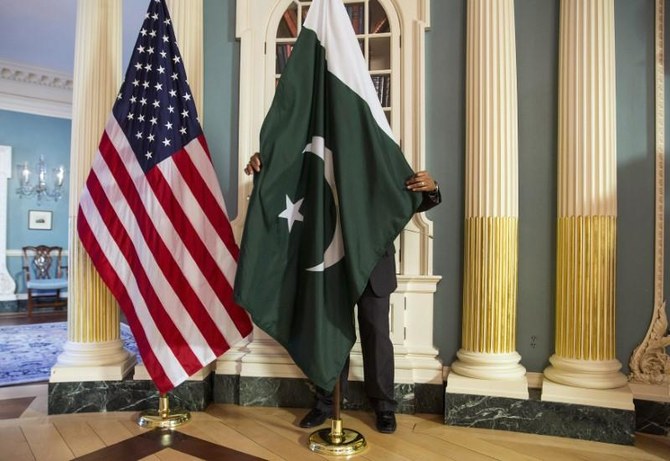
KARACHI: Pakistan must seek trade instead of aid from the United State during Prime Minister Imran Khan’s maiden visit to Washington, members of the Pakistani-American business community said on Saturday as the Pakistani premier left for Washington ahead of his meeting with the American leader on Monday.
Khan and Trump are expected to discuss a wide range of issues, including counterterrorism, defense, energy and trade, during the Pakistani PM’s first official visit.
Currently, Pakistan is the 56th largest trading partner of the US. Bilateral trade between the two countries amounted to $6.6 billion in 2018. Pakistan’s imports totaled $2.9 billion while exports stood at $3.7 billion, with the overall trade volume being in favor of the South Asian country. Pakistan was also the 55th largest goods export market for the US in 2018, according to the office of the US Trade Representative (USTR).
“I think the visit [of PM Khan] is a very positive development,” Najeeb Ghauri, vice chairman of the US-Pakistan Business Council (USPBC) at the US Chamber of Commerce, told Arab News.
Ghauri, the CEO of US technology giant NetSol, was part of the USPBC delegation that visited Pakistan ahead of PM Khan’s Washington visit. Other members of the team included representatives of US multinational giants, including PepsiCo, who pledged to expand investment in Pakistan.
“They are quite interested in house care, pharmaceutical, energy sectors etc.,” Ghauri said. “PepsiCo. has invested a billion dollars in five years and promised another billion dollars for expansion. Obviously they want to add another plant for bottling etc.”
Pakistani-American business leaders also said Pakistan’s exports, mainly of textile products, to the US and other countries, were much below potential.
“Textile export [of Pakistan] has remained at the same level of $12-13 billion a year for many years, almost a decade,” said Pakistani Shoaib A. Kothawala, who has a textile business in the US. “Backed by the 4th largest cotton crop and capability and state of the art textile plants producing value added products like Knit and Woven Apparel, Bedding, Towels, Socks, core basic production like fabric and yarn, Pakistan can fetch $40-50 billion annually.”
Kothawala, who is scheduled to meet with Khan in Washington ahead of the Trump-Khan meeting, has established businesses in eight countries including China, India, Sri Lanka and Thailand.
“There is no need for asking favors from the US which will not be given in any case,” he said.
He added: “Pakistan currently enjoys GSP preference from the US on many products [not all of] which have zero percent duty. My company produces many textile products in Pakistan and import in US under GSP where we pay zero percent tariff.”
Other business leaders complained that though they were keen to extend a helping hand for the promotion of trade and economic ties between the two countries, they had been neglected by past governments.
“In the past, no government attempted to consult with veteran businessmen for policy making but we expect a positive outcome from PM Khan’s visit,” said Pervaiz Lodhie, the president of Los Angeles-based LEDtronics, a pioneer in designing and manufacturing LED lighting products.
“Pakistan can manufacture and export engineered products, machine parts for caterpillar and other big companies and IT, textile are major areas where we can play a big role,” Lodhie added.
While the business community is optimistic that the Khan-Trump meeting will produce positive results, political analysts mostly remain skeptical.
“Right now American arms sales are booming,” former Pakistani envoy to the US, Husain Haqqani, said. “Gulf countries are buying, India is buying. So why should the US allocate large sums of money for foreign military funding, for Pakistan? It is unlikely that Pakistan will get a large aid package from the US, like it has in the past.”


![]()

Seek trade not aid from US, Pak-American businessmen advise Khan ahead of US visit
Seek trade not aid from US, Pak-American businessmen advise Khan ahead of US visit
- Pakistan 56th largest trading partner of US, bilateral trade at $6.6 billion during 2018
- Diaspora business leaders say neglected by past governments but hopeful for positive results of Khan-Trump meeting
Latest updates


© 2026 SAUDI RESEARCH & PUBLISHING COMPANY, All Rights Reserved And subject to Terms of Use Agreement.