

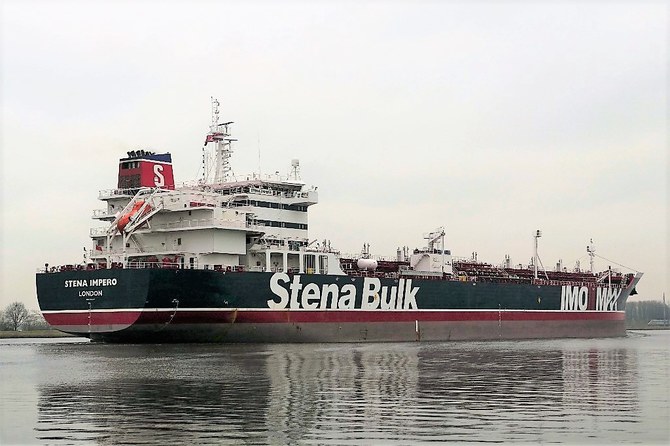

LONDON: London Saturday advised British ships to avoid the Strait of Hormuz for “an interim period” following Iran’s seizure of a British-flagged oil tanker.
“We remain deeply concerned about Iran’s unacceptable actions which represent a clear challenge to international freedom of navigation,” a government spokeswoman said following an overnight meeting of the government’s COBRA emergencies committee to discuss the crisis.
“We have advised UK shipping to stay out of the area for an interim period.”
She noted comments by Foreign Secretary Jeremy Hunt earlier that “there will be serious consequences if the situation is not resolved.”
She added that there will be further meetings over the weekend and “we remain in close contact with our international partners.”
Hunt said on Saturday that he was worried that Iran had taken a “dangerous path” after it seized a British-flagged tanker on Friday.
“Yesterday’s action in Gulf shows worrying signs Iran may be choosing a dangerous path of illegal and destabilizing behavior after Gibraltar’s LEGAL detention of oil bound for Syria,” Hunt said on Twitter.
1/2 Yesterday's action in Gulf shows worrying signs Iran may be choosing a dangerous path of illegal and destabilising behaviour after Gibraltar’s LEGAL detention of oil bound for Syria.
— Jeremy Hunt (@Jeremy_Hunt) July 20, 2019
“As I said yesterday our reaction will be considered but robust. We have been trying to find a way to resolve Grace1 issue but WILL ensure the safety of our shipping.
In comments on Twitter on Saturday, he wrote that he spoke with Iran's foreign minister and expressed extreme disappointment that the Iranian diplomat had assured him Iran wanted to de-escalate the situation but "they have behaved in the opposite way."
He wrote: "This has (to) be about actions not words if we are to find a way through. British shipping must & will be protected."
Hunt also said that Iran's seizure of a British-flagged tanker raises very serious questions for British and international shipping in the Strait of Hormuz.
The British government's emergency response committee COBRA discussed the situation at length and a statement will be made to parliament on Monday on further measures Britain will take, he told reporters.
Iran analyst Majid Rafizadeh told Arab News: "Instead of acting as a rational state, Iran is becoming more aggressive and violent. Tehran is attempting to further destabilize the region in order to impose insecurity and fear and advance the regime’s revolutionary and parochial interests.
"The UK and other European governments must now focus their diplomatic efforts on countering the clear and present threat that aggressive Iranian behaviour across the region poses. It is time for the UK to move its efforts away from keeping the failing deal alive. It is time for Europe to switch off the life support for the JCPOA," he added.
Iran’s seizure of a British-flagged oil tanker was allegedly due to a collision with an Iranian fishing boat, the country’s state-run IRNA news agency said Saturday.
2/2 As I said yesterday our reaction will be considered but robust. We have been trying to find a way to resolve Grace1 issue but WILL ensure the safety of our shipping.
— Jeremy Hunt (@Jeremy_Hunt) July 20, 2019
Also on Saturday, the UK Foreign Office said it summoned Iranian Charge d’Affaires after the incident.
France, Germany and the wider European Union have expressed solidarity with Britain and has called on Iran to release tanker, calling the incident "deeply concerning."
The British navy seized Iran’s Grace 1 tanker in Gibraltar on July 4 on suspicion of smuggling oil to Syria in breach of European Union sanctions.
Iran’s Islamic Revolutionary Guard Corps said on Friday it had seized the British-flagged Swedish-owned Stena Impero in the Strait of Hormuz for breaking “international maritime rules.”
Iranian authorities alleged Saturday the ship had collided with a fishing boat. It said the tanker was now at anchor off the port of Bandar Abbas with all its crew aboard. The Indian and Philippine governments said they were working to get Iran to release nationals from the two countries who were on board a British-flagged oil tanker seized by Iran in the Arabian Gulf.
India’s foreign ministry spokesman, Raveesh Kumar, said Saturday its diplomats were “in touch with the Government of Iran to secure the early release and repatriation” of the 18 Indian crew members on the Stena Impero.
Manila’s Department of Foreign Affairs also said its ambassador to Tehran was in contact with Iranian authorities to ensure the lone Filipino crew member’s safety and immediate release.
Philippine Foreign Affairs Undersecretary Sarah Lou Arriola said there have been no reports of injuries among the crew.
Iran’s state-run IRNA news agency has said the other crew members consisted of three Russians and a Latvian.
Dedicated escorts
Action to contain Iran has already begun, and further developments will follow soon, Dr. Theodore Karasik, senior adviser at Gulf State Analytics in Washington, told Arab News.
“US Central Command has announced Operation Sentinel to keep watch and relay information quickly to ship operators,” he said. “The next step is that the US will fire upon IRGC naval vessels and aircraft as part of the rules of engagement.”
Seizing commercial vessels was an act of piracy and subject to international legal action, Karasik said. “So litigation is a major option, since Iran’s arguments are going to be fairly easy to reject because of the illicit nature of Iran's shipping. The methods used by the IRGC, which is a US-designated foreign terrorist organization, open avenues to contend with this continuing threat to international shipping, especially in this critical region.
“Dedicated escorts in sea lanes will be a growing requirement in the short term. Specific vessels may be deemed more valuable for the IRGC to capture. Consequently, there is the possibility of hitting targets on Iranian territory, either through kinetics or cyberattack, to send a sharp message. Cyberattack has already been used once.
In addition, East Asian states who rely on the Gulf for their energy sources need to be compelled to tell Tehran to back down, as the longer this security situation continues, the more prices will rise for the Asian consumer.
“The next steps will be crucial, especially by Europe, and specifically the UK, the primary target of the IRGC just now.
“The IRGC calculation is that the UK is weak at this moment, but the IRGC should know better than to underestimate the UK in this matter. UK and US actions are likely to become joint operations, especially if there is a requirement to protect shipping, and options have been in the policy books for years. The UK will also be keen to project its new presence ‘East of Suez.’
“In this specific environment, adjustments are being made to counter the measures that the IRGC is taking, and to roll them back. These measures are going to be more public in the days and weeks ahead. The forthcoming Bahrain maritime conference will help cement how shipping and security will mix, and mitigate IRGC threats to the international maritime industry in the current security environment.”
(With Reuters)


