PARIS: A senior French cabinet minister resigned Tuesday after reports accused him of extravagant spending, including on luxury dinners, but lashed out at what he termed a "media lynching."
Environment Minister Francois de Rugy has been under unrelenting pressure for a week after the Mediapart website accused him of hosting friends to opulent meals, complete with lobster and vintage wines, while he was speaker of parliament.
"The attacks and media lynching targeting my family force me to take the necessary step back," said de Rugy, who also held the post of minister of state which made him the number two in government after Prime Minister Edouard Philippe.
"The effort required to defend my name means that I am not able to serenely and efficiently carry out my mission. I presented my resignation to the prime minister this morning," he added.
Rugy lashed out at Mediapart, which has repeatedly published stories that have rattled the French elite since it was established in 2008.
He said he had filed a legal complaint against the left-wing publication for "defamation", accusing it of a desire "to harm, smear and destroy."
President Emmanuel Macron, in his first reaction to the revelations, said Monday he had asked Philippe for "full clarity" as he took decisions not "based on revelations but facts".
Macron, who is keen to promote his green credentials, has struggled to find a long-term occupant for the environment ministry.
De Rugy last year succeeded Macron's first appointment to the job, Nicolas Hulot, a celebrity environmentalist who quit after saying that his cabinet colleagues were doing too little to tackle climate change.

French minister resigns in luxury dinners scandal
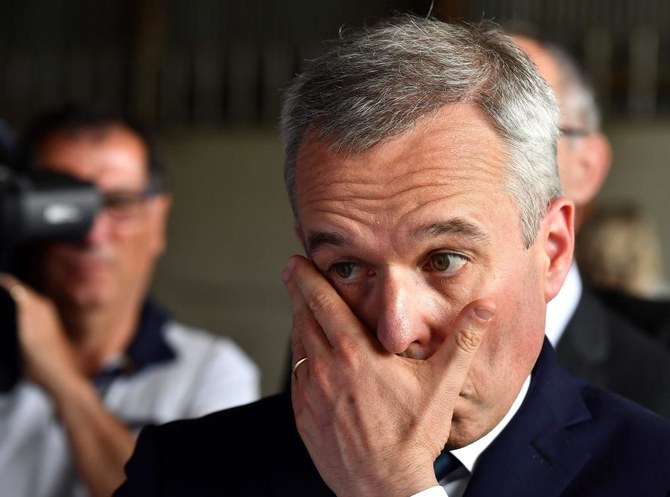
- The Mediapart website accused him of hosting friends to opulent meals
Germany’s Merz visits India to push defense industry ties ahead of EU trade deal
- India, Germany make joint declarations on cooperation in defense, critical minerals, energy
- Merz is accompanied by CEOs of top German companies such as Thyssen, Siemens, Bosch
NEW DELHI: German Chancellor Friedrich Merz met Indian Prime Minister Narendra Modi on Monday to push for defense industry cooperation ahead of India’s awaited free trade agreement with the EU.
Merz’s two-day trip is his first since taking office in May and he is accompanied by German business leaders.
The visit started in Ahmedabad in Gujarat, Modi’s home state, where they held a press conference after a delegation-level meeting and a series of joint declarations, including on strengthening bilateral cooperation in the defense industry, critical minerals, semiconductors, and energy.
“The growing cooperation in defense and security is a symbol of our mutual trust and shared vision,” Modi said, as he thanked Merz for “simplifying the processes” related to defense trade.
“We will also work on a roadmap to enhance cooperation between our defense industries, which will open up new opportunities for co-development and co-production.”
The roadmap would promote long-term industry-level collaboration, including technology partnerships, co-development and co-production of defense platforms and equipment, according to Prof. Ummu Salma Bava, chairperson of the Special Centre for National Security Studies at Jawaharlal Nehru University.
“This defense cooperation marks a transformational shift in the bilateral relations that had till now focused on economic cooperation, and inaugurates a new chapter on a scaled-up defense engagement,” she told Arab News.
“PM Modi indicated that both countries are entering the ‘limitless’ phase in expanding economic cooperation in strategic sectors.”
Germany is India’s most important trading partner in Europe and one of its top partners worldwide, with bilateral trade in goods and services estimated by the Indian Ministry of External Affairs at $50 billion.
In Merz’s delegation are 25 CEOs and industry leaders, including from Thyssen Krupp Maritime Systems, Siemens, DHL Group, Infineon Technologies, Uniper, Airbus Defence and Space.
German media reported that one of the key focuses of the visit is finalizing the details of an $8 billion deal to jointly build submarines in India.
The visit comes as India and the EU — of which Germany is the largest economy — are working on a free trade agreement. It also takes place ahead of an EU-India summit in New Delhi on Jan. 27, where parts of the pact are expected to be finalized.
“The visit of the large business delegation with 25 German CEOs is to tap into the growing economic potential and also further strengthen the bilateral economic relations,” Bava said.
“The signing of the India-EU FTA will further expand trade between India and Germany. Germany is the largest economy in the EU and has a strong base in automobiles, engineering, advanced manufacturing, chemicals and defense industry.”