LONDON: Two-year-old twins joined at the head have undergone successful surgery at a British hospital to separate their skulls, brains and blood vessels, doctors said on Tuesday.
The highly complex surgery involved multiple operations on Safa and Marwa Ullah, who were born in Pakistan in January 2017 with a condition known as “craniopagus” in which the girls’ skulls and parts of their brains were joined and intertwined.
“Craniopagus is an exceptionally rare and complex condition,” said David J. Dunaway, who co-led the surgical team that treated the twins. The operation, conducted in February, was the most complex such separation his team had performed to date, he said.
Having twins joined at the head with fused skulls and separate bodies occurs in less than one in a million births, while having the connection extend into the brain tissue is rarer still. Around 50 sets of craniopagus twins are estimated to be born around the world every year, of which only around 15 are thought to survive beyond the first 30 days of life.
Dunaway said this separation was helped by state-of-the-art technology including virtual reality, advanced imaging and three-dimensional rapid prototyping — allowing the surgeons to use images of the girls’ brains and blood vessels to plan and practice the surgery in advance to minimize complications.
The procedures took place at London’s Great Ormond Street hospital, with the girls well enough to be discharged from hospital four months later on July 1.
“These cutting-edge scientific techniques greatly increased the chance of success for Safa and Marwa. Their brains were more intertwined than the previous sets of craniopagus twins making it the most complicated separation to date,” the Great Ormond Street team said in a statement.
Five months after their final operation, Safa and Marwa are making slow but steady progress, the doctors said, adding that “a further period of recuperation and rehabilitation is essential to maximize their recovery.”

UK doctors reveal separation of Pakistani twins joined at the head
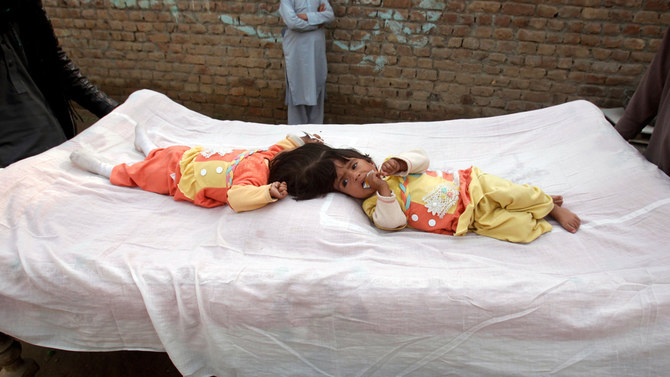
- Highly complex surgery involved multiple operations
- Their brains were more intertwined than the previous sets of craniopagus twins, says doctor
Pakistan vaccinates over 43 million children as last polio drive of 2025 enters 6th day
- Campaign running simultaneously in Pakistan and Afghanistan, last two polio-endemic countries
- Health authorities urge parents and communities to fully cooperate with anti-polio vaccinators
ISLAMABAD: Pakistan has vaccinated more than 43.8 million children in five days of its last nationwide polio campaign of 2025, health authorities said on Saturday, as the drive entered its sixth day amid renewed efforts to curb the virus.
The campaign, running from Dec. 15 to 21, targets children under the age of five and is being conducted simultaneously in Pakistan and Afghanistan, according to Pakistan’s National Emergency Operations Center (NEOC) which oversees eradication efforts.
Pakistan and neighboring Afghanistan are the only two countries where wild poliovirus transmission has never been interrupted, keeping global eradication efforts at risk. The virus, which can cause irreversible paralysis, has no cure and can only be prevented through repeated oral vaccination.
“The last nationwide polio campaign of 2025 continues in full swing on the sixth day,” the NEOC said in a statement. “Over 43.8 million children have been vaccinated in five days so far.”
Provincial data released by the National EOC showed that around 22.7 million children had been vaccinated in Punjab province, more than 10.2 million in Sindh, approximately 6.9 million in Khyber Pakhtunkhwa and about 2.5 million in Balochistan. In Islamabad, over 450,000 children received polio drops, while more than 274,000 were vaccinated in Gilgit-Baltistan and over 714,000 in Azad Jammu and Kashmir.
“The polio campaign is being conducted simultaneously in Pakistan and Afghanistan,” the NEOC said. “More than 400,000 polio workers are going door to door across the country to administer vaccines.”
Pakistan has logged 30 polio cases so far in 2025, underscoring the fragility of progress against the virus. The country recorded 74 cases in 2024, a sharp rise from six cases in 2023, reflecting setbacks caused by vaccine hesitancy, misinformation and access challenges in high-risk areas.
Health officials say insecurity remains a major obstacle. Polio workers and their security escorts have repeatedly been targeted in militant attacks, particularly in parts of northwestern Khyber Pakhtunkhwa and southwestern Balochistan, complicating efforts to reach every child. Natural disasters, including flooding, have further disrupted vaccination campaigns in recent years.
“Parents and communities are urged to fully cooperate with polio workers,” the NEOC said, stressing that every child under the age of five must be given polio drops.
Pakistan has dramatically reduced polio prevalence since the 1990s, when annual cases exceeded 20,000. Health authorities, however, warn that without sustained access to children in underserved and conflict-affected areas, eradication will remain out of reach.


