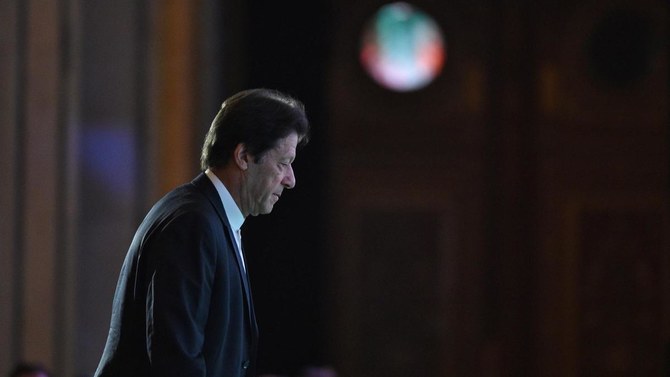
KARACHI: Pakistan’s business community wants the government to negotiate a Preferential Trade Agreement with the United States during the upcoming visit of Prime Minister Imran Khan to Washington next week where he is scheduled to meet with US President Donald Trump on July 22.
The two leaders are expected to discuss a range of issues, including counterterrorism, defense, energy and trade, “with the goal of creating conditions for a peaceful South Asia and an enduring partnership between the two countries,” confirmed the White House ahead of the summit level meeting.
Founding chairman of the Pak-US Business Council, Iftikhar Ali Malik, said that “Pakistan has rendered huge sacrifices in the war on terror and its economy is suffering from the impact of the conflict in Afghanistan.”
“Pakistan deserves preferential business treatment without tariff and non-tariff barriers and free flow of bilateral trade, said Malik. “The US must help Pakistan build its industrial institutions, undertake joint ventures and increase investment in Pakistan.”
Pakistan is the 56th largest goods trading partner of the US, and the two countries had $6.6 billion of bilateral trade during 2018 where Pakistan’s imports totaled $2.9 billion and its exports with the US stood at $3.7 billion. The overall trade volume was in favor of Pakistan with surplus trade last year.
“The US goods trade deficit with Pakistan was $783 million in 2018, a 2.2% increase over 2017,” noted the office of the US Trade Representative (USTR) in one of its reports.
Pakistan’s major exports comprise of textile goods which stand at about 3 percent to US textile imports, while the country’s regional competitors, China, Bangladesh and India, have much higher contributions.
Members of the local business community say they want PM Khan to take up the issue of including his country, especially its textile products, in the US trade preference programs, such as the Generalized System of Preference (GSP). The program provides opportunities for many of the world’s least developed countries to use trade for their economic growth.
“We are not included in the GSP program of the United States and we want to avail this facility to increase the range of our textile products in US markets,” Junaind Makda, president of Karachi Chamber of Commerce and Industry (KCCI), told Arab News.
“If the US is persuaded to include Pakistan’s textile products in GSP, it will increase Pakistan’s exports up to $500 million because textiles contribute 90 percent to USA market from Pakistan,” Dr. Mirza Ifkhtiar Baig, senior vice president of the Federation of Pakistan Chambers of Commerce and Industry (FPCCI), the apex body of businessmen and traders, said.
Many Pakistanis believe that the US government can rescue their country from the grey list of the Financial Action Task Force (FATF) and help soften the condition of the International Monetary Fund’s bailout package.
“The prime minister can take up the issue of FATF that has grey-listed Pakistan, as fears of further downgrading is hanging over our head like the sword of Damocles. Pakistan can also seek US help to ease the harsh conditions attached to the IMF bailout program,” Dr. Baig suggested.
Pakistani business community also seeks US help with urban forestry since “they have very good expertise related to environmental issues,” Makda said.
Pakistani businessmen, who are fed up with the constant inflow of smuggled goods, mainly from Afghanistan, also want the prime minister to raise this issue with the US authorities. “We need their help to stop smuggling from Afghanistan,” the KCCI president stressed.


![]()

Pakistan’s business community holds high hopes from PM’s US visit
Pakistan’s business community holds high hopes from PM’s US visit
- Eyes Preferential Trade Agreement with the US
- Wants inclusion of textile goods in the United States’ GSP program
Latest updates


© 2026 SAUDI RESEARCH & PUBLISHING COMPANY, All Rights Reserved And subject to Terms of Use Agreement.