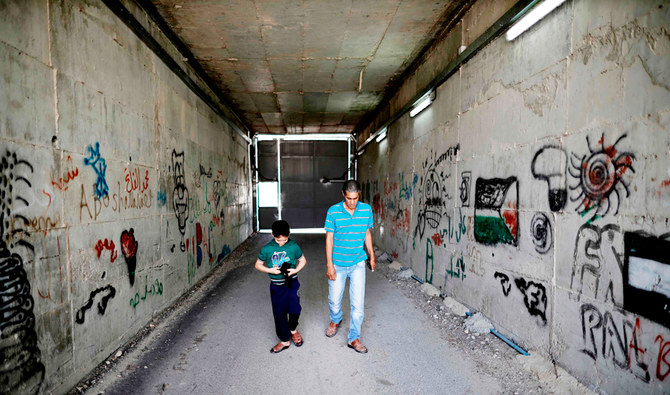

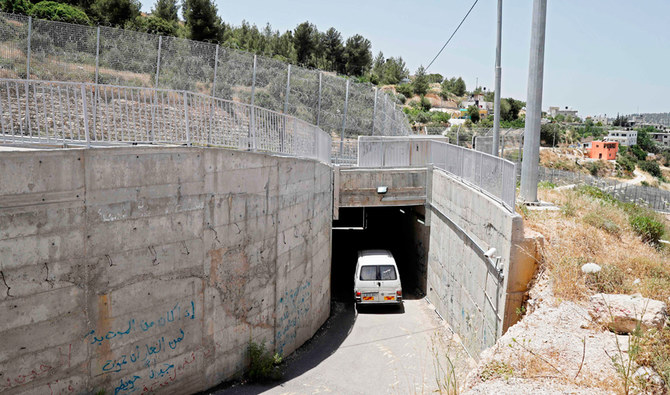
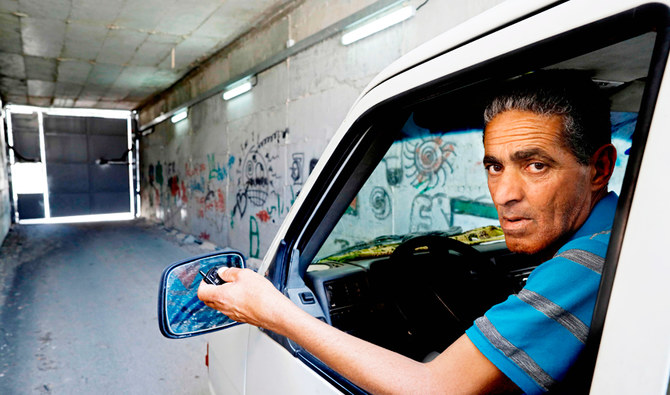

AL WALAJAH, Palestinian Territories: On one side of the Israeli separation barrier sits the Hajjajla family’s home. The Palestinians’ house is cut off from the rest of their village that lies on the other side, with only a tunnel connecting the two.
Endless trouble has followed, they say.
Their situation made the news again when Israeli authorities locked the gate leading to the tunnel linking their home to their village of Al-Walajah in the occupied West Bank.
For more than a week, 10-year-old Mohammed Hajjajla had to walk six kilometers (nearly four miles) in the blazing sun as part of his route to school due to the closure, the family says.
Israeli authorities say the closure was because the family was suspected of allowing illegal crossings into Jerusalem from the West Bank through the Israeli-built tunnel.
The family denies it and says it is another example of harassment from Israeli authorities they have faced over the years.
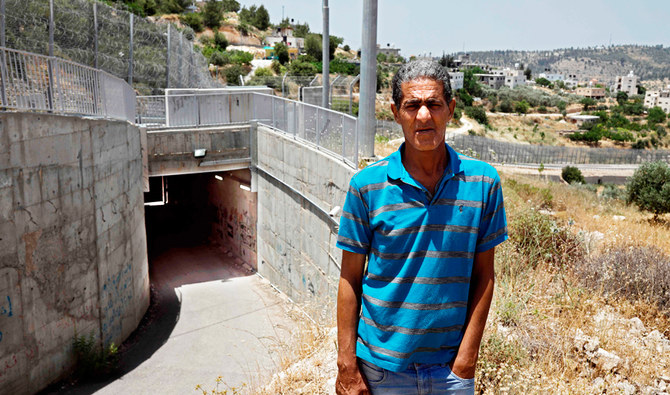
“I already refused to bend. I will not be discouraged,” said the father of the family, Omar Hajjajla.
The brick house sits on a hill, across the valley from the Israeli settlement of Gilo on the outskirts of Jerusalem.
Their problems date back to 2010, when construction of Israel’s separation barrier cutting off the West Bank reached their area.
Israel began constructing the barrier in 2002, during the bloody second Palestinian intifada.
For Israel, the barrier is for security reasons. Palestinians see it as an “apartheid wall,” a potent symbol of the Israeli occupation.
Israeli authorities gave the family a choice: leave or see their home cut off by a fence. Other village land was also isolated by the barrier’s construction.
Omar Hajjajla says they offered him large amounts of money to move, but he refused and took the case to court.
In 2016, an agreement was reached with Israeli authorities on strict conditions for his family’s use of the tunnel, whose gate can be opened by remote.
Hajjajla said he later installed an electric doorbell at the other side of the tunnel to make it easier for family members to come and go, especially since his children don’t have mobile phones.
But an Israeli police officer spotted it in May. “They said to me, ‘This bell is in the (Israeli military’s) security zone,’” the 53-year-old said. Hajjajla said he was taken for questioning for four hours and the gate was padlocked.
For eight days, the family was only able to get out by a clandestine side exit, he said. Mohammed and his brother’s route to school included walking six kilometers.
“We left very early in the morning and came back late,” said Mohammed. The family threatened to take the case to court again and the lock was eventually removed, the family says.
But later Omar lost his Israeli-granted permit to cross a checkpoint into Israel and Jerusalem, where he works.
“Each time they invent a new excuse to force us to leave the house,” he said.
Israel’s military referred questions on the issue to police, who did not respond to requests for comment from AFP.
In a statement to Israeli newspaper Haaretz, police said Omar Hajjajla “is suspected of taking advantage of the gate to improperly bring Palestinians through it and was therefore taken in for questioning.” “All investigations that involve suspicion of security-related crimes of Palestinians result in the revocation of entry permits into Israeli territory until the suspicions can be clarified and/or an indictment filed.” Palestinians say the family’s situation is another example of the troubles posed by Israel’s separation barrier.
The barrier, a combination of up to nine-meter-high (30-foot-high) walls, electronic fences and barbed wire, is now more than two-thirds complete.
When complete, some 85 percent of it is to be built inside the West Bank, the territory occupied by Israel in the 1967 Six-Day War.
It cuts off nearly 10 percent of Palestinian territory, according to the UN.
Meanwhile, Israeli settlement expansion has continued in the West Bank, construction the international community considers illegal.
More than 400,000 Israelis live in West Bank settlements and another 200,000 in annexed east Jerusalem.
Karim Joubran of Israeli NGO B’Tselem said “security is an excuse for all Israeli violations, a pretext for denying Palestinian property on the land, justifying the annexation and expansion of settlements.”
Before the 1948 war surrounding Israel’s creation, Al-Walajah village amounted to 18,000 dunams, according to Hassan Breijeh of the Palestinian Colonization and Wall Resistance Commission, which campaigns against the barrier.
Just 70 dunams now remain under the village’s control, he said.
As for the Hajjajlas, the padlock has been removed, but the family say they remain isolated.
“I cannot invite anyone as any visitor needs to coordinate with Israeli security 48 hours in advance and must leave before 10 pm,” Omar said.