Richard Branson’s Virgin Galactic plans to go public

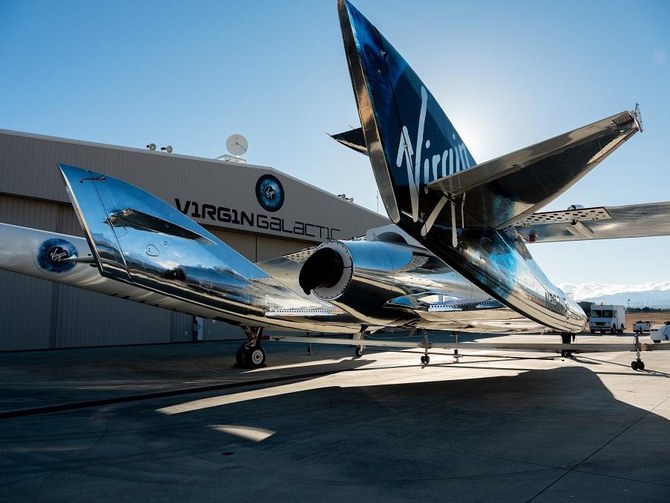
SpaceShipTwo mates to the mothership, WhiteKnightTwo, at Mojave Space Port in Mojave, California. (AFP)
Updated 09 July 2019
Follow

Richard Branson’s Virgin Galactic plans to go public

  • Virgin Galactic and Social Capital Hedosophia did not respond to requests for comment from Reuters outside regular business hours
  • Virgin Galactic in February soared to the edge of space with a test passenger for the first time

SEATTLE: Richard Branson’s space-tourism venture, Virgin Galactic, plans to go public as part of a deal with a special purpose acquisition company (SPAC) created by Social Capital LP Chief Executive Officer Chamath Palihapitiya, a person familiar with the matter said.
The deal was earlier reported by the Wall Street Journal, which said the SPAC, Social Capital Hedosophia Holdings Corp, will invest about $800 million for a 49% stake in Virgin Galactic.
The deal could be announced as early as Tuesday morning, said the source, who declined to be named because the matter is confidential.
Virgin Galactic and Social Capital Hedosophia did not respond to requests for comment from Reuters outside regular business hours.
Branson’s company is racing against Blue Origin, the space business of Amazon.com Inc. founder Jeff Bezos, to bring tourists into space.
Virgin Galactic in February soared to the edge of space with a test passenger for the first time, nudging the company closer to its goal of suborbital flights for space tourists.
After Branson founded the company in 2004, his ambitious timeline for taking customers into space suffered delays and a fatal setback when the original SpaceShipTwo crashed on a test flight in 2014 that killed the co-pilot and seriously injured the pilot.
Branson has said he plans to be the first passenger on SpaceShipTwo’s first commercial flight in mid-2019.


Saudi Arabia’s foreign reserves rise to a 6-year high of $475bn

Updated 22 February 2026
Follow

Saudi Arabia’s foreign reserves rise to a 6-year high of $475bn

RIYADH: Saudi Arabia’s foreign reserves climbed 3 percent month on month in January to SR1.78 trillion, up SR58.7 billion ($15.6 billion) from December and marking a six-year high.

On an annual basis, the Saudi Central Bank’s net foreign assets rose by 10 percent, equivalent to SR155.8 billion, according to data from the Saudi Central Bank, Argaam reported.

The reserve assets, a crucial indicator of economic stability and external financial strength, comprise several key components.

According to the central bank, also known as SAMA, the Kingdom’s reserves include foreign securities, foreign currency, and bank deposits, as well as its reserve position at the International Monetary Fund, Special Drawing Rights, and monetary gold.

The rise in reserves underscores the strength and liquidity of the Kingdom’s financial position and aligns with Saudi Arabia’s goal of strengthening its financial safety net as it advances economic diversification under Vision 2030.

The value of foreign currency reserves, which represent approximately 95 percent of the total holdings, increased by about 10 percent during January 2026 compared to the same month in 2025, reaching SR1.68 trillion.

The value of the reserve at the IMF increased by 9 percent to reach SR13.1 billion.

Meanwhile, SDRs rose by 5 percent during the period to reach SR80.5 billion.

The Kingdom’s gold reserves remained stable at SR1.62 billion, the same level it has maintained since January 2008.

Saudi Arabia’s foreign reserve assets saw a monthly rise of 5 percent in November, climbing to SR1.74 trillion, according to the Kingdom’s central bank.

Overall, the continued advancement in reserve assets highlights the strength of Saudi Arabia’s fiscal and monetary buffers. These resources support the national currency, help maintain financial system stability, and enhance the country’s ability to navigate global economic volatility.

The sustained accumulation of foreign reserves is a critical pillar of the Kingdom’s economic stability. It directly reinforces investor confidence in the riyal’s peg to the US dollar, a foundational monetary policy, by providing SAMA with ample resources to defend the currency if needed.

Furthermore, this financial buffer enhances the nation’s sovereign credit profile, lowers national borrowing costs, and provides essential fiscal space to navigate global economic volatility while continuing to fund its ambitious Vision 2030 transformation agenda.