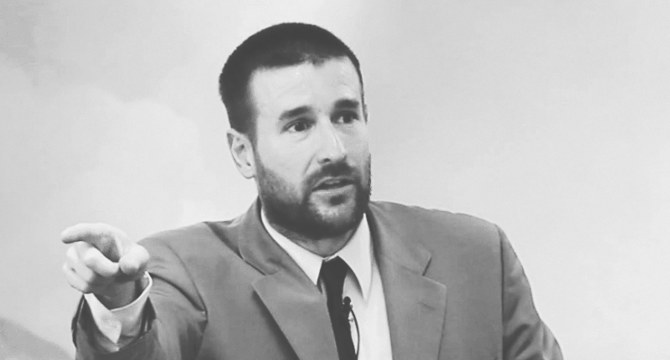

DUBAI: Pastor Steven Anderson uses his pulpit as his hate platform and justifies his extremist views in the name of religion.
Banned from half a dozen countries across the globe, the US-born hate preacher has lauded the 2016 Orlando massacre, publicly prayed for the death of former US President Barack Obama and denied the Holocaust.
Anderson says he hates anyone who believes in the “sin” of any other religion than his own fundamentalist Christian beliefs.
According to experts, he is part of a growing trend of hate preachers hiding behind religion, using their places of worship as a sanctuary to spread their discriminatory and bigoted messages to the world, all under the smokescreen of “religious freedom.”
Such preachers of hate justify their actions by saying they are fighting the enemies of God, said Josh Lipowsky, a research analyst at the Counter Extremism Project.
“Calling Anderson a hate preacher is an appropriate term as he promotes an extreme version of religion,” Lipowsky told Arab News.
BIO
- Nationality: American
- Place of residence: Tempe, Arizona
- Occupation: Pastor and founder of the Faithful Word Baptist Church, a fundamentalist Baptist church
- Legal status Banned from Ireland, the Netherlands, Jamaica, South Africa, Botswana and the UK
- Medium YouTube sermons, personal vlogs “sanderson1611” and “Faithful Word Baptist Church,” Facebook
“While he doesn’t specifically encourage violence, he praises it and justifies his ideology by using his religious beliefs to disprove others.”
Anderson promotes an image that “he’s on the side of God, therefore anyone who disagrees with him is an enemy of God,” Lipowsky said.
A father of 10, Anderson heads the infamous Faithful Word Baptist Church, a fundamentalist Independent Baptist church in Tempe, Arizona.
The church — which he describes as an “old-fashioned, independent, fundamental, King James Bible only, soul-winning Baptist church” — is currently listed as a hate group by the Southern Poverty Law Center (SPLC) because of Anderson’s radical stands.
Lipowsky said “dangerous is an appropriate term to describe the messages” that Anderson spreads, pointing to his comments in the aftermath of the massacre inside Pulse, a gay nightclub in Orlando, Florida.
Anderson claimed in one of his uploaded YouTube sermons that “these people all should’ve been killed anyway” given that “the Bible says that homosexuals should be put to death.”
He claimed at the time that a “righteous government” should have tried the victims in court and had them executed according to “God’s perfect law.”
Lipowsky said: “You could have people listening to that and take that responsibility because this is the will of God — ‘if the government won’t take that action then I have to do it.’ That’s the danger of the consequences of these types of work.”
It is also an example of why it is often so difficult to directly penalize hate speech, said Lipowsky.
“Under US laws, you have to be very clear in showing that the speech specifically led to the act of violence,” he added.
“By saying he doesn’t condone the violence in Orlando per se, Anderson is covered, although we can see he’s preaching that hatred and someone who listened to that might feel this makes sense and we need to take this from words into action.”
“In Anderson’s YouTube videos, you can see a physical pulpit, but social media also allows him a digital pulpit that allows him to reach much further.”
Josh Lipowsky, research analyst at the Counter Extremism Project
Katharine Gelber, professor of politics and public policy at the University of Queensland, said Anderson hides behind religion to spread his messages of hate.
“In some countries, those engaged in hate speech are trying to cite religious freedom as their defense,” she told Arab News.
“This is a clever tactic because they’re using the language of human rights to engage in an anti-human rights agenda. However, it shouldn’t be supported,” she said.
“The term ‘hate’ relates to hate speech, and should be used to identify people engaged in speech that’s discriminatory and harmful. Anderson certainly appears to fit this pattern,” Gelber added.
“Like any human right, free speech carries with it commensurate responsibilities. The right to free speech, and the right to religious freedom, aren’t absolute.”
Like many other hate preachers, Anderson goes online to spread religious discrimination and hatred.
He has a huge YouTube following, both on his personal vlog “sanderson1611,” which has more than 120,000 subscribers, and through his church’s dedicated vlog “Faithful Word Baptist Church,” which has more than 5,000 subscribers.
In one sermon, Anderson said “Hinduism is Satanic,” and those who follow the Roman Catholic faith are “confessing their sins to the priest who calls himself father and dresses like his mother in a dress.”
He has also said “I’m gonna pray that he (Obama) dies and goes to hell,” according to the SPLC.
Following the 2015 terror attack at the Bataclan concert hall in Paris, where 90 people were killed, Anderson said the victims deserved to die: “You went to a death metal concert. You bought the ticket.”
Opinion
This section contains relevant reference points, placed in (Opinion field)
He has also openly criticized Pope Francis for his more tolerant views, describing him as “the greatest false prophet on the earth at this time.”
Gelber said Anderson is a key example of extremists’ use of social media and the problems that arise with it.
“Social media provides a reach and volume that wouldn’t be possible without it. Narrowing hate speech regulations is entirely appropriate, and should be applied online just as they are offline,” she said.
“Beyond that, we need leadership that clarifies that rights come with commensurate responsibilities, and that one person’s exercise of their human rights stops at the point at which their exercise of their rights impedes another’s exercise of their own.
ALSO READ: All About Steven Anderson
“Democratic states have drawn a line in the sand that says discrimination isn’t acceptable. We need to hold that line.”
Anderson has made international headlines by getting banned from several countries — including Ireland, the Netherlands, Jamaica, South Africa, Botswana and the UK — because of his comments and beliefs.
While his physical presence in these countries may have been curtailed by the bans, his digital presence continues uncensored.
Until stricter online rules are introduced, Lipowsky said, listening to — and being influenced by — the messages of hate spread by preachers such as Anderson will continue to expand.