

King Salman meets British finance minister Philip Hammond

1 / 10
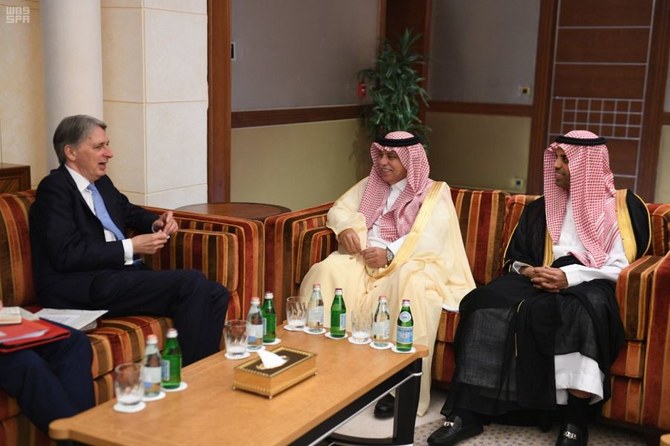
Saudi Arabia’s King Salman, right, meet British chancellor of the exchequer Philip Hammond at Al-Salam Palace in Jeddah. (SPA)
2 / 10
Saudi Arabia’s King Salman, right, meet British chancellor of the exchequer Philip Hammond at Al-Salam Palace in Jeddah. (SPA)
3 / 10
Saudi Arabia’s King Salman meets with British chancellor of the exchequer Philip Hammond at Al-Salam Palace in Jeddah. (SPA)
4 / 10
From left: Saudi interior minister Prince Abdul Aziz bin Saud bin Naif, Saudi minister of state Dr. Musaed bin Mohammed Al-Aiban, Saudi minister of foreign affairs Ibrahim Al-Assaf and Saudi finance minister Mohammed Al-Jadaan during King Salman’s meeting with British chancellor of the exchequer Philip Hammond at Al-Salam Palace in Jeddah. (SPA)
5 / 10
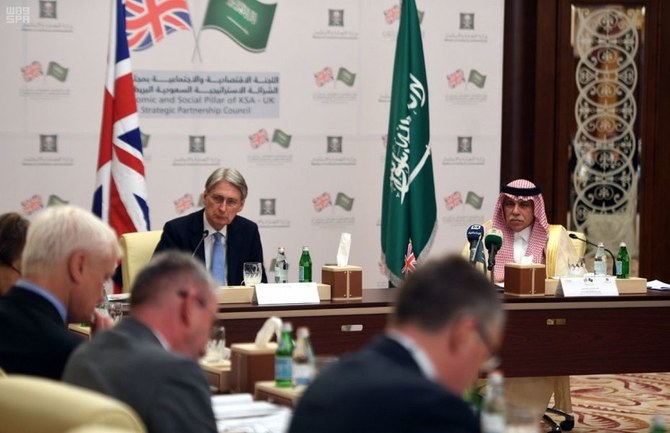
UK confirms its commitment to supporting Vision 2030 and implementing the Saudi Program for Economic Diversity and Social Development Saudi Minister of Commerce and Investment Dr. Majid bin Abdullah Al-Qasabi and British Chancellor of the Exchequer Philip Hammond held a meting of the Strategic Partnership Council. (SPA)
6 / 10
UK confirms its commitment to supporting Vision 2030 and implementing the Saudi Program for Economic Diversity and Social Development Saudi Minister of Commerce and Investment Dr. Majid bin Abdullah Al-Qasabi and British Chancellor of the Exchequer Philip Hammond held a meting of the Strategic Partnership Council. (SPA)
7 / 10
UK confirms its commitment to supporting Vision 2030 and implementing the Saudi Program for Economic Diversity and Social Development Saudi Minister of Commerce and Investment Dr. Majid bin Abdullah Al-Qasabi and British Chancellor of the Exchequer Philip Hammond held a meting of the Strategic Partnership Council. (SPA)
8 / 10
UK confirms its commitment to supporting Vision 2030 and implementing the Saudi Program for Economic Diversity and Social Development Saudi Minister of Commerce and Investment Dr. Majid bin Abdullah Al-Qasabi and British Chancellor of the Exchequer Philip Hammond held a meting of the Strategic Partnership Council. (SPA)
9 / 10
UK confirms its commitment to supporting Vision 2030 and implementing the Saudi Program for Economic Diversity and Social Development Saudi Minister of Commerce and Investment Dr. Majid bin Abdullah Al-Qasabi and British Chancellor of the Exchequer Philip Hammond held a meting of the Strategic Partnership Council. (SPA)
10 / 10
UK confirms its commitment to supporting Vision 2030 and implementing the Saudi Program for Economic Diversity and Social Development Saudi Minister of Commerce and Investment Dr. Majid bin Abdullah Al-Qasabi and British Chancellor of the Exchequer Philip Hammond held a meting of the Strategic Partnership Council. (SPA)
Updated 07 July 2019
Follow

King Salman meets British finance minister Philip Hammond

  • King Salman and Hammond reviewed means of developing and strengthening economic opportunities
  • UK confirms its commitment to supporting Vision 2030 and implementing the Saudi Program for Economic Diversity and Social Development

JEDDAH: Saudi Arabia’s King Salman on Sunday met British Chancellor of the Exchequer Philip Hammond at Al-Salam Palace in Jeddah to discuss economic and financial investments between the two countries and security cooperation amid heightened tensions with Iran.
During the meeting, King Salman and Hammond reviewed means of developing and strengthening economic opportunities in accordance with Vision 2030.

The meeting was attended by Saudi interior minister Prince Abdul Aziz bin Saud bin Naif, Saudi minister of state Dr. Musaed bin Mohammed Al-Aiban, Saudi minister of foreign affairs Ibrahim Al-Assaf and Saudi finance minister Mohammed Al-Jadaan.
The meeting was also attended by Richard Oppenheim from the British Embassy in the Kingdom, Ken Costa – the special envoy for Vision 2030, and Duncan McCourt – the special advisor of the British Chancellor of the Exchequer.

Saudi Minister of Commerce and Investment Dr. Majid bin Abdullah Al-Qasabi and Hammond also held the first meeting of its Economic and Social Committee of the Strategic Partnership Council in Jeddah on Sunday, reported 

A joint statement was issued in which the UK reaffirmed its continuing commitment to support the implementation of Saudi Vision 2030, the Kingdom’s program for economic diversification and social Development.
The statement also highlighted the significant economic progress achieved since the vision was launched in 2016 as part of the strategic partnership.
“Both countries have worked to support the development of the skills and capabilities of Saudi citizens as the two countries are key strategic partners of Vision 2030, and both countries reaffirmed their common commitment to building and developing trade and investment, and to the common prosperity of the citizens of both kingdoms,” the statement added.
The UK has appointed Ken Costa as special envoy for Vision 2030 and Sir Anthony Seldon as special envoy for education for the vision, reinforcing the importance Britain attaches to developing bilateral ties to strengthen communication bridges between the two peoples and provide closer opportunities for economic and social cooperatio.
“Saudi Arabia and the UK are committed to a long-term partnership to support the implementation of Vision 2030 in the areas identified in the Strategic Partnership program, including the assessment of joint investment opportunities such as the UK Public Investment Fund, bilateral trade and investment that meet the vision’s orientations.
In the trade and investment hub, the joint statement pointed out that the volume of bilateral trade between Saudi Arabia and the UK exceeds $5 billion annually. 
The meeting reviewed ways to further enhance cooperation, including encouraging mutual exports and attracting direct domestic investments. The two sides also discussed investment licenses granted to British companies, which are estimated to invest more than $ 10b in capital.
The committee discussed the work of the private sector groups, which was established in March 2018 to facilitate relations between businesses, thus contributing to the achievement of the visions’s objectives.


Northern Borders rock art reveals ancient life

Updated 58 min 29 sec ago
Follow

Northern Borders rock art reveals ancient life

  • Among the most notable remains are stone structures scattered northwest of Arar
  • Evidence ranges from the Neolithic era to Islamic times, forming a chronological record

JEDDAH: Saudi Arabia’s Northern Borders region contains numerous archaeological sites, reflecting a long history of human settlement dating back to early periods, the Saudi Press Agency reported.
Among the most notable remains are stone structures scattered northwest of Arar.
Varying in shape, size and design, specialists believe these structures date to the end of the Neolithic period and the beginning of subsequent eras. They are thought to have been used as stone tombs to preserve the remains of the dead.
Evidence ranges from the Neolithic era to Islamic times, forming a chronological record that highlights the diversity of communities that once lived in the region and how they interacted with their natural environment over centuries.
Ajab Al-Otaibi, director general of antiquities at the Heritage Commission, said the stone structures and rock art sites in the Northern Borders region represent an integral part of Saudi Arabia’s national cultural heritage and serve as an important resource for archaeological studies and scientific research.
He highlighted the importance of surveys, documentation and protection efforts to preserve these cultural landmarks as a historical legacy for future generations.
The region is also home to several important rock art sites, such as Shu’ayb Hamer, which features a wide and diverse collection of drawings carved on natural rock surfaces, marking it as a key site that documented early human activity in the area.
The artworks depict scenes of hunting, horsemanship, dancing, daily life and social rituals. They were created using a variety of artistic styles, most notably framed and abstract forms, and produced through different techniques including incizing and pecking, both direct and indirect.
The carvings portray human figures and a range of animals, including camels, horses and gazelles, as well as some wild and predatory species that have long since disappeared.
These images provide insight into the richness of the natural environment in earlier periods and help researchers understand the evolving relationship between humans and their surroundings.