DOHA: Senior Afghan political leaders, including several Kabul government representatives and women activists, wrapped up day-long discussions with Taliban representatives on Sunday, the first time members of the insurgency sat face-to-face with members of President Ashraf Ghani’s administration to find a negotiated settlement to an 18-year-long war.
Taliban political spokesman, Suhail Shaheen, told Arab News ahead of the meeting that the intra-Afghan conference did not constitute “formal negotiations” and participants would not represent the Kabul government but speak in their personal capacity.
“Every participant,” he said, “will share views as to how peace could return to Afghanistan.”
Shaheen added, however, that the Taliban would represent their political office and explain their official stance on the peace process, with Sher Abbas Stanekzai leading the insurgents’ delegation.
Part of diplomatic efforts to end years of violence that continued this week with a devastating bomb attack in Kabul that killed at least eight Afghan security personnel and four civilians, the conference was held in a “friendly environment,” according to the Taliban spokesman, in which both sides freely expressed their views. He said the Taliban had welcomed “suggestions by the delegates from Kabul.”
Shaheen maintained that Taliban leaders explained their position on how to end foreign invasion and bring peace to Afghanistan. He also reiterated the longstanding Taliban position of not holding talks with the Kabul administration unless the US formally announced a time-frame for the withdrawal of troops.
“We will talk to all Afghan sides when the invasion comes to an end, and we are discussing this with the Americans,” he continued.
The conference will continue on Monday and a joint statement is likely to be issued at the conclusion of the meeting.
Representatives from the Taliban and the United States started a seventh round of peace talks last week, aiming to hammer out a timeframe for the withdrawal of foreign troops in exchange for guarantees from the Taliban that they would not use Afghan soil to launch attacks against the United States.
US special envoy for Afghan reconciliation Zalmay Khalilzad, an Afghan-born American diplomat, has been tasked by his government to secure a political settlement with the Taliban, which now controls more Afghan territory than at any time since being toppled in 2001 by US-led forces.
In a tweet on Saturday, Khalilzad said the latest round of talks were the “most productive session” to date, adding that significant progress had been made on all four aspects of a potential peace deal: troop withdrawal, counter-terrorism assurances, participation in intra-Afghan dialogue and negotiations, and a permanent and comprehensive cease-fire.
The US and Taliban will resume talks on July 9 after Sunday’s dialogue, the Taliban and Khalilzad have said. In the past, the Taliban repeatedly refused to meet President Ashraf Ghani’s government, which they called a puppet regime.
The Doha conference was earlier scheduled to be held in April but Qatari organizers postponed it after differences emerged over who would participate in the dialogue.
Qatar and Germany have jointly hosted today’s conference, which some participants describe as the continuation of intra-Afghan meetings that began in Moscow in February this year.
Several members of the Taliban and delegates from Kabul met late on Saturday to discuss the agenda for the conference.
“Discussions will be held on Afghans’ basic rights, human rights and Islamic rights in the intra-Afghan negotiations and no one should have concerns,” the Taliban spokesman said when asked whether concerns about women and human rights would be addressed at the conference.
He added that during the Moscow conference, the Taliban had said that they would “ensure women rights ... in line with Islamic injunctions that include right to work, education, if they want to begin their own business or inherit...”
A larger number of women participated in the Doha conference than in previous meetings, with several women participants meeting Khalilzad on Saturday after the Taliban and Afghan delegates met informally at a dinner hosted by the organizers at a local hotel.
Afghan delegates were hopeful that the conference would pave the way for formal and direct peace negotiations between the Afghan government and the Taliban.
“This is our hope that the conference in Doha will lead to the beginning of a formal intra-Afghan dialogue,” Omar Zakhilwal, a former Afghan minister, told Arab News on Sunday ahead of the conference in Doha.


Taliban, government leaders meet as car bomb kills at least 14 in Afghanistan
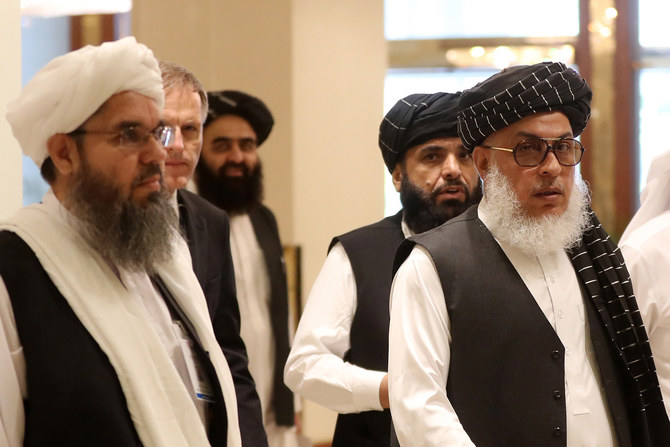
Taliban, government leaders meet as car bomb kills at least 14 in Afghanistan

- This is the first time members of the insurgency have met representatives from President Ghani’s government
- Taliban spokesman maintained ahead of the conference that the meeting did not constitute “formal negotiations,” Kabul leaders to speak in “personal capacity”

Pakistan turns to immersive technology to reimagine ancient Gandhara
- New gallery uses artificial intelligence and 3D visuals to present Buddhist heritage
- Visitors can explore archaeological sites digitally rather than through static displays
ISLAMABAD: At the Islamabad Museum, history no longer sits quietly behind glass.
In September 2025, the museum introduced Pakistan’s first Digital Immersive Gallery, an experiment in how ancient civilizations can be narrated in the age of artificial intelligence, 3D projection and virtual environments. Developed in collaboration with the Korea Heritage Agency, Pakistan’s Department of Archaeology and the National Heritage and Culture Division, the gallery marks a shift from object-centered displays to experience-based storytelling.
Rather than beginning with labels and timelines, the gallery opens with movement, sound and light. Visitors are invited to step into a reconstructed visual world shaped around Gandhara, one of South Asia’s most influential yet often under-explained civilizations that developed across what is now northwestern Pakistan and parts of eastern Afghanistan and later played a foundational role in the spread of Buddhism beyond the subcontinent.
“We have shown here in our Immersive Gallery how Buddhism flourished here, how it was introduced, how it declined and how it shifted to China, Korea and Japan from here,” Dr. Abdul Ghafoor, Deputy Director at the Department of Archaeology and Museums, told Arab News.
“In order to make it, the content developed by Korea has fully used AI and IT,” he continued. “AI and IT are common in Korea and other developed countries, but we have done it for the first time in Pakistan.”
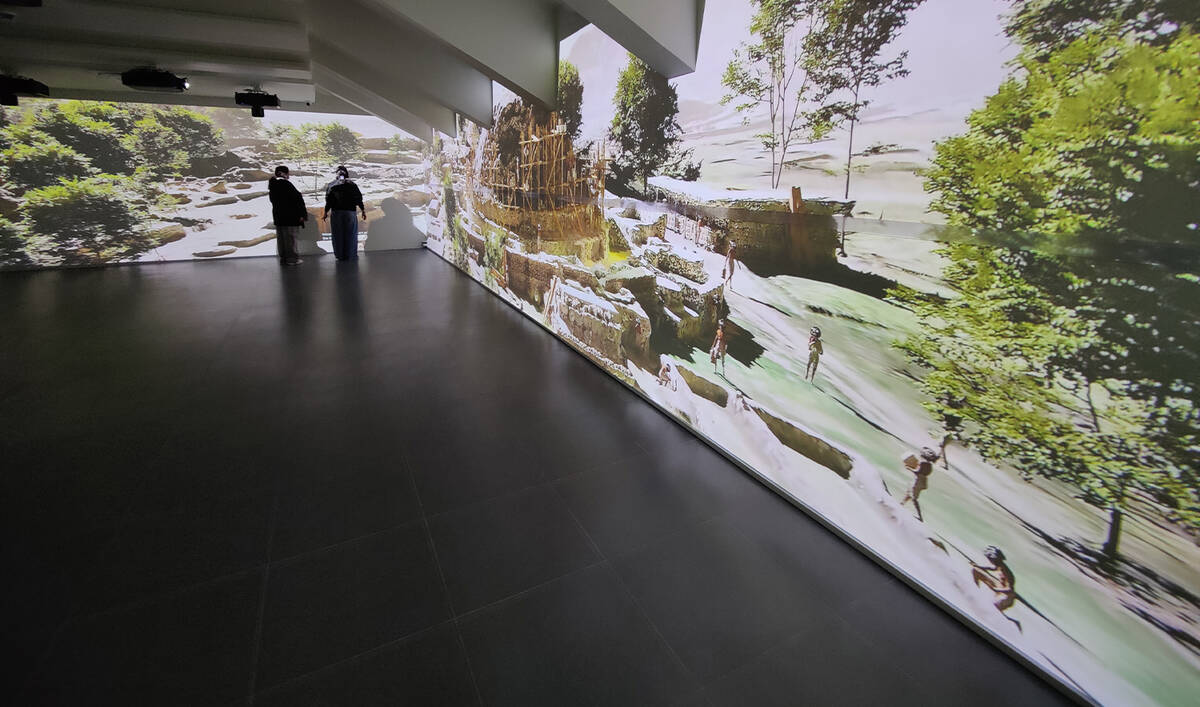
Gandhara flourished between the first century BCE and the fifth century CE in this region, which served as a cultural crossroads, shaped by Greek, Central Asian, Persian and South Asian influences.
It was here that artists first began depicting the Buddha in human form, a visual language that later traveled along trade routes to Central Asia, China, Korea and Japan. This transmission of ideas, beliefs and artistic styles forms the core narrative of the immersive gallery.
“Inside the gallery, visitors are drawn into a world of interactive experiences, heritage documentaries they can zoom in and out of, Gandhara artifacts explored up close and photo zones where they can capture themselves against Pakistan’s most iconic sites,” Muhammad Azeem, Project Director at the Department of Archaeology and Museums, said.
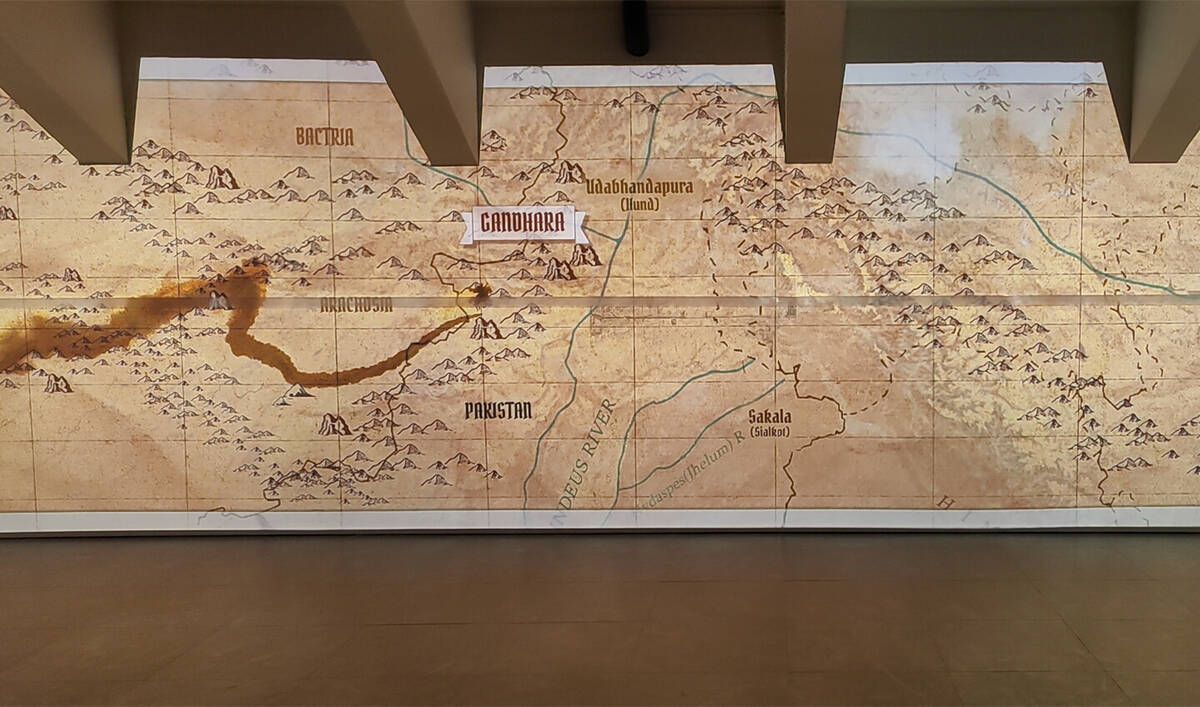
While Gandhara anchors the gallery, the experience expands outward to place it within a longer and wider historical arc. One section is dedicated to Pakistan’s six UNESCO World Heritage Sites, offering visitors a compressed journey across centuries and regions.
“The main hall takes it further with a fully immersive 3D journey,” Azeem added. “Each seven-minute segment transports audiences to treasures like Mohenjo-Daro, Makli Necropolis, Lahore’s Shalimar Gardens and Sheesh Mahal, and the historic landscapes of Taxila and Takht-i-Bahi, making the past feel vivid, unforgettable and alive.”
For many visitors, the gallery’s appeal lies in how it lowers the barrier to understanding. Instead of long explanatory panels, history is introduced through visuals, motion and guided narrative.
“I saw different historical sites on big screens which was very exciting for me,” Fatima Nawaz, a government employee, said. “After that, I watched a complete documentary in the gallery, which was about 20 minutes long, and in which different historical sites related to Gandhara were highlighted.”
“Overall, it was a very good experience,” she added.

Researchers see the initiative as part of a broader global shift in how museums function.
“My topic is Cultural Heritage Museum, and with this research, I am studying and visiting museums,” Abdul Khaliq, an M.Phil. student at Quaid-e-Azam University, said. “One thing I have not seen in Pakistan before is the shift toward virtual reality.”
He added that it was a good step while calling the immersive gallery “very educational and gives us a lot to learn.”
For the officials involved in the project, the gallery is a starting point rather than a finished model.
“The response we have received from the public in Islamabad makes me feel that this should be done in all the museums, in all four provinces of Pakistan,” Dr. Ghafoor, the senior archaeology department official, said. “This is because it can make it easier to follow history.”
“I think such immersive galleries should be there in all the museums,” he added.


