

Arab officials discuss Brexit opportunities in London

1 / 8
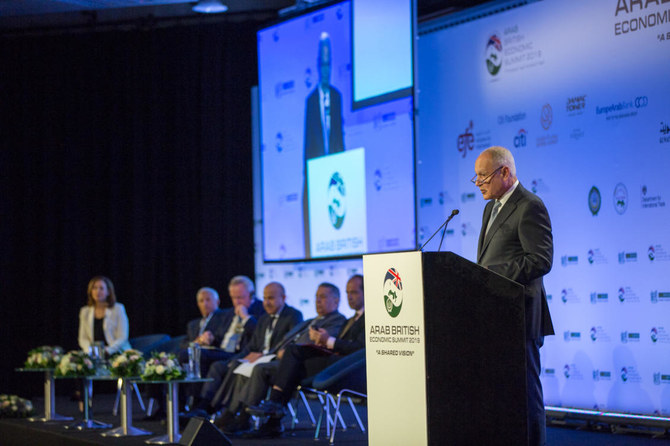
Arab League Secretary General Ahmed Aboul Gheit speaking at the event. (Supplied)
2 / 8
Arab League Secretary General Ahmed Aboul Gheit speaking at the event. (Supplied)
3 / 8
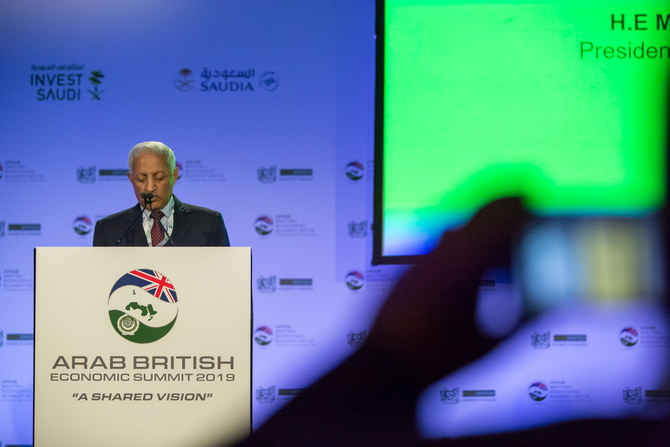
GCC Secretary General Abdullatif bin Rashid Al Zayani speaking at the event. (Supplied)
4 / 8
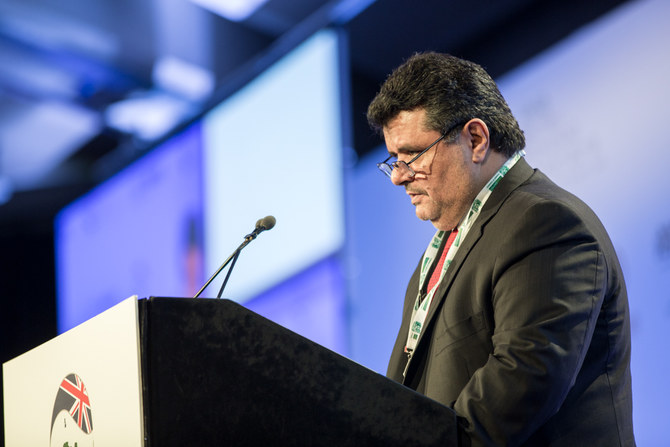
Mohamed Abdo Saeed, President of The Union of Arab Chambers addressing the event. (Supplied)
5 / 8
Mohamed Abdo Saeed, President of The Union of Arab Chambers addressing the event. (Supplied)
6 / 8
Dr. Sami A. Alabidi, Chairman of Council of Saudi Chambers make a speech during the event. (Supplied)
7 / 8
Arab British Economic Summit panel. (Supplied)
8 / 8
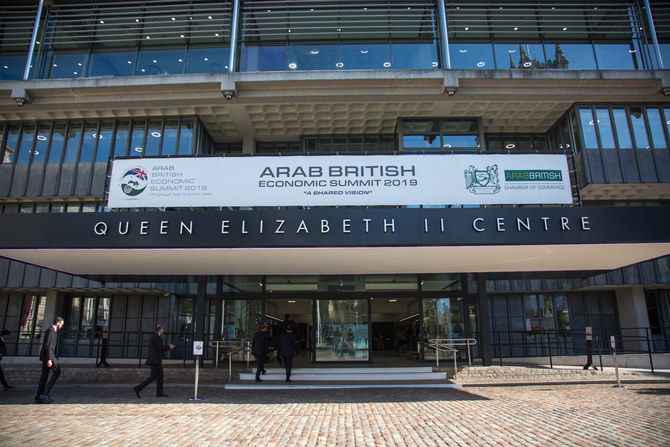
Arab British Economic Summit at Queen Elizabeth II Center in London (Supplied)
Updated 05 July 2019
Follow

Arab officials discuss Brexit opportunities in London

  • Conference, hosted by Arab British Chamber of Commerce (ABCC), tackled areas regarding infrastructure, investment, sustainable development and renewable energy
  • head of the Gulf Cooperation Council (GCC), Secretary-General Abdullatif Al-Zayani, spoke at the event

LONDON: Senior Arab officials and organizations met with their UK counterparts at a summit in London on Wednesday to discuss investment and bilateral opportunities, as the country prepares to leave the EU.
“Britain is on the verge of a crucial turning point in its relationships with the rest of the world,” said Arab League Secretary-General Ahmed Aboul Gheit. “The Arab world has a combined gross domestic product (GDP) exceeding $2.5 trillion annually. It has great economic power, wants sustainable investments in Britain, and sustainable British investments in its own countries.”
The head of the Gulf Cooperation Council (GCC), Secretary-General Abdullatif Al-Zayani, said harnessing the talents of young people — “a genuine asset to the region” — would be essential for any future relationship between the UK and GCC countries.
“If our societies can harness the energy and resourcefulness of our young people, then they can lead us into a vibrant new world with possibilities we could not have dreamed of a few years ago, but which to them are second nature,” he claimed.
The conference, hosted by the Arab British Chamber of Commerce (ABCC), tackled areas regarding infrastructure, investment, sustainable development and renewable energy opportunities in the Middle East and North Africa.

The chairman of the Council of Saudi Chambers, Sami Al-Abidi, said the Kingdom’s delegation represented Saudi Arabia’s experience in investment, infrastructure and reliance on sustainable development, as well as current projects being undertaken by the Saudi government and in the private sector. 
“Saudi Arabia has had a historic relationship with Britain with many old mutual investments, and now we are at a turning point as investment is increasing with very high returns due to the Vision 2030,” Al-Abidi told Arab News. 
Meanwhile, the President of the Union of Arab Chambers said commercial activities would expand between the two countries if the UK leaves the EU.
Mohamed Abdo Saeed said: “If the UK follows through with Brexit, this relationship is only going to be stronger and will see new British investments in the Kingdom, as well as Saudi capital in Britain.”

FASTFACT

£50 billion

The UK's trading relationship with the Middle East region exceeds £50 billion ($62.5 billion).

UK trade commissioner for the Middle East, Afghanistan and Pakistan, Simon Penney, said Britain’s trading relationships with the region exceeded £50 billion ($62.5 billion), and that the GCC was the UK’s fourth largest trading partner outside of the EU.
“We are very keen to partner with Saudi companies and Brexit offers many opportunities, particularly around Vision 2030, but also around future trading relationships,” he told Arab News, adding that he would be visiting Riyadh soon to follow up on their commitments and obligations toward the vision.
“We are a trading island nation that has done so for hundreds of years, and we have always traded with the Arab world, and want to ensure that those relationships are developed properly.”

The chair of the Arab International Women’s Forum, Baroness Symons, said the UK was focusing on technology, the environment, youth and their employment and women’s issues in the region.
“The Kingdom has opened not only windows, but doors as well, for women to be more engaged in the economy, get the best education and be given more opportunities,” she said.
ABCC Secretary-General Haifa Al-Kaylani stressed the long-standing relations between the two Kingdoms were “dramatically increasing” every year. 
Several Saudi businesses were present at the summit, among them Saudi Arabian Airlines (Saudia), to shed light on the Kingdom’s investment opportunities and support new businesses.
“Saudi Arabia is now on everybody’s mind when they talk about investment and I tell people this is the time to invest because, by 2025 and 2030, there will be a great return on investment,” Frank Valle, Saudia’s manager of sales and marketing in the UK and Ireland, told Arab News.


Crude oil prices surpass $100 a barrel as the Iran war impedes production and shipping

Updated 09 March 2026
Follow

Crude oil prices surpass $100 a barrel as the Iran war impedes production and shipping

  • 15m barrels of crude oil — about 20 percent of the world’s oil — typically are shipped every day through the Strait of Hormuz
  • Iraq, Kuwait and the UAE have cut their oil production as storage tanks fill due to the reduced ability to export crude

CHICAGO: Oil prices have eclipsed $100 per barrel for the first time in more than three and a half years as the Iran war hinders production and shipping in the Middle East.
The price for a barrel of Brent crude, the international standard, was at $101.19 shortly after trading resumed on the Chicago Mercantile Exchange, up 9.2 percent from its settlement price of $92.69 Friday.
West Texas Intermediate, the light, sweet crude oil produced in the United States, was selling for about $107.06 a barrel. That’s 16.2 percent higher than its Friday settlement price of $90.90.
Both could rise or fall as market trading continues.
The increases followed US crude prices jumping by 36 percent and Brent crude prices rising 28 percent last week. Oil prices have surged as the war, now in its second week, ensnared countries and places that are critical to the production and movement of oil and gas from the Arabian Gulf.
Roughly 15 million barrels of crude oil — about 20 percent of the world’s oil — typically are shipped every day through the Strait of Hormuz, according to independent research firm Rystad Energy. The threat of Iranian missile and drone attacks has all but stopped tankers from traveling through the strait, which is bordered in the north by Iran, carry oil and gas from Saudi Arabia, Kuwait, Iraq, Qatar, Bahrain, the United Arab Emirates and Iran.
Iraq, Kuwait and the UAE have cut their oil production as storage tanks fill due to the reduced ability to export crude. Iran, Israel and the United States also have attacked oil and gas facilities since the war started, exacerbating supply concerns.
The last time US crude futures traded above $100 per barrel was June 30, 2022, when the price reached $105.76. For Brent, it was July 29, 2022, when the price hit $104 per barrel.
The global surge in oil prices since Israel and the US attacked Iran on March 1 has rattled financial markets, sparking worries that higher energy costs will fuel inflation and lead to less spending by US consumers, the main engine of the economy.
In the US, a gallon of regular gasoline rose to $3.45 on Sunday, about 47 cents more than a week earlier, according to AAA motor club. Diesel was selling for about $4.60 a gallon, a weekly increase of about 83 cents.
The price of natural gas has also climbed, though not as much as oil. It rose about 11 percent last week and ended Friday at $3.19 per 1,000 cubic feet.
If oil prices stay above $100 per barrel, some analysts and investors say it could be too much for the global economy to withstand.
Over the weekend, Israel’s military struck oil depots in Tehran and four oil storage tankers and a petroleum transfer terminal.
Mohammad Bagher Qalibaf, the speaker of Iran’s parliament, said the war’s impact on the oil industry would spiral, warning it soon could become harder to produce and sell oil.
Iran exports roughly 1.6 million barrels of oil a day, mostly to China, which may need to look elsewhere for supply if Iran’s exports are disrupted, another factor that could increase energy prices.