ISLAMABAD: Pakistan will start receiving Saudi oil on deferred payment facility from July 1, a press statement from the Saudi embassy in Islamabad confirmed late Monday.
“Pakistan will start receiving monthly oil supplies worth $275 million from Saudi Arabia with effect of July 1, 2019,” the embassy said in a statement.
These supplies will continue over the next three years, with a total value of $9.9 billion, the statement added.
In October 2018, Saudi Arabia announced a $20 billion economic support package for Pakistan, which included $3 billion to support balance of external payments in addition to oil import facility on deferred payment.
Saudi embassy said that the package showed “keenness of Saudi leadership to support Pakistan’s economy for achieving financial stability and help the government to overcome the economic challenges and push the comprehensive development in Pakistan, and to emphasize the depth of relations between the two brotherly counties and people.”
Dr. Vaqar Ahmed Joint Executive Director at Sustainable Development Policy Institute (SDPI), an Islamabad based think-tank, said that “this will bring significant relief to the balance of payment situation in Pakistan,” which is already struggling to narrow down the current account gap. “Any arrangement which can allow Pakistan deferred payment of its oil supplies will certainly be welcomed.”
“This will also provide certainty to the industry which of course requires sustained oil supplies as input and raw material,” Ahmed added calling the move “a great help for Pakistan in pressing times.”
According to official figures, Pakistan spends more than $16 billion each year on importing 26 million tons of petroleum products, including 800 million cubic feet of Liquefied Natural Gas (LNG) from Saudi Arabia, the UAE and other Gulf countries.
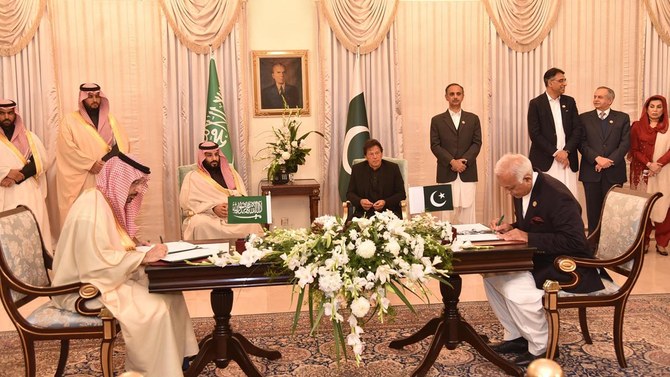
Pakistan and Saudi Arabia enjoy deep-rooted economic ties. During the visit of Crown Prince Mohammed bin Salman to Pakistan in February 2019, the Kingdom signed several agreement and memoranda of understandings (MoUs) pledging to invest $20bn in Pakistan to boost its depleting foreign exchange reserves — including establishing a $10bn oil refinery in the port city of Gwadar in Balochistan province.

Pakistan to start receiving Saudi oil on deferred payment
- Supplies will continue over the next three years, with a total value of $9.9 billion
- The facility is part of $20 bn Saudi economic support package for Pakistan
Pakistan in talks with Saudi Arabia, China, banks for $2 billion refinery expansion— official
- Islamabad seeks to expand Pakistan Refinery Limited’s crude oil processing capacity from 50,000 bpsd to 100,000 bpsd, says official
- Official says three-year project would need $2 billion investment, with 60-70 percent to be raised through debt financing
KARACHI: Pakistan’s government and the state-owned Pakistan Refinery Limited (PRL) are in talks with Saudi Arabia, China, global commercial banks and financial institutions to secure funding for a $2 billion refinery expansion project, an official said on Tuesday.
The PRL is an energy company located in Pakistan’s commercial hub Karachi. With a processing capacity of 50,000 barrels of crude oil per day, it supplies refined petroleum products countrywide. It is a subsidiary of the state-owned Pakistan State Oil (PSO), which owns 63.56 percent of its shares.
Pakistan is seeking partners that can finance PRL’s Refinery Expansion and Upgrade Project (REUP). The official confirmed that REUP is part of Pakistan’s Brownfield Refinery Policy, which aims to upgrade the nation’s five existing oil refineries to deep conversion refineries, with a combined crude processing capacity of about 350,000 barrels per stream day (bpsd). The total project cost to upgrade these five refineries has been estimated at $5-6 billion.
“We are in contact with Saudis, Chinese, Export Credit Agencies and Development Finance Institutions and others to obtain the financing and firms have shown interest,” an official with direct knowledge of the development told Arab News on condition of anonymity as he was not authorized to speak to media.
The official said that the government was in talks with investors in Saudi Arabia while the PRL was in contact with the Chinese government and ECAs, DFIs and global commercial banks.
The PRL aims to double the crude processing capacity of its Karachi hydro-skimming plant to 100,000 bpsd, produce Euro V-compliant motor spirit and diesel, meet evolving environmental standards and decrease Pakistan’s reliance on imported fuels.
The move would help Pakistan reduce its reliance on costly fuel imports. The South Asian country imported petroleum products worth $16 billion in fiscal year 2025, more than 27 percent of its total imports.
“The project is estimated at $2 billion and is to be implemented in 36 months with debt ranging between 60-70 percent,” the official said.
He added that potential investors may secure an equity stake in the project.
Pakistan’s Petroleum Minister Ali Pervaiz Malik visited Saudi Arabia earlier this month to lead a high-level delegation at the Future Minerals Summit. There, he reportedly met investors and briefed them on REUP.
Malik and the petroleum ministry spokesperson Zafar Abbas did not respond to Arab News’ request for comments on the matter.
The official said Saudi authorities have asked Pakistan to brief them on the project. He said the government has planned an official visit “in the near future” to the Kingdom, where Saudi investors would be given the required briefing.
The official said once the required financing is available, PRL would aim to achieve REUP’s financial close by December and begin work on the project in January 2027.
“All our potential financers are expected to undertake due diligence of the project in the coming months,” the official said.
Sheikh Imran ul Haque, project director of the PRL, said the company was making steady and measurable progress on REUP, a strategically significant initiative designed to enhance refining capabilities and product quality.
“PRL has successfully completed detailed technical and commercial evaluations with EPC (engineering, procurement and construction) bidders,” he told Arab News.
Haque said the company’s next target is signing the EPC contract in the first quarter of 2026.
He said this would be followed by the financial close at the end of the year, marking the formal transition of REUP from its development phase to the execution one.
Pakistan has desperately tried to reform its economy by looking for cheaper sources of fuel. Its refining sector has long struggled with aging infrastructure, limited upgrading and thin margins.
Industry officials argue that over-reliance on imports increases exposure to global price volatility, shipping disruptions and foreign exchange pressure.