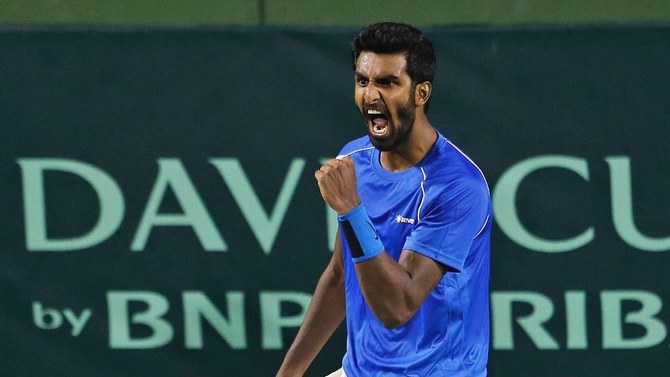
LONDON: India’s Prajnesh Gunneswaran admits that being his country’s top tennis star places him under an obligation to play a Davis Cup tie against bitter rivals Pakistan.
India have been drawn to face their neighbors in Islamabad in September with a prize of being able to contest the World Group qualifiers at stake.
It will be the first time India have played a Davis Cup tie in Pakistan in 55 years.
“I think I will play although it is still to be discussed as we have the option to go now,” said the 29-year-old at Wimbledon on Monday.
“If I want to stay in the top 100 then those two weeks make an impact but playing for my country is very special and I want to do everything to do that.
“If I had been number four or five in India I would be jumping at the chance.
“Nothing should change being number one.”
The long-running political tension between the nuclear-armed India and Pakistan spiked in February over Kashmir, which both countries have fought two wars over since the territory was divided in 1947.
A deadly suicide attack — claimed by a militant group based in Pakistan — in Indian-administered Kashmir killed 40 Indian troops.
In response, India staged its first air attack on Pakistani territory in decades, with Pakistan responding a day later.
Despite those tensions, India were cleared to make the trip across the border as the Davis Cup is not a part of a bilateral series.
When India last played in Pakistan in Lahore in 1964 they won 4-0.
They won on home ground in Mumbai in 2006 while their third meeting in the tournament in 1973 had to be played on neutral territory.
On Monday, Gunneswaran made his Wimbledon debut but was defeated 7-6 (7/1), 6-4, 6-2 by 2016 runner-up Milos Raonic of Canada.
His progress to the All England Club has come late in his career following a battle with stress fractures in both knees which left him without a ranking in 2015.
Those physical problems are a thing of the past as is his bizarre decision to once incorporate the name of two-time major winner Pat Rafter into his personal email address.
“I was a big fan of his when I was younger so I created an email ID with his name,” explained the world number 94.
“I never used it for official purposes but some people in my school still have it.”
On Monday, Gunneswaran insisted that his clash with big-serving Raonic, the 15th seed, had been decided by small margins.
“There were a few lapses in concentration and they determined the match. I had chances but didn’t convert.
“I gave him early leads in the second and third sets and they were the killers.”


![]()

'Special to play Davis Cup in Pakistan', says India’s top player
'Special to play Davis Cup in Pakistan', says India’s top player
- It will be the first time India have played a Davis Cup tie in Pakistan in 55 years
- Despite tensions, India were cleared to make the trip across the border
Latest updates


Recommended


© 2026 SAUDI RESEARCH & PUBLISHING COMPANY, All Rights Reserved And subject to Terms of Use Agreement.