

Manila sounds alarm on ‘new face of terror’

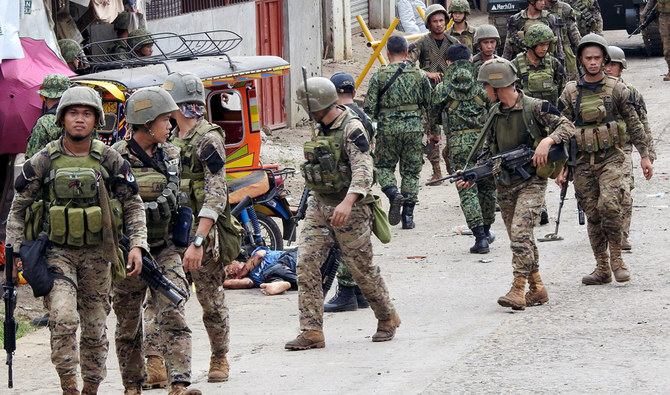
Soldiers walk past the body of a man slumped beside a tricycle following an armed attack in front of the temporary headquarters of the army's First Brigade Combat team, in Jolo on the southern island of Mindanao on June 28, 2019. (AFP)
Updated 02 July 2019
Follow

Manila sounds alarm on ‘new face of terror’

  • Suicide bombers pose growing threat, defense minister warns after latest attack

MANILA: Philippines officials on Monday voiced growing alarm over what they described as the “changing face of terrorism” in the country following the suicide attack on an army command post on the island of Sulu.

Eight people, including three soldiers and two suspected bombers, were killed in twin explosions near the military counterterrorism base on June 28.

Speaking on Monday, Delfin Lorenzana, Philippines national defense secretary, described the attack as a worrying development that highlighted the rising terror threat in the country.

The attack on the army counter-terrorism facility is the third suicide strike since July 31 last year when a Moroccan suspect struck on Basilan island. Then, on Jan. 27, a suicide attack by an Indonesian couple devastated the Mount Carmel Cathedral on Jolo island, also in Sulu, killing 20 people.

“It’s becoming (a more frequent) occurrence and we are very concerned about this,” Lorenzana said on the sidelines of the Disaster Emergency Logistics Systems for ASEAN at Camp Aguinaldo.

“This has raised the level of extremism here and I think we have a lot of work to do, to talk to the leaders on the ground, the traditional leaders, the sultans, the datus, and also officials from BARMM (Bangsamoro Autonomous Region in Muslim Mindanao).

“I think they do not want that happening in their area. They want peace so that development will take place,” he said.

The attacks have occurred despite the implementation of martial law in Mindanao since 2017. However, Lorenza said that martial law is not the answer to every security threat.

“Martial law is not the solution to all these threats because an individual or two individuals can go anywhere — we have not controlled the movement of people in Mindanao. You can basically go anywhere you want without any checkpoints sometimes,” he said. 

Daesh claimed responsibility for the latest attack, but Lorenzana said that the military and police are waiting for DNA test results before drawing any conclusions.

Meanwhile, a lawmaker urged the coming 18th Congress to further tighten security legislation following Friday’s bomb attack. 

Rep. Jericho Nograles said the incident “could be a sign that suicide bombing is becoming the weapon of choice for Islamic extremists in the country.” 

He urged the Congress to amend the 2007 Human Security Act, saying that without changes to the law “our armed forces and police cannot fully protect us.”

“These brazen attacks must be stopped, Nograles said. “The military and police can only do so much to protect us from this new method of terror.

“We need the cooperation of our people so that we can bring the perpetrators to justice.” 

He described Sulu as “the playground of foreign terrorists who come to our country either through the back door or through the airports disguised as religious or tourist visits.”

“I think the Anti-Terrorism Council should order a prompt and full review on existing protocols defending our nation against terrorists,” Nograles said.

“We see our domestic terrorists being influenced by a global terror movement inspired by groups such as Daesh, which use the most extreme violence to advance their causes. We need protection from these influencers as well.”


As India claims fourth-largest economy spot, what it means on the ground

People gather to shop for clothes at a weekend market in Bengaluru, India, on Dec. 28, 2025. (AFP)
Updated 05 January 2026
Follow

As India claims fourth-largest economy spot, what it means on the ground

  • Indian government review says economy grew to $4.19 billion, overtaking Japan
  • Claim still needs IMF review as only organized sector counted, economist says

NEW DELHI: When Ramesh Chandra Biswal left his job as a space scientist in the US, he returned to eastern India and ran an agriculture startup on a promise of his country’s rapid economic growth.

Nine years on, as India positions itself as the world’s fourth largest economy, he is still waiting for the promise to come true.

India’s economy was the sixth largest in the world, valued at about $2.6 trillion in 2017, when Biswal launched his Villamart project in his home village in Odisha.

According to calculations in the Indian government’s end-of-year economic review, it has now grown to $4.19 trillion, overtaking Japan’s economy in terms of nominal Gross Domestic Product.

The review also projects that India will overtake Germany to become the world’s third-largest economy within the next three years, trailing only the US and China in economic weight.

But on the ground, Biswal was not sure what the projections meant because they had no impact on his life or business.

“The hype around India becoming the fourth largest economy is not grounded. People cannot relate to that,” he said.

“The number of people here in India is much more than Japan ... We have to improve the per capita income instead of telling the story of being the fourth largest economy.”

Over the years that he has been running his company, Biswal has not noticed much change, but hoped that the news of the country’s growth would at least create a positive hype and motivate everyone.

“People are trying. As an entrepreneur, we are also trying, struggling every day, trying to do something new,” he said.

“I’m getting some respect in society. That way, it is giving me the driving force.”

But not everyone was immediately optimistic. For Sarvesh Sau, a fruit seller in Delhi, it has been increasingly difficult to keep his family afloat.

“Rich people are getting rich, those who have resources ... but a low-income group person like me finds it difficult to manage a decent living despite putting in more than 12 hours of work every day.

“We are a big nation, and we will look big compared to others. Are we able to match Japan?”

The world’s most populous nation, India has about 1.46 billion people and a GDP per capita estimated by the World Bank to be about $2,700. It is about 12 times lower than Japan’s.

Yogendra Kumar, a plumber in Noida, said his income has been rising, but it is consistently outpaced by the cost of living, leaving him feeling poorer over time.

“I have heard that India has become the fourth largest economy, but I don’t know how to react to that. It does not make any difference to our lives. It sounds good that India is growing, but the matter of fact is that for people like me the struggle for survival is more acute now than before,” he said.

“Today I earn more but the inflation takes away all the money, and it makes it difficult to have a comfortable life,” he told Arab News. “Mustard oil was 50 rupees 10 years ago. It is now 200 rupees. A cooking gas cylinder used to cost 500 rupees — now it costs more than double. Everything is so expensive.”

While India’s claim of being the fourth-largest economy is still awaiting review by the International Monetary Fund, Prof. Arun Kumar, a development economist, does not expect it to be confirmed.

“Our GDP data, as the IMF has said, is suspect because it doesn’t include the informal sector ... According to my estimate, we are still the seventh largest economy, just ahead of Italy,” he told Arab News, also estimating India’s actual growth to be much lower than the government’s projection.

“Even though official data shows a 7 percent to 8 percent rate of growth, people realize that it’s not growing so well,” Prof. Kumar said.

“The rate of growth is only of the organized sector, not of the unorganized sector ... The unorganized sector is declining and that is where 94 percent of the employment is.”