

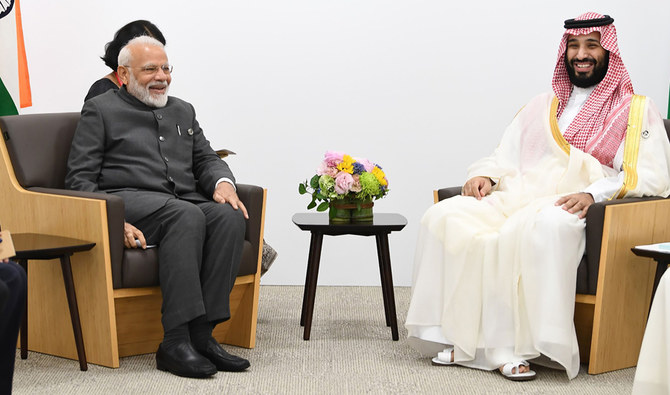
Saudi Crown Prince Mohammed bin Salman announces Hajj gift for India with 30,000 increase in quota

Saudi Crown Prince Mohammed bin Salman with Indian Prime Minister Narendra Modi during the G20 Summit in Osaka on Friday. (AFP/Indian Ministry of Foreign Affairs)
Updated 29 June 2019
Follow

Saudi Crown Prince Mohammed bin Salman announces Hajj gift for India with 30,000 increase in quota

  • The total figure rises to 200,000 per year
  • The meeting took place in Osaka where the yearly G20 summit is taking place

NEW DELHI: Saudi Arabia has increased India’s Hajj quota by 30,000, lifting the figure to 200,000 per year. The enhanced quota means India will send the second-highest number of pilgrims for Hajj after Indonesia. 

Saudi Crown Prince Mohammed bin Salman decided to raise the quota after a bilateral meeting with Indian Prime Minister Narendra Modi in the Japanese city of Osaka.

Vijay Gokhale, India’s foreign secretary, said that the “crown prince has promised PM Modi the quota will be increased.”

“This is important and this has been done,” he said

India’s Minority Affairs Minister Mukhtar Abbas Naqvi said the increase was a result of Modi’s “cordial and friendly” relations with the Saudi leadership.

“This is the third hike in three years. When the Modi government came to power in 2014, India’s Hajj quota was 136,000. That has now been increased to 200,000,” he said.

Dr. Ausaf Sayeed, India’s ambassador to Saudi Arabia, welcomed the crown prince’s decision.

“We are grateful to the Kingdom for increasing the Hajj quota. This will be the highest number of pilgrims to be handled by the Indian Hajj mission in its history,” he told Arab News. “The decision reflects the increasingly close and developing strategic relationship between the two countries, which has taken an upward trajectory in the recent years,” he said.

“We are geared up to receive the Indian Hajj pilgrims starting from July 4, 2019. The Saudi leadership involved in Hajj management, including Makkah Gov. Prince Khaled Al-Faisal and Hajj Minister Mohammed Salih Bentin, have promised to make Indian pilgrims’ stay in the Kingdom as comfortable as possible.”

Anwar Sadat, a New Delhi resident, also welcomed the increase in the quota. “I waited for three years before my turn came to perform Hajj. The increase of 30,000 is significant ... I feel that the quota should go up further.”


Economic growth and resilience at heart of 2nd AlUla Emerging Market Economies Conference

Updated 03 February 2026
Follow

Economic growth and resilience at heart of 2nd AlUla Emerging Market Economies Conference

  • Event on Feb. 8 and 9 will bring together ministers, governors of central banks, policymakers, economic experts and international financial institutions
  • Emerging-market economies a ‘pivotal element’ in global economic system due to effect they have on growth and stability, says Saudi Finance Minister Mohammed Al-Jadaan

RIYADH: The second annual AlUla Conference for Emerging Market Economies, which Saudi Arabia will host next week, offers a platform to exchange views on global developments and discuss policies and reforms that support inclusive growth and strengthen economic resilience, the Kingdom’s finance minister said.

The event on Feb. 8 and 9 will bring together finance ministers, governors of central banks and policymakers, alongside economic experts and representatives of international financial institutions.

Organized by the Saudi Ministry of Finance in partnership with the International Monetary Fund, it takes place as emerging-market economies face mounting challenges amid rapid global economic change.

Finance Minister Mohammed Al-Jadaan said the decision to host the conference reflects Saudi Arabia’s ongoing commitment to efforts that support global financial and economic stability, and highlights the growing influence of emerging economies on worldwide growth.

Emerging-market economies represent a “pivotal element” in the global economic system due to the direct impact they have on economic growth and stability, he added.

“The AlUla Conference for Emerging Market Economies provides a unique platform for exchanging views on global economic developments, and discussing policies and reforms that will support inclusive growth and enhance economic resilience, in light of broader international cooperation that contributes to confronting common challenges,” Al-Jadaan said.

Kristalina Georgieva, managing director of the IMF, said the event would help emerging economies deal with growing uncertainty driven by technological change, demographic shifts and geopolitical tensions.

“The AlUla conference provides a vital platform for emerging economies to discuss how they can navigate the risks and embrace the opportunities ahead,” she said.

“In these times of sweeping transformations in the global economy, policymakers face a more challenging and uncertain environment. Countries should work together to strengthen resilience through sound macroeconomic and financial policies.”