



RIYADH: As the trade relationship between Japan and Saudi Arabia continues to grow, both countries aim to capitalize on the opportunities created by Saudi Vision 2030. The depth of the relationship has been in evidence at the G20 summit in Osaka, where Crown Prince Mohammed bin Salman is leading the Saudi delegation.
Moreover, next year Saudi Arabia will become the first Middle Eastern country to host the G20, the most anticipated global gathering. Against this backdrop, Hideki Sho, the managing director of the Riyadh offices of both the Japan External Trade Organization (JETRO) and the Saudi-Japan Vision 2030 Office, spoke to Arab News on plans for bilateral trade and the ways in which cooperation can be further enhanced.
He noted that as the Kingdom’s second-largest source of foreign capital and third-biggest trading partner Japan is one of the country’s major partners.
“Saudi-Japanese total trade volume is significant and we consider each other as very important trading partners,” he said. “In this free-trade world, both Japan and Saudi Arabia gain huge economic benefits from trade. I believe that export items from Saudi Arabia can be more diversified as the result of the Vision 2030 reforms.”
Vision 2030 aims to diversify the Saudi economy, reduce the dependency on oil revenue and create employment through a strategy for sustainable growth. The countries have already agreed a Saudi-Japan Vision 2030, with the Kingdom expecting Japan to be an increasingly significant trading partner.
“The Saudi-Japan Vision 2030 initiative, which was agreed and launched in March 2017, covers a wide range of sectors, including trade and investment, finance, energy and industry, small and medium enterprises, human-capacity development, sports and culture,” said Hideki. 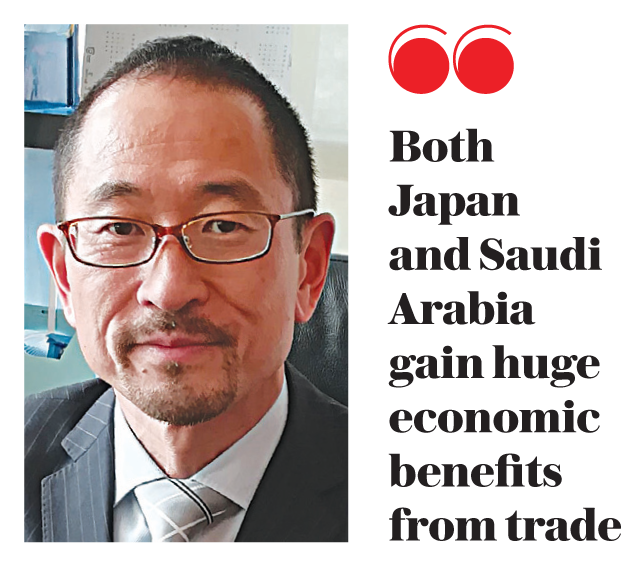
Under the initiative, further promotion of trade in manufactured goods is expected, in addition to crude oil and chemicals. Increased trade in services is also possible.
The latest Saudi-Japan Vision 2030 Business Forum, organized jointly by the Saudi Arabian General Investment Authority (SAGIA) and JETRO, took place on June 17 in Tokyo.
“More than 300 businesspersons attended the forum and 14 memorandums of understanding were exchanged,” said Hideki.
The forum heard updates on the Saudi business environment and investment opportunities, along with information about new business opportunities in the Kingdom, such as venture investment in start-up businesses and the rapidly growing entertainment sector.
“In the customer satisfaction survey completed by the forum attendees, 91.1 percent said that the event was beneficial and informative,” said Hideki.
SAGIA has introduced new laws designed to encourage foreign investment. Hideki said that this relaxation of regulations governing access to the Tadawul stock exchange for foreign investors is a positive step.
The recently established Nomu equity market, which operates in parallel to the main Saudi market, has lighter listing requirements and serves as an alternative platform for companies to go public, is very important, he said. As part of the Saudi-Japan Vision 2030, there is continuous cooperation between Tadawul and the Tokyo Stock Exchange. He also expressed hopes for more cross-border listings in the near future.
The introduction of VAT in the Kingdom is positively contributing to the financial reform, Hideki said, though he noted that new taxes come with pros and cons; this one, for example, means higher investment costs for the private sector. Other recent changes have also been positive, he added.
“I believe that the introduction of a new insolvency law will enhance the business environment in the Kingdom because it will provide firm choices for foreign investors to liquidate entities in the future,” he said. “I have a strong interest in a new procurement law that will be issued in the very near future.”
FASTFACT
● Saudi-Japan Vision 2030 initiative launched in 2017.
● Areas include trade, investment, finance, energy, SMEs, sports and culture.
● Saudi-Japan Vision 2030 Business Forum held on June 17 in Tokyo.
● Japanese firms have set up 115 business entities in Saudi Arabia.
● Saudi-Japan annual trade currently worth $26.67 billion.
Hideki said a stronger commitment by the government to local procurement is natural and that the new law will contribute further to industrial development and diversification in the Kingdom.
Citing a survey by the Japanese government, Hideki noted that there are 115 business entities operating in Saudi Arabia that were established by Japanese companies. In terms of accumulated direct investment in the Kingdom, Japan ranks fourth, he said.
Since the launch of Saudi-Japan Vision 2030, Japanese companies have contributed more than $30 billion in direct investment and financial commitment to Saudi Arabia.
Hideki said the latest trade statistics show that Japan is the top global destination for Saudi exports, with annual trade worth $26.67 billion, and ranks sixth in terms of imports to the Kingdom, which are worth $5.47 billion.
So Saudi Arabia has a huge trade surplus with Japan. Major export items include crude oil and chemical products, while imports include automobiles, tires and spare parts.
JETRO is a government agency that exists to promote global business by providing a variety of business intelligence to Japanese investors, while adopting a neutral position, Hideki said.
One of JETRO’s most important tasks is to provide accurate, up-to-date information about the Saudi business environment, including investment rules and regulations, the regulatory framework for doing business, tax and incentives, the labor market, and consumer-market trends.
“The collection of statistical data is also an important part of our mission and based on this research, we design and plan business-promotio n activities such as seminars, workshops, delegations, business matching events and one-on-one meetings,” Hideki said.
He noted that the keys to Saudi Arabia’s competitiveness are its geographical location and natural resource-rich economy. He also welcomed the positive effects of the current national reforms to the business environment in general, and to the labor force in the private sector in particular.
“We highly appreciate the great efforts of related Saudi authorities that are making it easier for foreign companies to do business in Saudi Arabia,” he said. “More Saudi participation, including by females, in the private sector is a positive result of ongoing reforms.”


