GENEVA: Western donors must ensure that humanitarian aid and any future reconstruction assistance in Syria do not fuel repression or benefit “cronies” of President Bashar Assad, Human Rights Watch (HRW) said on Friday.
The Syrian government has kept tight controls on the aid flow into the country throughout its eight-year civil war, often depriving civilians in opposition areas of supplies while favoring loyalists, according to New York-based HRW.
Syrian authorities have denied using starvation tactics as a weapon of war or diverting aid to government-held areas.
But Human Rights Watch, in a report based on interviews with aid workers and experts, said that UN and other aid agencies had been forced into complicity in selective distributions in order to access some areas.
Donors must be in the “driver’s seat” now that Assad has all but won the war and millions of Syrian refugees consider returning to their homeland where one-third of the infrastructure has been destroyed, the report said.
The Syrian government has proven to be “a master of manipulation when it comes to aid,” Kenneth Roth, executive director of Human Rights Watch, told Reuters.
“This is an important moment...because it is a moment when the Syria government is also begging the West for billions (of dollars) of new funds for reconstruction aid. So, the problems that we have seen are going to recur in spades if there is not a serious effort to address them.”
The United States and European Union say they cannot provide aid for reconstruction in Syria without a political transition and end to a war that has killed hundreds of thousands.
The economies of Syria’s main allies Russia and Iran are hurting, Roth said. “So, I don’t see other big sources of funds. They are going to be Western funds which gives the Western donors some leverage which we hope that they will exercise.”
“Anybody proposing to provide humanitarian or reconstruction assistance in Syria has the responsibility to do basic due diligence to ensure that their funds are going to those in greatest need, that they are not underwriting ongoing repression, that they are not padding the bank accounts of government officials and cronies,” he said.


![]()


West must be in ‘driver’s seat’ for Syria reconstruction: human rights group
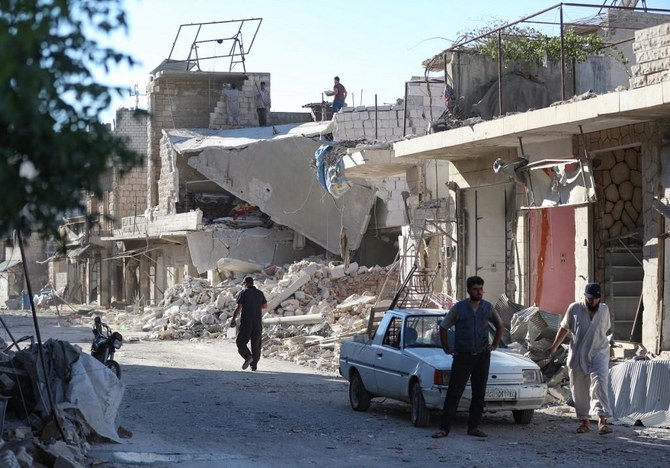
West must be in ‘driver’s seat’ for Syria reconstruction: human rights group
- Syrian authorities have denied using starvation tactics as a weapon of war or diverting aid to government-held areas
- The US and EU say they cannot provide aid for reconstruction in Syria without a political transition


India’s Modi is making his second official visit to Israel to meet with Netanyahu
JERUSALEM: Indian Prime Minister Narendra Modi was expected in Israel on Wednesday for a two-day visit focusing on strengthening security, economic and technological cooperation between the two countries.
Modi has said he would hold talks with Israeli Prime Minister Benjamin Netanyahu and President Isaac Herzog and would speak to Israeli parliament on Wednesday evening.
“Our nations share a robust and multifaceted Strategic Partnership,” Modi wrote on X. “Ties have significantly strengthened in the last few years.”
Netanyahu referred to himself and Modi as “personal friends” when he announced the visit earlier this week and the visit is likely to give Israel a boost of international support after seeing relations with many of its allies deteriorate since the war in Gaza began in October 2023.
In addition to being a powerful ally, India is also Israel’s No. 2 trading partner in Asia. Total trade between India and Israel was valued at $3.62 billion in the 2025 fiscal year, according to India’s Ministry of Commerce and Industry.
Modi became India’s first prime minister to travel to Israel in 2017, and Netanyahu reciprocated with a trip to India the following year.
Netanyahu told a Cabinet meeting Sunday that economic and security issues will be high on the leaders’ agenda, as will sharing technology, including artificial intelligence and quantum computing.
“We are partners in innovation, security, and a shared strategic vision,” Netanyahu said on the social platform X ahead of Modi’s arrival. “Together, we are building an axis of nations committed to stability and progress.”
Modi’s embrace of Israel has marked a shift in India’s foreign policy. India has historically supported the Palestinians, and did not establish full diplomatic ties with Israel until 1992.
A staunch Hindu nationalist, Modi was one of the first global leaders to swiftly express solidarity with Israel following the Oct. 7, 2023 attack by the Palestinian militant Hamas group.
India was also among more than 100 countries earlier this month to condemn Israel’s newly approved measures to deepen its control over the occupied West Bank and weaken the already limited powers of the Palestinian Authority.
Modi has said he would hold talks with Israeli Prime Minister Benjamin Netanyahu and President Isaac Herzog and would speak to Israeli parliament on Wednesday evening.
“Our nations share a robust and multifaceted Strategic Partnership,” Modi wrote on X. “Ties have significantly strengthened in the last few years.”
Netanyahu referred to himself and Modi as “personal friends” when he announced the visit earlier this week and the visit is likely to give Israel a boost of international support after seeing relations with many of its allies deteriorate since the war in Gaza began in October 2023.
In addition to being a powerful ally, India is also Israel’s No. 2 trading partner in Asia. Total trade between India and Israel was valued at $3.62 billion in the 2025 fiscal year, according to India’s Ministry of Commerce and Industry.
Modi became India’s first prime minister to travel to Israel in 2017, and Netanyahu reciprocated with a trip to India the following year.
Netanyahu told a Cabinet meeting Sunday that economic and security issues will be high on the leaders’ agenda, as will sharing technology, including artificial intelligence and quantum computing.
“We are partners in innovation, security, and a shared strategic vision,” Netanyahu said on the social platform X ahead of Modi’s arrival. “Together, we are building an axis of nations committed to stability and progress.”
Modi’s embrace of Israel has marked a shift in India’s foreign policy. India has historically supported the Palestinians, and did not establish full diplomatic ties with Israel until 1992.
A staunch Hindu nationalist, Modi was one of the first global leaders to swiftly express solidarity with Israel following the Oct. 7, 2023 attack by the Palestinian militant Hamas group.
India was also among more than 100 countries earlier this month to condemn Israel’s newly approved measures to deepen its control over the occupied West Bank and weaken the already limited powers of the Palestinian Authority.
Latest updates


© 2026 SAUDI RESEARCH & PUBLISHING COMPANY, All Rights Reserved And subject to Terms of Use Agreement.