GENEVA: Western donors must ensure that humanitarian aid and any future reconstruction assistance in Syria do not fuel repression or benefit “cronies” of President Bashar Assad, Human Rights Watch (HRW) said on Friday.
The Syrian government has kept tight controls on the aid flow into the country throughout its eight-year civil war, often depriving civilians in opposition areas of supplies while favoring loyalists, according to New York-based HRW.
Syrian authorities have denied using starvation tactics as a weapon of war or diverting aid to government-held areas.
But Human Rights Watch, in a report based on interviews with aid workers and experts, said that UN and other aid agencies had been forced into complicity in selective distributions in order to access some areas.
Donors must be in the “driver’s seat” now that Assad has all but won the war and millions of Syrian refugees consider returning to their homeland where one-third of the infrastructure has been destroyed, the report said.
The Syrian government has proven to be “a master of manipulation when it comes to aid,” Kenneth Roth, executive director of Human Rights Watch, told Reuters.
“This is an important moment...because it is a moment when the Syria government is also begging the West for billions (of dollars) of new funds for reconstruction aid. So, the problems that we have seen are going to recur in spades if there is not a serious effort to address them.”
The United States and European Union say they cannot provide aid for reconstruction in Syria without a political transition and end to a war that has killed hundreds of thousands.
The economies of Syria’s main allies Russia and Iran are hurting, Roth said. “So, I don’t see other big sources of funds. They are going to be Western funds which gives the Western donors some leverage which we hope that they will exercise.”
“Anybody proposing to provide humanitarian or reconstruction assistance in Syria has the responsibility to do basic due diligence to ensure that their funds are going to those in greatest need, that they are not underwriting ongoing repression, that they are not padding the bank accounts of government officials and cronies,” he said.


West must be in ‘driver’s seat’ for Syria reconstruction: human rights group
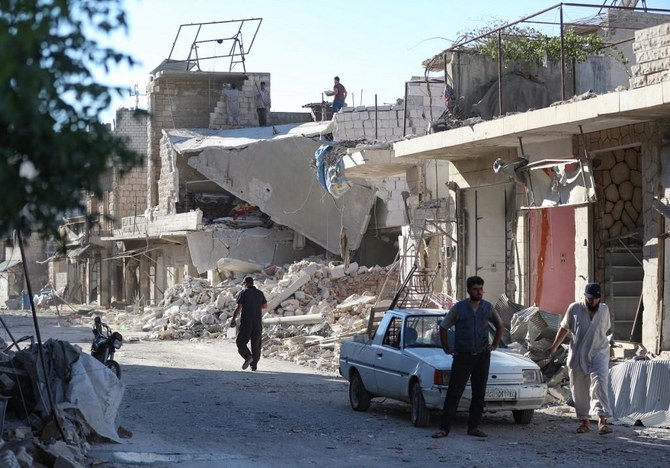
West must be in ‘driver’s seat’ for Syria reconstruction: human rights group

- Syrian authorities have denied using starvation tactics as a weapon of war or diverting aid to government-held areas
- The US and EU say they cannot provide aid for reconstruction in Syria without a political transition


Controversial Israeli minister enters area around Al-Aqsa Mosque on first Friday of Ramadan
- Far-right National Security Minister Itamar Ben-Gvir is seen making provocative remarks directed at Palestinians in presence of Israeli police
- It comes amid heightened Israeli security and restrictions on Palestinians entering the mosque, despite which an estimated 80,000 people attend first Friday prayers of the holy month
JERUSALEM: Israel’s far-right national security minister, Itamar Ben-Gvir, entered the area around Al-Aqsa Mosque on Friday, coinciding with the first Friday prayers of Ramadan.
Footage shared on social media showed him arriving through the Moroccan Gate, accompanied by the Israeli police commissioner, Daniel Levy, and the Jerusalem District police commander, Avshalom Peled.
Ben-Gvir was seen making provocative remarks directed at Palestinians in the presence of Israeli police officers, the Palestinian Wafa news agency reported.
The Moroccan Gate, located near Al-Buraq Wall, is one of the main entrances to Al-Aqsa and has been under Israeli control since 1967. It is regularly used by Israeli forces and settlers to access the mosque compound.
Jerusalem Governorate said the minister’s actions came amid heightened Israeli security measures and tighter restrictions on Palestinian in occupied Jerusalem during Ramadan.
Despite this, an estimated 80,000 worshippers attended the first Friday prayers of Ramadan at Al-Aqsa Mosque, according to figures provided by the Islamic Waqf Department in Jerusalem.
From early in the morning, Israeli forces imposed strict controls on Palestinians traveling from the West Bank to Jerusalem. Dozens of elderly worshippers were reportedly turned back at the Qalandia and Bethlehem checkpoints after being told they lacked the necessary permits.
Security forces also briefly detained four paramedics and disrupted the work of journalists and medical teams at Qalandia, witnesses said.
Additional security measures were also enforced at entrances to Jerusalem’s Old City and the gates of Al-Aqsa, with young men subjected to identity checks and a number of worshippers denied access.


