How cockroaches spread around the globe to become the pest we know today

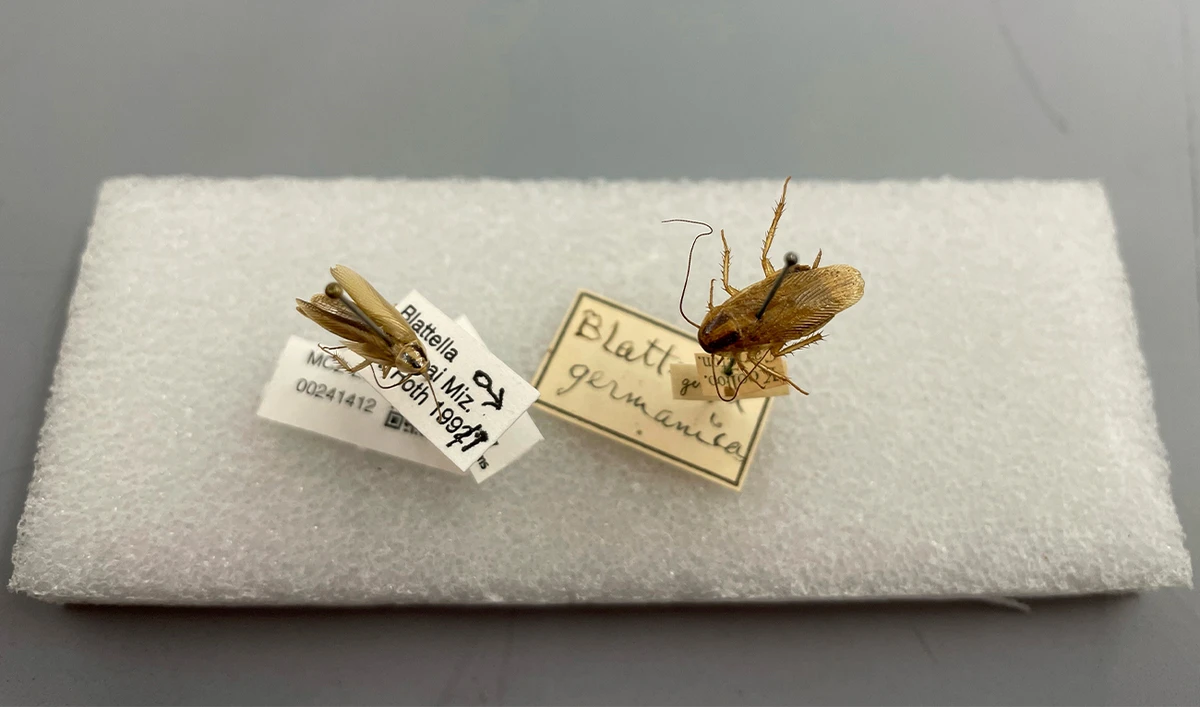
This photo provided by Qian Tang shows a German cockroach and an Asian cockroach, specimens from Harvard Museum of Comparative Zoology, in Cambridge, US on May 17, 2024. (AP)
Short Url
Updated 21 May 2024
Follow

How cockroaches spread around the globe to become the pest we know today

  • Study confirms German cockroach species found worldwide actually originated in southeast Asia
  • Cockroaches may have stowed away with people to travel to Middle East, Europe, says study

DALLAS: They’re six-legged, hairy home invaders that just won’t die, no matter how hard you try.

Cockroaches are experts at surviving indoors, hiding in kitchen pipes or musty drawers. But they didn’t start out that way.

A new study uses genetics to chart cockroaches’ spread across the globe, from humble beginnings in southeast Asia to Europe and beyond. The findings span thousands of years of cockroach history and suggest the pests may have scuttled across the globe by hitching a ride with another species: people.

“It’s not just an insect story,” said Stephen Richards, an assistant professor at Baylor College of Medicine who studies insect genes and was not involved with the study. “It’s an insect and humanity story.”

Researchers analyzed the genes of over 280 cockroaches from 17 countries and six continents. They confirmed that the German cockroach — a species found worldwide — actually originated in southeast Asia, likely evolving from the Asian cockroach around 2,100 years ago. Scientists have long suspected the German cockroach’s Asian origins since similar species still live there.

The research was published Monday in the journal Proceedings of the National Academy of Sciences.

The cockroaches then globe-trotted via two major routes. They traveled west to the Middle East about 1,200 years ago, perhaps hitchhiking in soldiers’ breadbaskets. And they may have stowed away on Dutch and British East India Company trade routes to get to Europe about 270 years ago, according to scientists’ reconstruction and historical records.

Once they arrived, inventions like the steam engine and indoor plumbing likely helped the insects travel further and get cozy living indoors, where they are most commonly found today.

Researchers said exploring how cockroaches conquered past environments may lead to better pest control.

Modern-day cockroaches are tough to keep at bay because they evolve quickly to resist pesticides, according to study author Qian Tang, a postdoctoral researcher studying insects at Harvard University.


Sri Lanka doubles troops for flood disaster recovery

Updated 5 sec ago
Follow

Sri Lanka doubles troops for flood disaster recovery

  • Sri Lanka is expecting further heavy monsoon rains, topping 75 millimeters in many places, including the worst-affected central region, the Disaster Management Center said

COLOMBO: Sri Lanka has doubled its military deployment to regions struck by a cyclone that has killed 635, sending tens of thousands of troops to help areas hit by a wave of destruction, the army said Monday.

More than 2 million people — nearly 10 percent of the population — have been affected by the disaster caused by Cyclone Ditwah, the worst on the island this century.

Sri Lanka is expecting further heavy monsoon rains, topping 75 millimeters in many places, including the worst-affected central region, the Disaster Management Center said. It has also issued warnings of further landslides.

“Given that mountain slopes are already saturated with rain water since last week, even slight showers could make them unstable again,” an official said, urging those evacuated from high-risk areas not to return.

The center has confirmed 635 deaths, with another 192 people unaccounted for since Nov. 27, when intense rains brought on by Cyclone Ditwah triggered landslides and floods.

The disaster management agency warned residents to “take adequate precautions to minimize damage caused by temporary localized strong winds and lightning during thundershowers.”

Army chief Lasantha Rodrigo said 38,500 security personnel had been sent to boost recovery and clean-up operations in flood-affected and landslide-hit areas, nearly doubling the inital deployment.

“Since the disaster, security forces have been able to rescue 31,116 people who were in distress,” Rodrigo said in a pre-recorded statement.

Army spokesman Waruna Gamage said additional troops were deployed as the rescue efforts turned into a recovery operation.