MIAMI: A lot could have gone wrong for Elizabeth Warren at Wednesday’s Democratic presidential debate.
It didn’t.
Warren, a US senator from Massachusetts, arrived in Miami riding a wave of momentum among the race’s more than 20 candidates. By luck of the draw, she was onstage a night before most of the other top-tier Democratic contenders, such as former Vice President Joe Biden and US Senator Bernie Sanders.
As the first night’s top-polling candidate, she did not falter. Her progressive platform — similar to Sanders’— largely went unchallenged by the moderates standing alongside her.
Most important, her status in the race to take on Republican President Donald Trump in the November 2020 election placed her front and center for the Democratic voters watching at home, and she was given ample time at the outset to detail the populist, anti-corporate themes of her candidacy.
“When you’ve got a government, when you’ve got an economy that does great for those with money and isn’t doing great for everyone else, that is corruption, pure and simple,” Warren said in the early moments of the debate, when viewership is typically highest. “We need to call it out. We need to attack it head- on.”
Warren benefited as well from the sheer chaos of the program. With 10 candidates onstage clamoring for attention and each given only a minute to respond, the evening often felt like a 10-car pileup or a round of speed dating.
It was difficult for viewers to track the questions and responses as some candidates often changed the subject. They talked over one another in an effort to reassure the Democratic base that they all mostly shared a common set of progressive values, making it hard for lesser-known contenders to distinguish themselves.
Given the chance to take Warren on, some centrist candidates punted. Early in the debate, US Senator Amy Klobuchar of Minnesota was asked about Warren’s plan to provide tuition-free college at public universities. Instead of criticizing Warren’s plan as being too far-reaching, Klobuchar talked about her own support of community college and Pell grants for college students.
The evening illustrated the difficulty Democrats may face next year if the US economy remains robust. Following Warren’s lead, several candidates framed the issue in terms of the economy failing to serve middle-class, working-class and minority voters.
“I live in a low-income black and brown community,” said US Senator Cory Booker of New Jersey. “I see every single day that this economy is not working for average Americans.”
Booker, Castro score points
Despite Warren’s strong performance, there were signs of potential pitfalls ahead. She was one of the few candidates onstage to promote the idea of doing away with private health insurance entirely in favor of Medicare. That earned some skepticism from others such as former Congressman Beto O’Rourke.
Her pledge was quickly highlighted by the Republican National Committee, which promised to use it against her in an effort to alarm voters worried about changes to their coverage.
Beyond Warren, the candidate who likely helped himself the most on Wednesday was Booker, who spoke more than anyone else and gave passionate, engaged answers on immigration and guns.
On gun violence, Booker said it was “something that I’m tired of. And I’m tired of hearing people, all they have to offer is thoughts and prayers.”
Former US Housing Secretary Julian Castro also may have raised his stock by getting into a sharp exchange with O’Rourke over decriminalizing border crossings by migrants.
Warren’s moment in the sun likely will be short-lived. On Thursday, Biden and Sanders will take the stage along with other top-tier White House hopefuls, including South Bend, Indiana, Mayor Pete Buttigieg and US Senator Kamala Harris of California.


Warren emerges from first Democratic debate unscathed
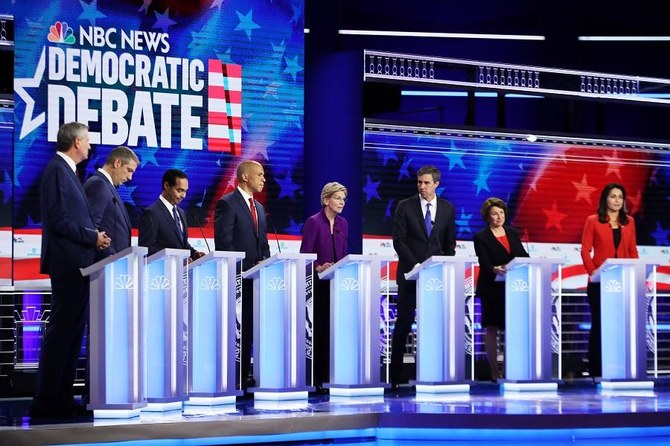
Warren emerges from first Democratic debate unscathed

- With 10 candidates onstage clamoring for attention and each given only a minute to respond, the evening often felt like a 10-car pileup or a round of speed dating
- Warren benefited as well from the sheer chaos of the program


US Justice Department official eyes cases against Cuba leaders as Trump floats ‘friendly takeover’
- “Working group” formed to build cases against people connected to the Cuban government
- Trump’s has increasingly displayed aggressive stance against Cuba’s communist leadership
MIAMI: The top Justice Department prosecutor in Miami is considering criminal investigations of Cuban government officials, according to people familiar with the matter. The inquiry comes as President Donald Trump has raised the possibility of a “friendly takeover” of the communist-run island.
Jason Reding Quiñones, the US attorney for the Southern District of Florida, has created a “working group” that includes federal prosecutors and officials from the Drug Enforcement Administration and other agencies to try to build cases against people connected to the Cuban government and its Communist Party, according to one of the people. They spoke on the condition of anonymity because they were not authorized to publicly discuss the effort.
It was not immediately clear which Cuban officials the office is targeting or what criminal charges prosecutors may be looking to bring.
The Justice Department said in a statement Friday that “federal prosecutors from across the country work every day to pursue justice, which includes efforts to combat transnational crime.”
The effort is taking place against the backdrop of Trump’s increasingly aggressive stance against Cuba’s communist leadership.
Emboldened by the US capture of Cuba’s close ally, Venezuelan President Nicolás Maduro, Trump last month said his administration was in high-level talks with officials in Havana to pursue “a friendly takeover” of the country. He repeated those claims this week, saying his attention would turn back to Cuba once the war with Iran winds down.
“They want to make a deal so bad,” Trump said of Cuba’s leadership.
While Cuba has faded from Washington’s radar as a major national security threat in recent decades, it remains a priority in the US Attorney’s office in Miami, whose political, economic and cultural life is dominated by Cuban-American exiles.
The FBI field office has a dedicated Cuba group that in 2024 was instrumental in the arrest of former US Ambassador Victor Manuel Rocha on charges of serving as a secret agent of Cuba stretching back to the 1970s.
In recent weeks, several Miami Republicans, in addition to Florida Sen. Rick Scott, have called on the Trump administration to reopen its criminal investigation into the 1996 shootdown of four planes operated by anti-communist exiles.
In a letter to Trump on Feb. 13, lawmakers including Reps. Maria Elvira Salazar and Carlos Gimenez highlighted decades-old news reports indicating that former President Raúl Castro — the head of Cuba’s military at the time — gave the order to shoot down the unarmed Cessna aircraft.
“We believe unequivocally that Raúl Castro is responsible for this heinous crime,” lawmakers wrote. “It is time for him to be brought to justice.”
While no indictment against Castro has been announced, Florida’s attorney general said this week that he would open a state-level investigation into the crime.
The Trump administration has also accused Cuba of not cooperating with American counterterrorism efforts, adding it alongside North Korea and Iran to a select few nations the US considers state sponsors of terrorism.
The designation stems from Cuba’s harboring of US fugitives and its refusal to extradite several Colombian rebel leaders while they were engaged in peace talks with the South American nation.


