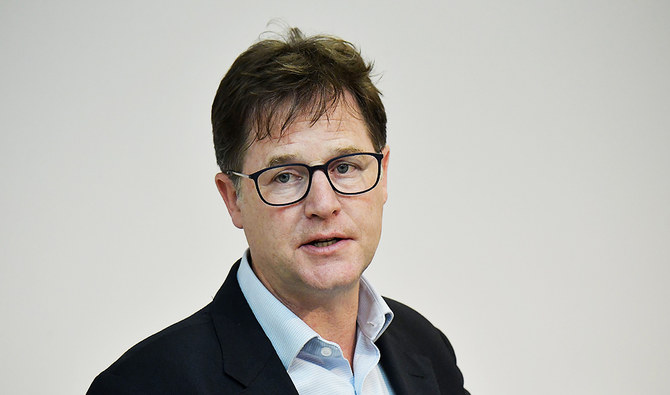
LONDON: Governments, not companies, must regulate social networks, Facebook’s head of global affairs and former UK deputy prime minister Nick Clegg, said Monday.
“It’s not for private companies, however big or small, to come up with those rules. It is for democratic politicians in the democratic world to do so,” Clegg told the BBC in an interview.
Clegg, the former leader of British Liberal Democrats party, said there was a “pressing need” for new “rules of the road” on issues including data privacy and election rules.
At the same time, companies such as Facebook should play a “mature role” in advocating regulation, he told the BBC.
Clegg later told an audience in Berlin that countries like China would not wait for the west to set standards for the Internet.
“If we in Europe and America don’t turn off the white noise and begin to work together, we will sleepwalk into a new era where the Internet is no longer a universal space but a series of silos where different countries set their own rules and authoritarian regimes soak up their citizens’ data while restricting their freedom,” he said at the Hertie School of Governance.
“The fact is there is no longer a single unilateral Internet but rather two Internets: China and the rest of the world.”
Clegg said he was in Berlin for the last in a series of meetings with experts around the world about the creation of a Facebook “independent oversight board” that would make binding decisions about content issues such as reported hate speech.
He said the company expected to release a “final charter” for the oversight board this summer.
“But it would be a much easier task as well as a more democratically sound one if some of the decisions that we have to make were instead taken by people who are democratically accountable to the people at large rather than by a private company,” he said.
Britain has said it will make social media bosses personally liable for harmful content and shut down offending platforms under a “world-leading” government plan.
Coming in for heavy criticism over the past year, Facebook has instituted changes, particularly on privacy and the transparency of political campaign ads.
Facebook chief Mark Zuckerberg has called for “globally harmonized” online regulation.
Sceptics say Facebook is seeking to buy time amid calls for tougher regulation in the United States and elsewhere — with some calls to break up major tech firms and other activists questioning whether they should maintain immunity from liability for content posted by users.


Governments must regulate social networks: Facebook’s Clegg
Governments must regulate social networks: Facebook’s Clegg

- Clegg said there was a “pressing need” for new “rules of the road” on issues including data privacy and election rules


Copper slips as subdued demand, high inventories weigh
LONDON: Copper fell on Thursday, giving up some gains from the previous session as rising inventories and subdued demand due to the holiday in top metals consumer China weighed on prices.
Benchmark three-month copper on the London Metal Exchange edged down 0.7 percent to $12,816 a metric tonne as of 1:10 p.m. Saudi time, after a 2.3 percent jump on Wednesday.
The Shanghai Futures Exchange is closed until February 23 for Lunar New Year, with Chinese traders largely out of the market.
“It’s really difficult to read too much into the price action this week,” said Ole Hansen, head of commodity strategy at Saxo Bank. “We need to get China back and see what happens then, both on the speculative and also on the physical demand in the following weeks.”
The dollar dipped but held above its recent lows after minutes from the US Federal Reserve showed policymakers did not seem to be in a rush to cut interest rates and that several were open to hikes if inflation proved sticky.
A weaker US dollar makes greenback-priced metals more affordable for holders of other currencies.
Copper stocks in LME-approved warehouses meanwhile increased by another 925 tonnes to 225,575 tonnes, the highest since March.
While high stocks were weighing on prices, copper was being propped up by technicals, Hansen explained. “Since last August, every time we have come down the 50-day moving average has been giving support,” he said, adding that the support level was currently at $12,670.
In other metals, zinc fell 0.3 percent to $3,342.50 a tonne and aluminum shed 0.7 percent to $3,067, after breaking a four-day losing streak on Wednesday. Lead edged up 0.1 percent to $1,965, nickel nudged up 0.6 percent to $17,375 and tin was up 0.5 percent at $46,120.


