ISLAMABAD: Contrary to an assessment by an international emergency committee of the World Health Organization last month that Pakistan’s polio eradication campaign was “no longer on track,” the country’s polio chief said the anti-polio drive had been streamlined for the first time in decades and he would quit office if the number of reported cases did not decline by 2021.
Pakistan is in the spotlight as one of only three countries where polio, a virus that can cause paralysis or death, still persists. Around 27 new cases have been reported this year, a majority of them in the northwestern Khyber Pakhtunkhwa province bordering Afghanistan.
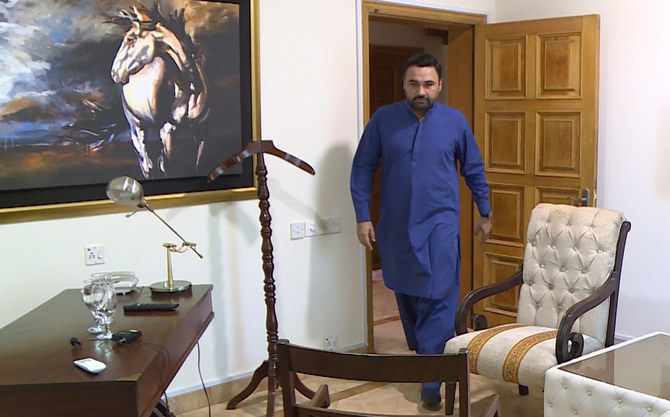
Any setback to the national anti-polio program is “either a collective failure or a collective success because the World Health Organization and the government of Pakistan are partners,” Babar bin Atta, the prime minister’s focal person on polio, said in an interview with Arab News.
“So when you say you’re talking to the Prime Minister’s Focal person on polio, this means you’re talking to the person who leads the program on behalf of the World Health Organization, UNICEF, the global partners and the people of Pakistan,” Atta added.
Asked if the May assessment by the WHO’s international emergency committee saying the eradication program was off track was incorrect, he replied, “absolutely,” but added that the committee’s comments had been made in the context of real concerns that the virus could be exported to other countries from Pakistan.
“The polio program has been put right on track for the first time ever in the last 2.5 decades,” Atta said.
In Pakistan, the battle to ensure full eradication has been beset with challenges other than just a lack of political will or administrative capacity.
Militants, convinced the anti-polio drive is a Western plot against Muslims, have killed nearly 100 polio workers and their guards since 2012, accusing them of being spies. Many clerics and religious leaders have also peddled stories that the vaccine is a ploy to sterilize Muslims, leading families to refuse vaccination, particularly for male children.
All this may seem absurd to the West, but in Pakistan, years of secrecy during military dictatorships, frequent political upheaval in times of civilian rule and a poor education system mean conspiracy theories easily run wild.
“Parents will do anything for their children but we [governments] have not been able to educate them,” Atta said.
“CULTURE V. STRATEGY”
But for a brief moment in the last four years, polio eradication was tantalizingly close.
According to figures released by the World Health Organization, 20,000 cases were reported in Pakistan in 1994. Since then, polio has been on the decline, dropping from 306 cases in 2014 to 54 in 2015, 20 in 2016 and 8 in 2017. In 2018, an election year in Pakistan, cases increased to 12 and have more than doubled this year.
“The recent elections and political transition may have adversely affected delivery of the polio program, it is now essential that the new government renews its efforts,” the WHO said in its statement last month.
Atta said the government had restarted eradication campaigns since he took over and was currently carrying out a sub-national drive in 23 percent of the country, targeting 12.5 million children.
The June campaign is the first since April this year when religious hard-liners in Khyber Pakhtunkhwa triggered mass panic by spreading rumors on social media that some children had been poisoned from contaminated vaccines and a number had died.
Since then, Facebook has removed up to 700 pages, links and profiles spreading spurious content on its platform, Atta said.
“Thank you Facebook, amazing collaboration,” he said. However, he added that Twitter had been less than cooperative, often taking weeks to respond to queries, if at all, and refusing to remove content despite repeated requests by the government. Only around 15 tweets had been removed by Twitter since the April scare, Atta said.
“Does Twitter not want to see a polio-free world?” he asked. “I don’t know what’s wrong with them, they’re not cooperating, they don’t respond.”
A spokesperson for Twitter said the company was working to launch new product interventions to assist users in locating reliable public health information on vaccines and would amplify credible public health accounts and direct individuals using Twitter’s search function to credible public health resources in response to keyword searches on vaccines.
“We will not suggest queries that are likely to direct individuals to vaccine-related misinformation,” the spokesperson told Arab News.
Atta said apart from battling misinformation, changes in the provincial administration set up were also required for the campaign to succeed.
On Monday after an “emergency meeting” with the chief minister of Khyber Pakhtunkhwa, Atta announced that district health officers (DHO) of Bannu and Lakki Marwat, two districts worst hit by the latest outbreak, had been sacked. He also said the powers of the health department would be delegated to commissioners from the civil administration who were responsible for running campaigns and authorities would no longer be allowed to file police cases against parents refusing vaccination, a policy of previous administrations.
“You can’t force it; coercion and force will never ever give you the solution,” Atta said. “Culture beats the hell out of strategy,” he added, commenting on the conservative mindset of the largely ethnic Pashtun Khyber Pakhtunkhwa belt.
“TWO VILLAGES ON A MOUNTAIN”
Changing mindsets is indeed Atta’s biggest challenge.
He described two villages on a mountaintop in southern Khyber Pakhtunkhwa that had been embroiled in a dispute for decades over who the mountain belonged to. When polio workers arrived there a few months ago, the head of the two villages said they would not allow vaccination unless the administration helped settle the matter once and for all.
Such examples help understand the complexity of Pakistan’s polio eradication challenge, Atta said.
“What have polio drops got to do with a mountain?” he said, laughing.
During a recent trip to supervise an anti-polio drive in North Waziristan, Atta said officials informed him that many families in the region curiously seemed in possession of a special pen used by vaccinators to mark the fingers of immunized children with ink that stayed on the skin for over a month.
When polio workers knock on doors, parents have to show the mark as proof that vaccination had already been done.
Atta said it was clear that locals were getting access to the markers through polio workers, since they were only available with the WHO, which supplied them to polio teams.
“Absolutely, who else is doing it [supplying parents with the pens]? Community mistrust is a larger problem in which everyone is a part,” he said, even the polio workers themselves.
Like others before him, Atta has tried to shatter many of the myths that can undermine even the best-intentioned health projects by turning to moderate clerics and paying them a per diem to raise awareness in mosques and neighborhoods and issue religious rulings supporting anti-polio efforts.
The polio chief said engaging clerics had been a major success and religious and cultural reasons accounted for only twenty percent refusals, while refusals based on fear of espionage were now non-existent.
“Eighty percent [refusals are due to] medical based misconceptions resulting from multiples doses,” he said, explaining that parents were alarmed by multiple visits to their homes by polio teams trying to confirm if children had been immunized and the fact that the vaccine had to be repeatedly administered to be effective.
For his final push to end polio in Pakistan, Atta said he needs $367 million in funds till 2023.
“We will give the world a polio-free Pakistan in this government,” he said. “If we are unable to do it by 2021, if we are unable to interrupt transmission, I think the prime minister needs to look for a new adviser on polio. Then I’m not the right person.”


![]()

Contrary to WHO concerns, Pakistan polio chief says eradication program ‘right on track’
Contrary to WHO concerns, Pakistan polio chief says eradication program ‘right on track’
- Setback to the national anti-polio campaign is “either a collective failure or a collective success,” Babar bin Atta says
- Alleges ‘negligible’ cooperation from Twitter to remove anti-vaccine misinformation, says Facebook’s response “amazing”
Latest updates


© 2026 SAUDI RESEARCH & PUBLISHING COMPANY, All Rights Reserved And subject to Terms of Use Agreement.