


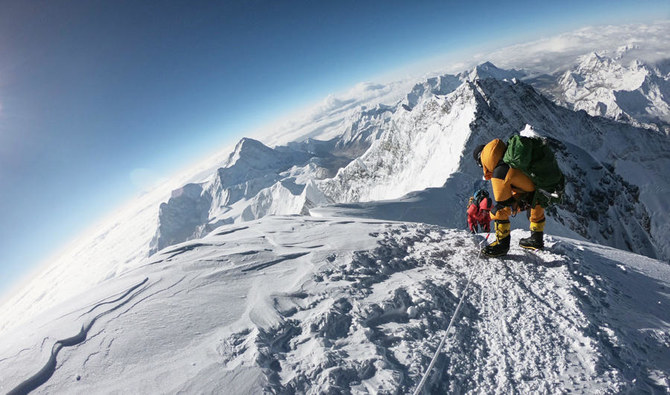

NEW DELHI: The bodies of seven climbers killed on India’s second-highest mountain were retrieved Sunday, capping a nearly month-long search by mountaineering experts in treacherous Himalayan terrain.
The eight-person group that went missing in late May included four Britons, two Americans, one Indian and one Australian.
They had set out to summit a previously “unclimbed peak” in India’s northern state of Uttarakhand.
A group of mountaineers from the paramilitary Indo-Tibetan Border Police (ITBP) found the seven bodies near an unnamed peak on Nanda Devi East.
The search for the last remaining body would continue on Monday, ITBP spokesman Vivek Kumar Pandey told AFP.
Those retrieved have been “taken to a nearby site,” Pandey said, adding: “We have also found some mountaineering equipment and gear.”
The bodies have not yet been identified.
The eight climbers were part of a 12-strong expedition, but four Britons were rescued after breaking away.
The main group, which was led by experienced British mountaineer Martin Moran, had permission only to climb the eastern peak of Nanda Devi.
But a Facebook post by Moran’s firm on May 22 said they planned to attempt “an unclimbed peak” around 6,500 meters (21,300 feet) high.
The missing climbers last communicated on May 26, a day before heavy snow fell and massive avalanches hit the heights.
Indian authorities began a search but operations were affected by bad weather and difficult terrain.
Pandey said it took five hours on Sunday to retrieve the bodies.
“The terrain conditions were extremely difficult due to steep gradient, snow accumulation and wind conditions,” he said.
Aerial searches for the climbers were repeatedly hindered earlier by turbulent winds, the risk of avalanches and the bowl-shaped terrain.
On June 3, a helicopter spotted five bodies and climbing equipment in the snow, at a height of about 5,000 meters but attempts to drop troops by air to retrieve them were aborted due to the risks.
In addition to Moran, the climbers have been named as John McLaren, Rupert Whewell and University of York lecturer Richard Payne from Britain, US nationals Anthony Sudekum and Ronald Beimel, Australian Ruth McCance and Indian guide Chetan Pandey.
Officials earlier told AFP the climbers had risked their lives by taking an untested route for which they did not have permission.
The climbers may have fallen from an ice ridge or an overhanging mass of snow during the avalanches, a military source said.
Hundreds of mountaineers from around the world visit India to scale peaks across the Himalayan chain, and those in Nanda Devi sanctuary are considered among the toughest.
The first successful ascent of Nanda Devi was in 1936.
India has 10 peaks above 7,000 meters, including Kangchenjunga — the world’s third highest — sandwiched between India and Nepal.
The deaths in India followed the deadliest climbing season in years on Nepal’s Mount Everest. Eleven people died on the world’s highest peak, and some of the fatalities were blamed on overcrowding.


