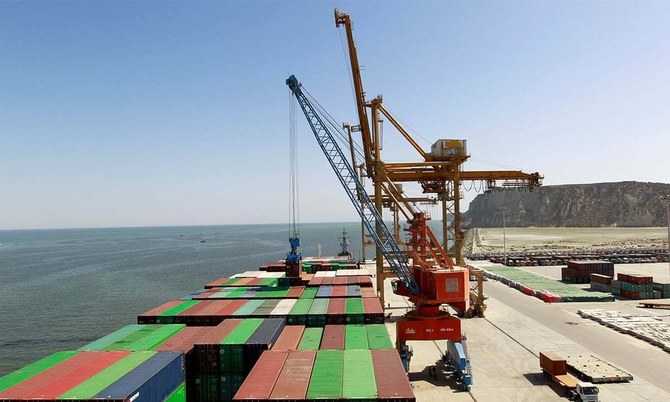
KARACHI: A high-level Saudi trade delegation will visit Pakistan next month to explore mutual trade opportunities, the Karachi Chamber of Commerce and Industry has said, as both countries work to enhance bilateral trade which currently stands at a meager $3.5 billion.
Saudi Arabia and Pakistan are historically close allies. In February, the two countries signed short-, mid- and long-term investment agreements worth $21 billion during the visit to Islamabad of Saudi Crown Prince Mohammed bin Salman.
“A Saudi delegation comprising around 32 members is coming to Pakistan in July to hold talks with local companies and explore avenues to increase bilateral trade,” Junaid Makda, the president of the Karachi Chamber of Commerce and Industry KCCI, told Arab News.
A report released by the Research and Policy Division of the Federation of Pakistan Chambers of Commerce and Industry (FPCCI) said Pakistan mainly imports petroleum products, plastic goods, organic chemical and fertilizer from Saudi Arabia and exports cereals, meat, textile, beverages, edible fruit and vegetable to Saudi Arabia.
In an email sent to various trade bodies earlier this month, the Saudi Trade Mission in Pakistan had said the Saudi Exports Development Authority was planning to send to Islamabad an “outbound trade mission for Saudi companies in two sectors, Food and Petrochemical.”
“More than 25 Saudi companies in those two sectors will come to Pakistan and meet their Pakistani counterparts which are interested in importing Saudi products,” the email read. “Saudi companies are very competitive in those two sectors and they can provide Pakistani companies with high quality products.”
“We will hold meetings with the Saudi delegation on the prospects of import of Saudi goods, mainly petroleum products and food items, which are cost effective for Pakistan,” Makda said.
“Petroleum is their [Saudis] natural resource so they will give us petrochemical products and Pakistan will export textile products to Saudi Arabia,” he added. “They are saying that petrochemical products, tiles and food items are cheaper in the Kingdom.”
Saudi Arabia has sought help from trade bodies in Pakistan to nominate the companies interested in participating in the trade talks with their Saudi counterparts next month.
The FPCCI report suggested that Pakistan and Saudi Arabia should sign a bilateral investment treaty to remove complex investment procedures and avoid taxation complications. It also identified trade barriers such as compliance of standards, lack of information and lack of commercial activities between both nations.
“Having a bilateral investment treaty will make the investment cooperation rules clear and transparent not just for existing but potential investors,” economist Vaqar Ahmed said. “The issue of double taxation can also be resolved through such a treaty. Furthermore, it will be possible to create investment value chains across both countries.”
“Business persons on both sides could also focus on non-traditional sectors where there exists large potential for joint ventures,” Ahmed added. “This could include information technology and several services-based sectors. Such a treaty could help lure investment from Saudi Arabia into Pakistan’s priority special economic zones.”
The FPCCI report also suggested that Pakistan and Saudi Arabia should formulate a strategy for mutual recognition of standards for exports of surgical instruments, food items and pharmaceutical goods given the huge demand for these products in Saudi Arabia.
Both the nations should formulate a mechanism to reduce non-tariff measures which are faced by Pakistan in exporting agriculture products to Saudi Arabia, the report said.
The report added that there was potential for Pakistan to enhance its exports to Saudi Arabia in textile, pharmaceutical, rice, sea food, meat, edible fruits and vegetable, dairy products, leather goods and information technology.
The FPCCI also suggested the activation of a Joint Business Council between both countries and the holding of business people-to-people contact, formulation of trade delegations and participation in trade fairs. The Trade Mission of both nations should also play their due role in the enhancement of bilateral trade, the report added.


![]()

Saudi delegation due in July to explore trade opportunities with Pakistan
Saudi delegation due in July to explore trade opportunities with Pakistan
- Kingdom interested in exporting petrochemical and food products to Pakistan
- FPCCI says both countries working to enhance bilateral trade which currently stands at meager $3.5 billion
Latest updates


© 2026 SAUDI RESEARCH & PUBLISHING COMPANY, All Rights Reserved And subject to Terms of Use Agreement.