IOC lifts India ban after Pakistan visa assurances

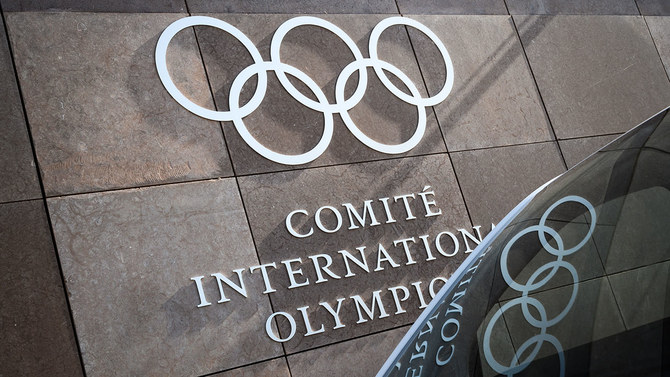
In this file photo, the logo of the International Olympic Committee (IOC) is seen at the sports governing body’s headquarters in Pully near Lausanne on May 22, 2019. (AFP)
Updated 21 June 2019
Follow

IOC lifts India ban after Pakistan visa assurances

  • Ban removed after Indian government’s assurance they will in future respect the Olympic charter
  • India triggered standoff with IOC when it refused to allow Pakistan to attend Tokyo 2020 Games competition

LAUSANNE: The International Olympic Committee has lifted a ban on India hosting international sporting events after receiving assurances over visas for Pakistani competitors.
In February, India triggered a standoff with the IOC when it refused to allow Pakistani shooters attend a Tokyo 2020 Games qualifying competition.
But on Thursday, IOC president Thomas Bach said India were now back in the Olympic fold.
“We have received the assurance of the Indian government that they will in future respect the Olympic charter and that they will give permission to enter India for all athletes who want to participate in the relevant Olympic events or qualifications events,” Bach announced.
The Olympic chief continued: “For this reason, the (IOC) Executive Board has today (Thursday) lifted this suspension of India to organize international sports events.”
India had accused Pakistan of involvement in a suicide bombing in Kashmir in February that killed 40 paramilitary soldiers and had vowed to “isolate” its arch-rival neighbor over the attack.


Pakistan army chief meets world leaders in rare Davos appearance

Updated 30 min 56 sec ago
Follow

Pakistan army chief meets world leaders in rare Davos appearance

  • Field Marshal Asim Munir attends World Economic Forum alongside prime minister
  • Pakistan delegation holds meetings with US, Saudi and Azerbaijani leaders

ISLAMABAD: Pakistan’s Chief of Army Staff Field Marshal Syed Asim Munir is attending the World Economic Forum’s annual meeting in Davos this week alongside Prime Minister Shehbaz Sharif, marking a rare appearance by a serving army chief at the global gathering of political and business leaders.

Pakistan’s participation at Davos comes as Islamabad seeks to attract investment, project economic stability and deepen engagement with key international partners following recent reforms aimed at stabilizing the economy. 

While Pakistani leaders routinely attend the World Economic Forum, it is uncommon for a serving army chief to be present. In 2017, former army chief Raheel Sharif addressed the forum only after his retirement, while General Pervez Musharraf spoke at Davos on a number of occasions in his role as president, not as military chief. 

Pakistan’s governance structure has evolved in recent years, particularly through the expanded role of the military in economic decision-making through bodies such as the Special Investment Facilitation Council, a civil-military platform designed to fast-track foreign investment in sectors including minerals, energy, agriculture and technology.

“The Prime Minister and the Field Marshal met with the President of Azerbaijan Ilham Aliyev, United States Secretary of State Marco Rubio, and Saudi Arabia’s Foreign Minister Prince Faisal bin Farhan Al Saud,” Sharif’s office said in a statement.

Officials say the delegation’s engagements focused on strengthening economic ties and maintaining high-level contact with partners in the Middle East, Central Asia and the United States at a time of shifting global economic and strategic alignments.

The World Economic Forum’s annual meeting brings together heads of state, ministers, investors and corporate leaders to discuss global economic risks, investment trends and geopolitical challenges. Davos is not a military forum, and while security issues are discussed there, the physical presence of a serving military chief remains the exception, not the norm, across countries. When military figures do appear, it is usually because they are heads of state or government, retired and speaking as security experts or hold a civilian defense portfolio such as defense minister or national security adviser.