

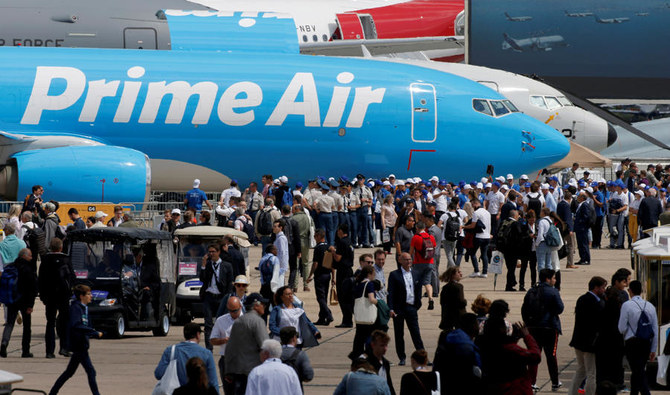

BENGALURU/PARIS/SINGAPORE: When Karan Mehrotra booked a flight from Delhi to Guwahati, he did not go to a travel agent or an airline website.
Instead, he turned to Amazon, the world’s biggest online retailer which now sells tickets to Indian customers and offers them an easy payment process and cash-back offers.
“It was just a lot simpler,” Mehrotra said of booking a flight through Amazon. “They are integrating most of my lifestyle needs under a single platform.”
Airlines are concerned that Amazon’s quiet launch of domestic plane ticket sales in India last month is only the start of a global trend and the beginning of a battle for control of valuable traveler data.
For years, airlines have found it difficult to compete with online travel agencies like Expedia Group Inc. and corporate travel agents that control a large number of customers, Travelport Chief Executive Gordon Wilson said.
“They have nothing left if Google is in that position, or Amazon,” he said at a CAPA Center for Aviation conference this month. “I think the airlines are being very watchful over this.”
Some carriers, like AirAsia and Easyjet are building digital travel businesses to help boost profits and keep passengers loyal beyond flying.
AirAsia’s website and app offers an all-in-one travel and lifestyle marketplace selling flights, hotels, activities and retail products. It has launched a digital wallet business called BigPay.
“The volume that we generate from our ticket sales is huge — bigger than a lot of other travel agents would sell. So we might as well do it ourselves, and probably sell a lot more,” AirAsia Executive Chairman Kamarudin Meranun told Reuters at the Paris Airshow.
Europe’s easyJet is signing direct booking contracts with hotels to give it more flexibility in pricing packaged holidays on its website. The easyJet Holidays product should be available for summer 2020 bookings by the end of the year, the airline said in a results presentation last month.
But companies like Amazon and Alphabet’s Google have the upper hand because their broader knowledge of purchasing habits might give them an edge over airlines in presenting attractive offers, travel industry executives said.
Amazon advantage
In India, Amazon has teamed up with local online travel agency Cleartrip to offer domestic airline bookings, with bigger discounts for members of its loyalty club Prime.
“They have an edge in that booking flights is, for most people, a low frequency purchase but most other products on Amazon are purchased with higher frequency,” said Seth Borko, a senior research analyst at Skift.
“So Amazon can sell discounted flights but then earn back a part of that promotion from customers that shop for other Amazon products and from their Prime membership fees.”
Amazon has dipped its toe in the travel industry before. The company launched “Amazon Destinations” in 2015 for customers to book hotel rooms in popular US getaways, like Napa Valley and the Hamptons. But it shut the service down the same year, after failing to gain traction in a crowded field of online agencies.
Four years later, Amazon is a more powerful company whose interest in bricks-and-mortar grocery, air cargo, health care and Hollywood has sent shockwaves through a growing number of markets, expanding its sources of intelligence about its users.
In India, shoppers have turned to Amazon for more purchases, including movie bookings, food orders and utility payments.
“Payment is very easy because I anyway keep my Pay account loaded,” said Atanu Khatua, a 34-year-old businessman from West Bengal who booked a flight to Delhi on Amazon.
Amazon, which has been expanding services available through “Alexa,” the digital assistant on its Amazon Echo smart speaker, has not revealed any plans to roll out its ticketing the product beyond India.
Amazon Pay Director Shariq Plasticwala declined to comment on whether it would expand in India to areas such as hotel bookings.
Think digital
Airlines, which operate in a highly regulated environment with high fixed costs, need to think more like digital retailers to maintain distribution margins, Kenya Airways CEO Sebastian Mikosz said.
“If we do not adopt an OTA (online travel agency) business model, we will become technology companies’ sub-divisions,” he said at the CAPA conference.
“If Amazon wanted to buy two or three airlines that wouldn’t be an effort for them. I think the only reason they don’t do it is because it is not practical. It is much better to have the problems outside and take the margin yourself.”
Not every airline has the cash or inclination to compete with tech giants like Amazon. But some are looking at partnerships.
“We’re working closely with the online travel agents, but we will look at the possibility also of working with Amazon,” Philippine Airlines CEO Jaime Bautista said at the Paris Airshow.
CAPA Executive Chairman Peter Harbison said ticket selling would face “dramatic changes” in the next couple years.
“The ones who are going to be successful are the ones who are actually going to partner with them, an Amazon or something like that,” he said.


