

Pakistan in talks with UK to sign treaty for return of visa overstayers

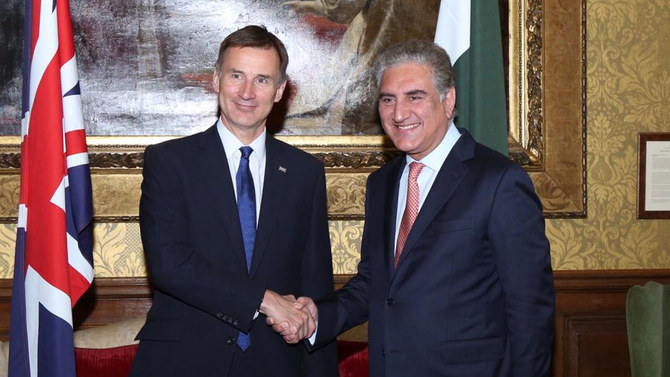
Foreign Minister Shah Mahmood Qureshi met with British Foreign Secretary Jeremy Hunt and reviewed 4th Pakistan-UK enhanced strategic Dialogue (ESD) at the Foreign and Commonwealth Office on June 19, 2019. (PID)
Updated 20 June 2019
Follow

Pakistan in talks with UK to sign treaty for return of visa overstayers

  • Legal experts advise Pakistan government against signing any “blanket provisions” of mutual treaty for return of overstayers
  • Say Islamabad should only accept its citizens back only after all legal appeals and judicial options exhausted

ISLAMABAD: Pakistan should not sign any blanket provisions of a proposed mutual treaty with the United Kingdom for the return of thousands of migrants who have overstayed visit visas, legal experts warned on Wednesday, a day after Foreign Minister Shah Mahmood Qureshi said UK authorities were pushing Pakistan to sign a mutual treaty to take back over 30,000 citizens staying illegally in London.

Qureshi made these remarks while addressing a press conference at the Pakistan High Commission in London on Tuesday.

A senior official at the Pakistan High Commission in London confirmed to Arab News on Wednesday that negotiations for the treaty regarding visa overstayers were ongoing.

“The agreement is in the interest of the people of Pakistan,” he said, declining to be named on account of not being a spokesman for the high commission. “At the moment, the UK is very careful in granting visit visas to Pakistanis due to increased cases of illegal stay but once the readmission treaty is signed, this will help our genuine visa applicants.”

The official did not specify a timeframe for when the treaty would be signed but said "this will definitely take some time.”

Around 1.5 million Pakistanis reside in the UK and remit over $2 billion annually to Pakistan.

Legal experts have advised Pakistani authorities against signing any “blanket provisions” of a mutual treaty for the return of its citizens from the UK who have been illegally staying there.

Muzzammil Mukhtar, solicitor and director of Synthesis Chambers Solicitors London, said UK laws permitted authorities to deport people who had either committed a crime, or entered the country illegally, but there had to be a mutual treaty of readmission with a relevant country for those who entered legally on a visa but overstayed.

“UK authorities are required to confirm identification of overstayers and get their travel documents from relevant embassies and high commissions before sending them back to their home countries,” he told Arab News. “And this process cannot be initiated in the absence of a mutual treaty.”

Mukhtar explained that Pakistanis or citizens of any other country in the UK could apply for asylum and other legal rights, including the right to have a private and family life under the EU Convention on Human Rights, and thus their “administrative removal from the UK is not any easy task.”

“Pakistan should not sign any blank provisions of the readmission treaty with the UK, and accept its citizens back home only after all their legal appeals and options in the courts stand exhausted,” Mukhtar said.


Pakistan completes first phase of 10-day training for Hajj facilitators in Islamabad

Updated 5 sec ago
Follow

Pakistan completes first phase of 10-day training for Hajj facilitators in Islamabad

  • “Khuddam-ul-Hujjaj” are trained government employees who facilitate Pakistani pilgrims during Hajj pilgrimage in Saudi Arabia 
  • Hajj facilitators equipped with digital maps, life-saving skills and crowd management modules to assist pilgrims, says official 

Islamabad: Pakistan’s Ministry of Religious Affairs (MoRA) has concluded its first phase of a 10-day modern training program for “Khuddam-ul-Hujjaj” or Hajj facilitators in Islamabad, state media reported recently, vowing to provide professional assistance to pilgrims in Saudi Arabia during the annual Islamic pilgrimage. 

Khuddam-ul-Hujjaj are trained government employees who facilitate Pakistani pilgrims during the Hajj pilgrimage in Saudi Arabia. Speaking to the state-run Associated Press of Pakistan (APP), Zulfiqar Khan, Pakistan’s coordinator for Makkah and Khuddam-ul-Hujjaj, said Hajj facilitators have been equipped with digital maps, life-saving skills from the Rescue 1122 emergency services and crowd management modules provided by the Islamabad Police. 

He said the training program marks a shift from traditional briefings to technical training in line with the best practices adopted in Indonesia, Turkiye and Malaysia.

“In a major move to ensure the smoothest Hajj experience in history for Pakistani pilgrims, the Ministry of Religious Affairs and Interfaith Harmony has successfully concluded the first phase of a 10-day modern training program for Khuddam-ul-Hujjaj,” APP reported on Sunday. 

Khan told APP that the Rescue 1122 emergency service conducted “mock exercises” for CPR and emergency medical aid during the first phase of the training. He said the program is divided into two phases: a joint session and the upcoming “Functional Level” specialized training.

“This second phase will prepare food, transport, and building teams for their specific ‘job desks’ to handle any crisis effectively,” the state media reported. 

Khan said the government has included a “significant” number of female assistants for this year’s Hajj to ensure comprehensive support for all pilgrims. He highlighted that assistants have been equipped with a ‘digital view’ of Mina’s roads, bridges and Jamarat routes, making them fully aware of camp locations and zones well in advance.

He said 870 Khuddam-ul-Hujjaj, selected through a competitive process, will serve as the backbone of the transport, food and accommodation sectors.

“This modern training signifies that Hajj 2026 will serve as an administrative role model, ensuring both spiritual peace and logistical excellence for our pilgrims,” he was quoted as saying. 

This year 179,210 pilgrims from Pakistan will perform Hajj, according to MoRA. Of these, 119,210 pilgrims will travel under the government scheme, while 60,000 will go through private tour operators, with applications processed on a first-come, first-served basis.