YANGON: The UN has warned it will pare back aid to thousands of Rohingya Muslims left destitute as Myanmar’s government closes camps in Rakhine state, over fears its continued support “risks entrenching segregation.”
Aid agencies are facing an increasingly sharp dilemma in the region as they balance relief for desperate communities with leverage over the government.
The majority of Myanmar’s Rohingya were driven into Bangladesh by a 2017 army crackdown, but around 400,000 remain inside conflict-battered Rakhine.
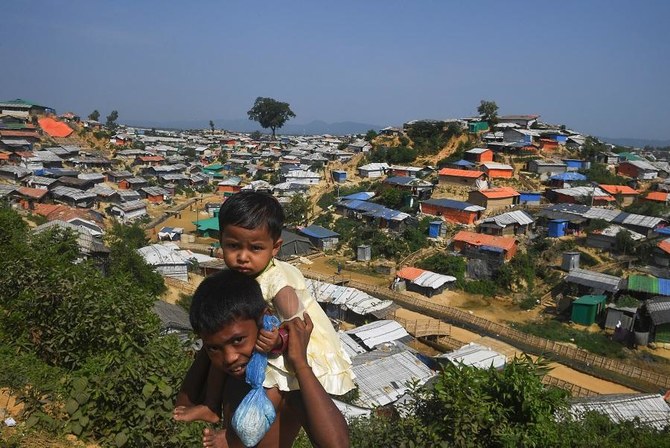
Those include nearly 130,000 held since 2012 in squalid camps, currently supported by UN agencies and humanitarian groups.
As part of its strategy to address the crisis, Myanmar has closed several camps holding around 9,000 Rohingya.
But they have not been allowed to return to their former homes and remain dependent on handouts. Instead, they are being settled in new accommodation close to the former camps.
That has sparked fears aid agencies are effectively being used to prop-up a policy that fails to address the fundamental needs of the Rohingya, including housing, work, food and security.
The camp closure plan “risks entrenching segregation,” UN Resident and Humanitarian Coordinator in Myanmar Knut Ostby wrote to the government in a leaked letter, dated 6 June and seen by AFP.
The letter, also written on behalf of aid groups, warned support “beyond life-saving assistance” at the closed sites would in future be linked to “tangible” progress made on “the fundamental issue of freedom of movement.”
“Life-saving” support includes food, health and water, but site planning, shelter construction and education facilities could be phased out, aid agency sources told AFP.
The UN has faced criticism for a slow response to violence against the Rohingya, which escalated after 2012 riots between Muslim Rohingyas and ethnic Rakhine Buddhists.
A UN report released Monday admitted “systemic failures” in its handling of the build-up to the Rohingya crisis.
Limited access to Rakhine’s camps makes independent reporting on conditions difficult.
But AFP has reviewed recent interviews conducted in five camps by an NGO requesting anonymity to protect its work.
“If I build a house, it can be seized arbitrarily,” one Rohingya man said.
“I have no right to the land and I can also be arrested at any time.”
An aid worker called the remaining 23 sites in Rakhine little more than “concentration camps.”
On condition of anonymity, she spoke of the “complicity” humanitarian staff feel for perpetuating the segregation.
Amnesty International has described Rakhine as an “apartheid state.”
All aid must be “heavily conditioned,” researcher Laura Haigh said, warning donors that building infrastructure could make them complicit in crimes against humanity.
The government defended the camp closures, telling AFP it would continue working with the UN and NGOs on the issue.
Any former camp resident holding a National Verification Card (NVC) will be able to “move freely within their township” and access “education, health facilities and livelihood activities,” the social welfare ministry said.
Most Rohingya refuse to apply for the card believing they should already be treated as full citizens.
Those interviewed said the few to have caved had no more rights than anyone else.
They were also forced to designate themselves as “Bengali,” a term implying they are from Bangladesh.
“They are just trying to dominate us and make us illegal through different ways,” one Rohingya man said.


![]()

UN gives Myanmar aid cut warning over Rohingya camp closures
UN gives Myanmar aid cut warning over Rohingya camp closures
- Myanmar has closed several camps holding around 9,000 Rohingya
- They have not been allowed to return to their former homes and remain dependent on handouts


Latest updates






© 2026 SAUDI RESEARCH & PUBLISHING COMPANY, All Rights Reserved And subject to Terms of Use Agreement.