Pakistan, UAE to set up joint platform to facilitate overseas Pakistani workers

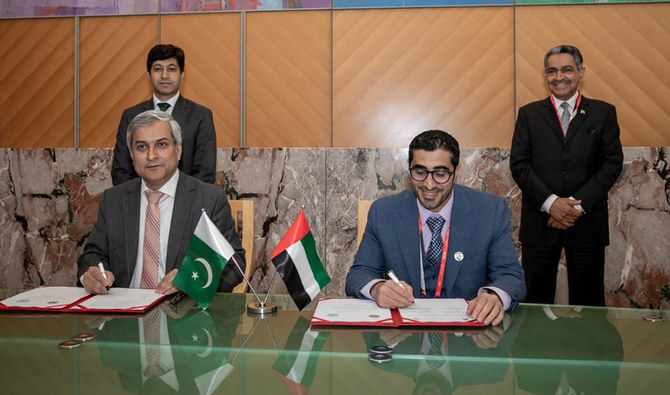
On the sidelines of the ongoing 108th session of the International Labour Conference in Geneva, on Monday Nasser Bin Thani Al Hameli, UAE Minister of Human Resources and Emiratisation, and Tahir Hussain Andrabi, Acting Permanent Representative of Pakistan to the United Nations, signed a memorandum of understanding (MoU).
Short Url
Updated 28 August 2022
Follow

Pakistan, UAE to set up joint platform to facilitate overseas Pakistani workers

  • New memorandum of agreement signed for protection of Pakistani labour
  • 1.6 million Pakistani expatriates live in the UAE, remit over $4 billion annually

Pakistan and the United Arab Emirates (UAE) have agreed to set up a joint platform to expedite the resolution of grievances and legal disputes of Pakistanis working in the Emirates, a senior Pakistani official said on Tuesday, hoping the mechanism would ensure a risk-free working environment for the Pakistani workforce in the UAE.
On Monday, on the sidelines of the ongoing 108th session of the International Labour Conference in Geneva, Nasser Bin Thani Al Hameli, UAE Minister of Human Resources and Emiratization, and Tahir Hussain Andrabi, Acting Permanent Representative of Pakistan to the United Nations, signed a memorandum of understanding (MoU) in the presence of senior officials from both sides.
Tassaduq Hussain, Senior Joint Secretary at the Pakistani Ministry of Overseas Pakistanis and Human Resource Development, called the understanding with the UAE a “landmark achievement,” saying it would help streamline the recruitment process of Pakistani workers and ensure their legal rights in the UAE.
“It has been mutually decided that Pakistani workers will sign an ‘Employment Job Offer’ with the UAE-based employer before landing in the UAE to avoid any fraud and job scams,” he told Arab News.
In order to ensure a risk-free working environment for Pakistani workers upon their arrival in the UAE, Hussain said the job offer would clearly state the rights and obligations of the worker and the employer, which could not be changed at a later stage unless in favor of the worker.
Hussain said both Pakistan and UAE had also agreed to set up a six-member committee, with three members from each side, to resolve disputes of overseas workers and facilitate them in the case of any legal proceedings or complaints.
“It is decided that any complaint or legal issue of Pakistani workers in the UAE will be resolved within a six-week time,” he said, adding that it has also been decided to initiate “cogent measures to curb human trafficking and money laundering” by ensuring strict implementation of relevant laws.
As per the MoU, Hussain said pre-departure and post-arrival training programs would also be conducted to make workers aware of UAE labor laws.
According to official statistics, more than 1.6 million Pakistani expatriates live in the UAE and work in different public and private departments. They remit over $4 billion annually to Pakistan.
Mohammad Sharif Leghari, manager of Zain Sharif Recruitment Agency, said the signing of the ‘employment job offer’ before the departure of workers to the UAE would help curb fraud in the recruitment process.
“This is a good initiative,” he said, “but the real challenge for the government remains to ensure its strict implementation and ban any overseas employment promoter for life if found guilty of its violation.” 


Afghanistan fires at Pakistani jets over Kabul as conflict intensifies

Updated 3 sec ago
Follow

Afghanistan fires at Pakistani jets over Kabul as conflict intensifies

  • Violence follows ‌air strikes inside Afghanistan this week Pakistan says ​targeted militant infrastructure
  • Pakistan says operation against Afghan forces ongoing, security forces destroyed Afghan posts, camps

KABUL: Afghanistan said it was firing at Pakistani jets in Kabul after blasts and gunfire rocked the capital on Sunday, compounding instability in a region rattled by US–Israeli strikes on Iran and retaliatory attacks on US targets in Gulf states.

The Taliban-ruled state has suffered Pakistani strikes against government installations over the past week following accusations, which it denies, that it harbors militants.

The heaviest fighting in years between the neighbors has raised fears of a protracted conflict ‌along their 2,600-km (1,615-mile) ‌border, with several countries including Qatar and Saudi ​Arabia ‌calling ⁠for restraint ​and ⁠offering to help mediate a ceasefire.

Explosions echoed across parts of Kabul before sunrise, followed by bursts of gunfire, a Reuters witness said. It was not clear what had been targeted or whether there were casualties.

Taliban administration spokesperson Zabihullah Mujahid said the sounds were the result of Afghan forces targeting Pakistani aircraft over the capital.

“Air defense attacks were carried out in Kabul against Pakistani aircraft. Kabul residents should not be concerned,” Mujahid ⁠said.

Pakistan’s prime minister’s office, information ministry and military did not ‌respond to requests for comment.

The violence follows ‌air strikes inside Afghanistan this week that Pakistan said ​targeted militant infrastructure. Afghanistan described the ‌strikes as a violation of sovereignty and announced retaliatory operations along their shared ‌border.

Iran, which shares borders with both Afghanistan and Pakistan, had offered to help facilitate dialogue before itself coming under attack on Saturday from Israel and the US bent on diminishing Iran’s military capability.

ACCUSATION AND ESCALATION

Pakistan has said Afghanistan harbors Tehreek-e-Taliban Pakistan (TTP) militants, which it ‌said are waging an insurgency inside Pakistan.

Afghanistan has denied the accusation, saying it does not allow Afghan territory to be ⁠used against other ⁠countries and that Pakistan’s security challenges are an internal matter.

Pakistani security sources have said operation “Ghazab Lil Haq,” meaning “Wrath for the Truth,” was ongoing and that Pakistani forces had destroyed Afghan posts and camps.

Both sides have reported heavy losses, issuing differing casualty figures for each other.

Reuters could not independently verify the claims.

Diplomatic efforts have intensified, with Saudi Arabia, Russia, China, the European Union and United Nations urging restraint and calling for talks.

The US said it supports Pakistan’s right to defend itself.

Pakistan Defense Minister Khawaja Muhammad Asif described the fighting as “open war.”

Afghanistan Interior Minister Sirajuddin Haqqani said the conflict would be “very costly.” He said only ​front-line forces were engaged in fighting that ​the country has yet to fully deploy its military.