

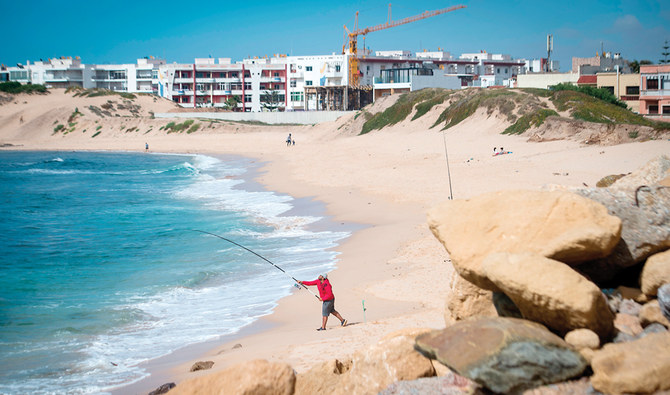

MOHAMMEDIA: Beneath an apartment block that looms over Monica beach in the western coastal city of Mohammedia, a sole sand dune has escaped the clutches of Morocco’s insatiable construction contractors.
Here, like elsewhere across the North African tourist magnet, sand has been stolen to help feed an industry that is growing at full tilt.
A report last month by the UN Environment Programme (UNEP) on the global over-exploitation of this resource accuses “sand mafias” of destroying Morocco’s beaches and over-urbanizing its coastline.
“The dunes have disappeared along the entire city’s coastline,” lamented environmental activist Jawad, referring to Mohammedia, on the Atlantic between Rabat and Casablanca.
The 33-year-old environmental activist leads Anpel, a local NGO dedicated to coastal protection.
“At this rate, we’ll soon only have rocks” left, chipped in Adnane, a member of the same group.
More than half the sand consumed each year by Morocco’s construction industry — some 10 million cubic meters (350 million cubic feet) — is extracted illegally, according to UNEP.
“The looters come in the middle of the night, mainly in the low season,” said a local resident in front of his grand home on the Monica seafront.
“But they do it less often now because the area is full of people. In any case, there is nothing more to take,” added the affable forty-something.
Sand accounts for four-fifths of the makeup of concrete and — after water — is the world’s second most consumed resource.
Exploitation
Beaches and rivers are heavily exploited across the planet, legally and illegally, according to UNEP.
In Morocco, “sand is often removed from beaches to build hotels, roads and other tourism-related infrastructure,” according to UNEP. Beaches are therefore shrinking, resulting in coastal erosion.
“Continued construction is likely to lead to... destruction of the main natural attraction for visitors — beaches themselves,” the report warned.
Theft of sand from beaches or coastal dunes in Morocco is punishable by five years in prison.
Siphoned away by donkey, delivery bike and large trucks, the beaches are being stripped from north to south, along a coastline that runs from the Mediterranean Sea to the Atlantic.
FASTFACT
Siphoned away by donkey, delivery bike and large trucks, the beaches are being stripped from north to south, along a coastline that runs from the Mediterranean Sea to the Atlantic.
“On some beaches, the sand has nearly disappeared” in parts of the north, said an ecological activist in Tangiers. “There has been enormous pressure on the beaches of Tangiers because of real estate projects,” he said.
To the south, the UNEP report noted, “sand smugglers have transformed a large beach into a rocky landscape” between Safi and Essaouira. Activist Jawad points to “small scale looting, like here in Mohammedia.”
But “then there is the intensive and structured trafficking by organized networks, operating with the complicity of some officials.”
While the sand mafias operate as smugglers, “key personalities — lawmakers or retired soldiers — hand out permits allowing them to over-exploit deposits, without respect for quotas,” he added.
A licensed sand dredger spoke of “a very organized mafia that pays no taxes” selling sand that is “neither washed nor desalinated,” and falls short of basic building regulations.
These mafia outfits have “protection at all levels... they pay nothing at all because they do everything in cash,” this operator added, on condition of anonymity.
“A lot of money is laundered through this trade.”
A simple smartphone helps visualize the extent of the disaster.
Via a Google Earth map, activist Adnane showed a razed coastal forest, where dunes have given way to a lunar landscape, some 200 km south of Casablanca.
Eyes fixed on the screen, he carefully scrutinized each parcel of land.
“Here, near Safi, they have taken the sand over (a stretch of) seven kilometers. It was an area exploited by a retired general, but there is nothing left to take,” he alleged.
Adnane pointed to another area — exploited, he said, by a politician who had a permit for “an area of two hectares.”
But instead, he “took kilometers” of sand.
Environmental protection was earmarked as a priority by Morocco, in a grandiose statement after the country hosted the 2016 COP22 international climate conference.
Asked by AFP about measures to fight uncontrolled sand extraction, secretary of state for energy Nezha El Ouafi pointed to “a national coastal protection plan (that) is in the process of being validated.”
The plan promises “evaluation mechanisms, with protection programs and (a) high status,” she said.
Meanwhile, environmental activists are pleading against the “head in the sand approach” over the scale of coastal devastation.


