

WEEKLY ENERGY RECAP: Traders keep their heads amid increased risk to tankers

While insurers seem to have responded to the increased risks to shipping, oil traders are more sanguine. (Reuters)
Updated 15 June 2019
Follow

WEEKLY ENERGY RECAP: Traders keep their heads amid increased risk to tankers

  • Oil seems to be steady in the $60 per barrel range for Brent even if the risks for tankers in the Arabian Gulf have gone up

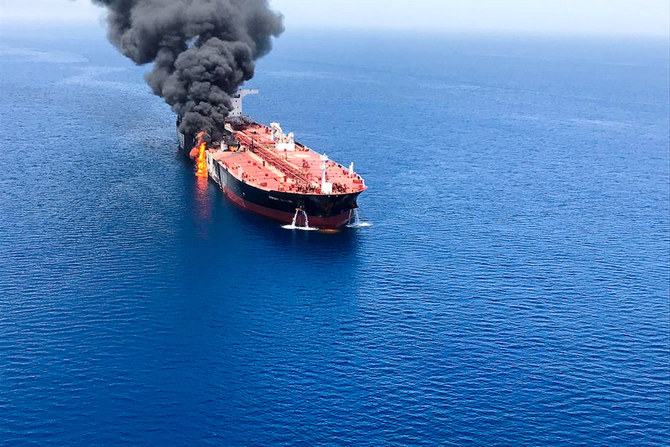
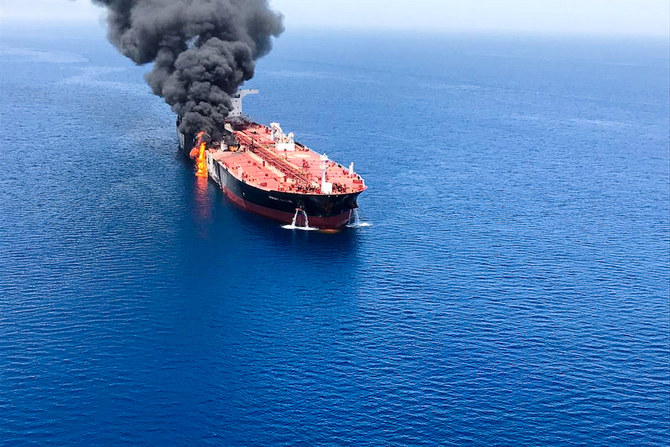
RIYADH: Counterintuitively, the latest attacks on tankers in the Gulf of Oman which ratcheted up regional tensions, did not have the same effect on the oil price, which ended the week lower. 

Brent crude and WTI prices deteriorated to $62.01 and $52.51 per barrel respectively. In the past even an isolated tanker hijacking or fire was enough to send the price rocketing — but these days traders appear more fixated on where global trade winds are blowing.

Oil seems to be steady in the $60 per barrel range for Brent even if the Arabian Gulf is now considered as one of the riskiest areas for oil tankers since the Iraq War. 

It is worth remembering that the Arabian Gulf is where more than a third of the world’s hydrocarbons are transported — a fact reflected in the rising premiums for tanker insurance in the region.

Yet while insurers seem to have responded to the increased geopolitical risks, oil traders are more sanguine. A slowing global economy, persistent trade war worries and rising shale output have combined to cap price increases.

The latest monthly reports from both OPEC and the IEA also cut their demand forecasts, adding to bearish sentiment.

OPEC, in its report, cited weaker growth in global oil demand amid escalated and ongoing global trade tensions, as a key factor in the downward adjustments to the outlook for global oil demand.

  • Faisal Faeq is an energy and oil marketing adviser. He was formerly with OPEC and Saudi Aramco. Twitter:@faisalfaeq


PIF-backed AviLease achieves revenue of $664m and 19% growth in 2025

Updated 27 February 2026
Follow

PIF-backed AviLease achieves revenue of $664m and 19% growth in 2025

RIYADH: Saudi Arabia’s Public Investment Fund-backed AviLease achieved exceptional performance and sustainable business growth during 2025, supported by the strategic expansion of its global platform.

According to its financial results for 2025, AviLease recorded total revenues of $664 million, an annual increase of 19 percent, driven by disciplined growth in its asset portfolio and strong performance in aircraft remarketing amid sustained global demand for modern, fuel-efficient aircraft, the Saudi Press Agency reported.

Profit before tax doubled compared to the previous year, reaching $122 million. The year witnessed an expansion in AviLease’s portfolio, reaching 202 owned and managed aircraft, leased to over 50 airline companies in more than 30 countries. 

The total value of the company’s assets stabilized at $9.3 billion. AviLease maintained a 100 percent fleet utilization rate, reflecting the resilience of its business model, the efficiency of its asset management, and the strength of its strategic relationships with airlines around the world.

AviLease concluded purchase agreements for aircraft from Airbus, including the A320neo family and A350F, and Boeing 737 aircraft, aiming to enhance its future asset portfolio with modern, fuel-efficient aircraft. This step will contribute to supporting future growth and meeting increasing customer demand for the latest aircraft, aligning with the Kingdom’s ambitions to become a leading global aviation hub.

AviLease strengthened its prestigious credit standing by obtaining a strong Baa2 credit ratings from Moody’s and BBB from Fitch, reflecting its financial solidity, managerial discipline, and efficiency in managing leverage. The company also successfully issued senior unsecured bonds worth $850 million last November under Regulation 144A/RegS. This issuance contributed to diversifying its funding sources and enhancing its financial flexibility.

Commenting on the results, AviLease CEO Edward O’Byrne said: “This exceptional performance reflects the quality of the company’s investment portfolio, the strength of its partnerships with airlines, and its strategic focus on responsibly deploying capital into highly sought-after, efficient, modern aircraft assets.”

He added: “As aviation markets continue to grow, AviLease is strategically positioned to continue its expansion plans and deliver sustainable long-term value for shareholders, contributing to the Kingdom’s ambitions.”

Throughout 2025, AviLease continued to play a pivotal role in the Kingdom’s growing aviation sector and contributed directly to the launch and scaling of the new national carrier, Riyadh Air, by completing a sale and leaseback transaction for a Boeing 787-9 aircraft, which thereby became the first aircraft to join the airline’s fleet.

AviLease also established a strategic partnership with Hassana Investment Co. This partnership aims to provide an opportunity for local and international investors to enter the aircraft financing asset class and benefit from AviLease’s technical expertise and operational capabilities to support partnership growth and enhance performance. 

Hassana Investment Co. has agreed to acquire an initial portfolio of 10 modern aircraft from AviLease.