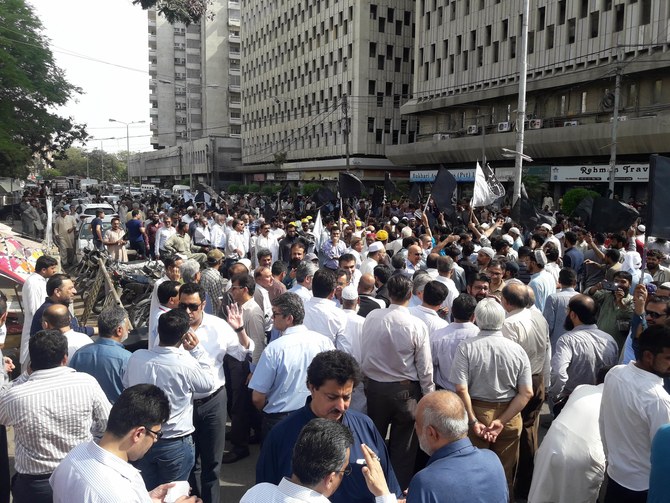
KARACHI: Five Pakistani industries launched protests in seven major cities on Saturday to denounce the withdrawal of a zero-rated sales tax facility in the budget for the fiscal year to June 2020, decrying the move as a “disaster” for the countries export-oriented sectors.
Seeking final approval for an International Monetary Fund bailout, the government’s new budget envisions widespread belt-tightening, a sharp hike in tax revenues and abolished the facility of zero-rated sales tax for the textile, leather, carpets, surgical and sports goods sectors.
A standard rate of 17 percent sales tax will now be imposed on these sectors to generate an expected Rs75-80 billion in additional revenue.
Muhammad Jawed Bilwani, Chief Coordinator of the Value Added Textile Export Sector, said peaceful protests were being held by the industry in Karachi, Lahore, Faisalabad, Sialkot, Multan, Kasur and Gujranwala against the new measure announced in the budget.
The new tax regime, he said, would be “a deadly blow” for exporters' liquidity, create hardships for exporters and threatened to eliminate small and medium sized enterprises.
“Exports will decline to approximately 30 percent in the next fiscal year,” Bilwani said.
The textile sector directly or indirectly provides 42 percent of total employment in urban centers, Zubair Motiwala, a former president of the Karachi Chamber of Commerce and Industry and chairman of the Council of All Pakistan Textile Associations, told Arab News.
Pakistan’s textile exports were $13.38 billion in fiscal year 2017-18 and $11.35 billion in the 10 months of fiscal year 2018-19: “This sector contributes almost 65-70 percent to the overall exports of the country. Does it make sense to disturb this sector?” Motiwala asked.
The surgical goods sector too is worried. State bank data shows Pakistan’s surgical exports stood at $477.2 million in fiscal year 2017-18 while $325.4 million worth of goods were exported during the 10 months of the current fiscal year.
“It was not a well-thought out decision,” Khalil ur Rehman, chairman of the Surgical Instrument Manufacturers Association of Pakistan, said referring to the government’s decision to withdraw the zero-rated facility. “We were not taken on board by authorities.”
Rehman said the government’s move would jeopardize the future of up to 250,000 people associated directly or indirectly with the industry, adding that the sector would now be forced to raise prices and become less competitive in the international market, leading to reduced operations and layoffs.
“The sector can survive for the next 2 to 3 years but after that, if the situation persists, 50 percent of the business would cease to exist,” Rehman said.
Representatives of the carpet manufacturing sector, whose representatives say 99 percent production is exported, also said the industry was struggling to survive. Pakistan exported $84.2 million worth of carpets and rugs in fiscal year 2017-18 and $65.8 million in the 10 months of fiscal year 2018-19.
The decision to withdraw the zero-rated tax facility will “totally collapse exports,” M Naeem Sajid, chairman of the Pakistan Carpet Manufacturers & Exporters Association, told Arab News.
He said Pakistan was facing tough competition in the carpets’ business from Afghanistan, India, and China: “We operate on 10-15 percent profit margin; with a 17 percent sales tax, doing business will not be viable,” Sajid said, adding that this would affect the livelihoods of around 800,000 people.
Syed Shujat Ali, chairman of the Pakistan Leather Garments Manufacturers & Exporters Association, said the sector employed 1.2-1.5 million people who would suffer as the cost of doing business went up by up to 15 percent because of new taxes, which would force the industry to cut down on its workforce and operations.
Leather exports stood at $365.4 million in fiscal year 2017-18 and $241.5 million in the 10 months of the current fiscal year, official data shows.
“The input cost hike will render us uncompetitive in the international market and we may lose our share to our competitors,” Ali said.
Pakistan’s sporting goods sector, which exported goods worth $551.4 million in fiscal year 2017-18 and $425.7 million during the 10 months of the current fiscal year, will also feel the burn of the government’s new measures.
“The government’s decision to abolish the zero-rated tax facility has sent a wave of uncertainty among the people of [the city of] Sialkot where every second person is involved in the sports goods manufacturing,” said Chaudhry Muhammad Arshad, the chairman of the Pakistan Sports Goods Manufacturers & Exporters.
The government had been forecasting growth of 4% for the next financial year, but after Revenue Minister Hammad Azhar delivered his budget speech to parliament on Tuesday evening, the government released a budget document showing it trimmed its growth estimate for the coming year to 2.4%. Inflation, which hit 9% in May, is seen at 11-13% during fiscal year 2019-2020.
“This (2.4 percent growth rate) means unemployment would increase to a large extent because economic growth has already declined by more than half,” senior economist Yousuf Nazar said.
Dr. Ashfaque Hassan Khan, a member of Pakistan’s Economic Advisory Council, added: “Every year 1.5 million new people enter the job market. The 2.4% growth is also equal to population growth rate which means the new entrants are not finding jobs. So the pool of unemployed will keep on rising and this may lead to social unrest in the country and increase poverty.”


Five industries launch countrywide protests as budget strikes down zero-rated tax
Five industries launch countrywide protests as budget strikes down zero-rated tax

- Pakistan government has abolished zero-rated sales tax for textile, leather, carpets, surgical and sports goods sectors
- Economists fear growth expected at 2.4 percent will fuel unemployment, poverty and social unrest

Pakistan opposition to continue protest over ex-PM Khan’s health amid conflicting reports
- Pakistan’s government insists that the ex-premier’s eye condition has improved
- Khan’s personal doctor says briefed on his condition but cannot confirm veracity
ISLAMABAD: Pakistan’s opposition alliance on Monday vowed to continue their protest sit-in at parliament and demanded “clarity” over the health of jailed former prime minister Imran Khan, following conflicting medical reports about his eye condition.
The 73-year-old former cricket star-turned-politician has been held at the high-security Adiala prison in Rawalpindi since 2023. Concerns arose about his health last week when a court-appointed lawyer, Barrister Salman Safdar, was asked to visit Khan at the jail to assess his living conditions. Safdar reported that Khan had suffered “severe vision loss” in his right eye due to central retinal vein occlusion (CRVO), leaving him with just 15 percent sight in the affected eye.
On Sunday, a team of doctors from various hospitals visited the prison to examine Khan’s eye condition, according to the Adiala jail superintendent, who later submitted his report in the court. On Monday, a Supreme Court bench led by Chief Justice Yahya Afridi observed that based on reports from the prison authorities and the amicus curiae, Khan’s “living conditions in jail do not presently exhibit any perverse aspects.” It noted that Khan had “generally expressed satisfaction with the prevailing conditions of his confinement” and had not sought facilities beyond the existing level of care.
Having carefully perused both reports in detail, the bench observed that their general contents and the overall picture emerging therefrom are largely consistent. The opposition alliance, which continued to stage its sit-in for a fourth consecutive day on Monday, held a meeting at the parliament building on Monday evening to deliberate on the emerging situation and discuss their future course of action.
“The sit-in will continue till there is clarity on the matter of [Khan's] health,” Sher Ali Arbab, a lawmaker from Khan's Pakistan Tehreek-e-Insaf (PTI) party who has been participating in the sit-in, told Arab News, adding that PTI Chairman Gohar Ali Khan and Opposition Leader in Senate Raja Nasir Abbas had briefed them about their meeting with doctors who had visited Khan on Sunday.
Speaking to reporters outside parliament, Gohar said the doctors had informed them that Khan’s condition had improved.
“They said, 'There has been a significant and satisfactory improvement.' With that satisfactory improvement, we also felt satisfied,” he said, noting that the macular thickness in Khan’s eye had reportedly dropped from 550 to 300 microns, a sign of subsiding swelling.
Gohar said the party did not want to politicize Khan’s health.
“We are not doctors, nor is this our field,” he said, noting that Khan’s personal physician in Lahore, Dr. Aasim Yusuf, and his eye specialist Dr. Khurram Mirza had also sought input from the Islamabad-based medical team.
“Our doctors also expressed satisfaction over the report.”
CONFLICTING ACCOUNTS
Despite Gohar’s cautious optimism, Khan’s personal physician, Dr. Yusuf, issued a video message on Monday, saying he could neither “confirm nor deny the veracity” of the government’s claims.
“Because I have not seen him myself and have not been able to participate in his care... I’m unable to confirm what we have been told,” Yusuf said.
He appealed to authorities to grant him or fellow physician, Dr. Faisal Sultan, immediate access to Khan, arguing that the ex-premier should be moved to Shifa International Hospital in Islamabad for specialist care.
Speaking to Arab News, PTI’s central information secretary Sheikh Waqas Akram said Khan’s sister and their cousin, Dr. Nausherwan Burki, will speak to media on Tuesday to express their views about the situation.
The government insists that Khan’s condition has improved.
“His eye [condition] has improved and is better than before,” State Minister Talal Chaudhry told the media in a brief interaction on Monday.
“The Supreme Court of Pakistan is involved, and doctors are involved. What medicine he receives, whether he needs to be hospitalized or sent home, these decisions are made by doctors. Neither lawyers nor any political party will decide this.”


