Algerians rally even after ex-premiers detained

1 / 4
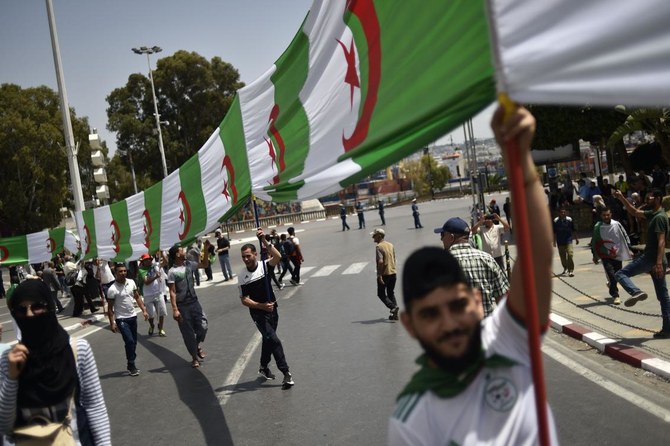
Algerians brandishing national flags take part in a weekly demonstration in the capital Algiers on June 14, 2019. (AFP)
2 / 4
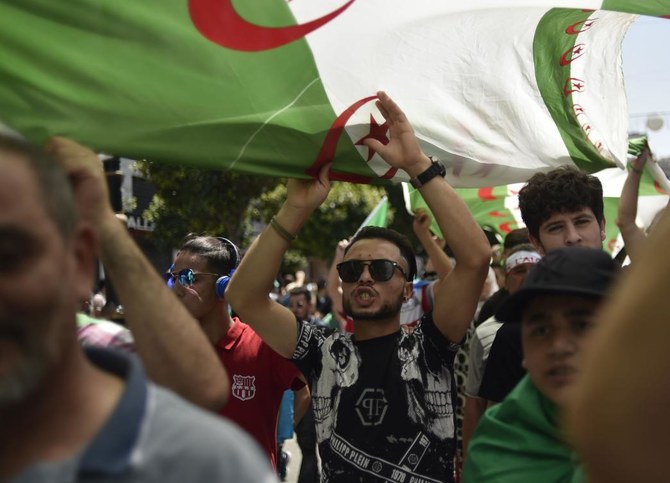
Algerians brandishing national flags take part in a weekly demonstration in the capital Algiers on June 14, 2019. (AFP)
3 / 4
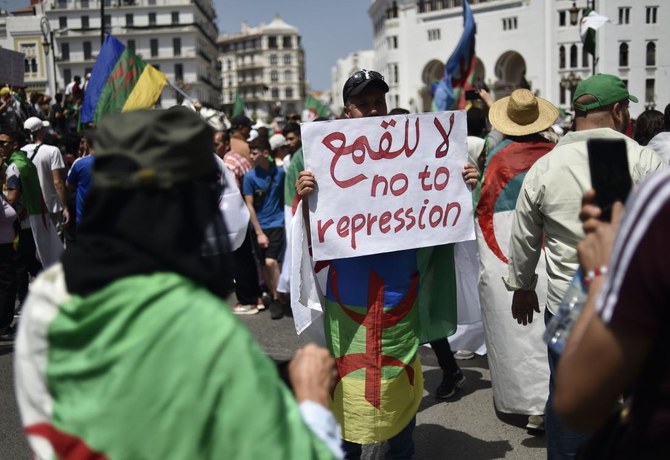
An Algerian man raises a placard as he takes part in a weekly demonstration in the capital Algiers on June 14, 2019. (AFP)
4 / 4
Algerians brandishing national flags take part in a weekly demonstration in the capital Algiers on June 14, 2019. (AFP)
Updated 14 June 2019
Follow

Algerians rally even after ex-premiers detained

  • The protest came a day after former prime minister Abdelmalek Sellal joined a long list of prominent politicians and businessmen who have been detained as part of investigations into corruption
  • Thursday’s supreme court decision against Sellal, an ally of ex-president Abdelaziz Bouteflika, came a day after another former premier, Ahmed Ouyahia, was also remanded in custody as part of a graft probe

ALGIERS: Demonstrators rallied in the Algerian capital Friday to keep up their demands for the ouster of all officials linked to the former president, unappeased by the detention of two ex-premiers.
The protest came a day after former prime minister Abdelmalek Sellal joined a long list of prominent politicians and businessmen who have been detained as part of investigations into corruption.
“Thieves, you have pillaged the country,” the crowds of protesters marching in Algiers chanted.
“They deserve what they got... and they must be held accountable by the people for their actions,” said protester Mohammed, who declined to give his surname.
Thursday’s supreme court decision against Sellal, an ally of ex-president Abdelaziz Bouteflika, came a day after another former premier, Ahmed Ouyahia, was also remanded in custody as part of a graft probe.
“Jailing Ouyahia and Sellal is an excellent thing,” said Cherif Tigrin, a 40-year-old carpenter taking part in the massive rally in the center of Algiers.
“But we must continue” to protest as long as Bouteflika’s cronies remain in power, he said.
Algerians have been holding massive protests since February, after an ailing Bouteflika announced plans to seek a fifth term in office.
The veteran leader resigned on April 2 as the pressure against him to quit mounted from all sides, only hours after army chief and close ally General Ahmed Gaid Salah demanding impeachment proceedings against him.
Gaid Salah has since emerged as a key power broker in the North African country.
Although the army chief has ordered anti-corruption investigations in the country, according to observers, he has not won favor with the demonstrators who are also calling for his departure.
“Gaid Salah to the (rubbish) bin,” protesters chanted on Friday, according to footage posted online by local journalists.
They also called on interim president Abdelkader Bensalah and his prime minister, Noureddine Bedoui, to step down.
Several demonstrators also held up signs to mark the 18th anniversary of the “Black Spring” bloody riots of 2001, sparked by the death of a high school student in a police station in the Kabylie region.
The mountainous Kabylie region east of Algiers is home to the largest Berber community in Algeria who have long suffered marginalization.
“April 2001 and February 2019... the struggle continues,” read one of the signs.
Demonstrations also took place Friday in several other Algerian cities and towns, according to social media reports.
It was not immediately clear, however, how many protesters took to the streets nationwide as official figures were unavailable.


First Ramadan after truce brings flicker of joy in devastated Gaza

Updated 55 min 51 sec ago
Follow

First Ramadan after truce brings flicker of joy in devastated Gaza

  • Ramadan lanterns and string lights appear on streets lined with collapsed buildings and piles of rubble in Gaza City
  • The first holy month since the October ceasefire brings mixed feelings for the many still living in tents

GAZA CITY: Little Ramadan lanterns and string lights appeared on streets lined with collapsed buildings and piles of rubble in Gaza City, bringing joy and respite as Islam’s holiest month began — the first since October’s ceasefire.
In the Omari mosque, dozens of worshippers performed the first Ramadan morning prayer, fajr, bare feet on the carpet but donning heavy jackets to stave off the winter cold.
“Despite the occupation, the destruction of mosques and schools, and the demolition of our homes... we came in spite of these harsh conditions,” Abu Adam, a resident of Gaza City who came to pray, told AFP.
“Even last night, when the area was targeted, we remained determined to head to the mosque to worship God,” he said.
A security source in Gaza told AFP Wednesday that artillery shelling targeted the eastern parts of Gaza City that morning.
The source added that artillery shelling also targeted a refugee camp in central Gaza.
Israel does not allow international journalists to enter the Gaza Strip, preventing AFP and other news organizations from independently verifying casualty figures.

‘Stifled joy’

In Gaza’s south, tens of thousands of people still live in tents and makeshift shelters as they wait for the territory’s reconstruction after a US-brokered ceasefire took hold in October.
Nivin Ahmed, who lives in a tent in the area known as Al-Mawasi, told AFP this first Ramadan without war brought “mixed and varied feelings.”
“The joy is stifled. We miss people who were martyred, are still missing, detained, or even traveled,” she said.
“The Ramadan table used to be full of the most delicious dishes and bring together all our loved ones,” the 50-year-old said.
“Today, I can barely prepare a main dish and a side dish. Everything is expensive. I can’t invite anyone for Iftar or suhoor,” she said, referring to the meals eaten before and after the daily fast of Ramadan.
Despite the ceasefire, shortages remain in Gaza, whose battered economy and material damage have rendered most residents at least partly dependent on humanitarian aid for their basic needs.
But with all entries into the tiny territory under Israeli control, not enough goods are able to enter to bring prices down, according to the United Nations and aid groups.

‘Still special’

Maha Fathi, 37, was displaced from Gaza City and lives in a tent west of the city.
“Despite all the destruction and suffering in Gaza, Ramadan is still special,” she told AFP.
“People have begun to empathize with each other’s suffering again after everyone was preoccupied with themselves during the war.”
She said that her family and neighbors were able to share moments of joy as they prepared food for suhoor and set up Ramadan decorations.
“Everyone longs for the atmosphere of Ramadan. Seeing the decorations and the activity in the markets fills us with hope for a return to stability,” she added.
On the beach at central Gaza’s Deir el-Balah, Palestinian artist Yazeed Abu Jarad contributed to the holiday spirit with his art.
In the sand near the Mediterranean Sea, he sculpted “Welcome Ramadan” in ornate Arabic calligraphy, under the curious eye of children from a nearby tent camp.
Nearly all of Gaza’s 2.2 million residents were displaced at least once during the more than two years of war between Israel and Hamas, sparked by the latter’s unprecedented October 7 attack on Israel.
Mohammed Al-Madhoun, 43, also lives in a tent west of Gaza City, and hoped for brighter days ahead.
“I hope this is the last Ramadan we spend in tents. I feel helpless in front of my children when they ask me to buy lanterns and dream of an Iftar table with all their favorite foods.”
“We try to find joy despite everything,” he said, describing his first Ramadan night out with the neighbors, eating the pre-fast meal and praying.
“The children were as if they were on a picnic,” he said.