

In Pakistan’s capital, a community drum circle where everyone is welcome

Participants at a session of the Drum Circle Islamabad on June 12, 2019 (AN photo)
Short Url
Updated 25 July 2020
Follow

In Pakistan’s capital, a community drum circle where everyone is welcome

  • Drum Circle Islamabad has expanded from six people in 2017 to groups of 500 people playing percussion instruments together
  • "It’s about being a part of something bigger than yourself," founder Natiq Ali said at Wednesday’s session

ISLAMABAD: A rhythmic thump and thrum reverberated out into the streets surrounding the Cafe Garage in the Pakistani capital of Islamabad.
It is a familiar sound every Wednesday as the Drum Circle Islamabad — an informal group of people who play percussion instruments together — meets at a new venue to partake in community drumming.
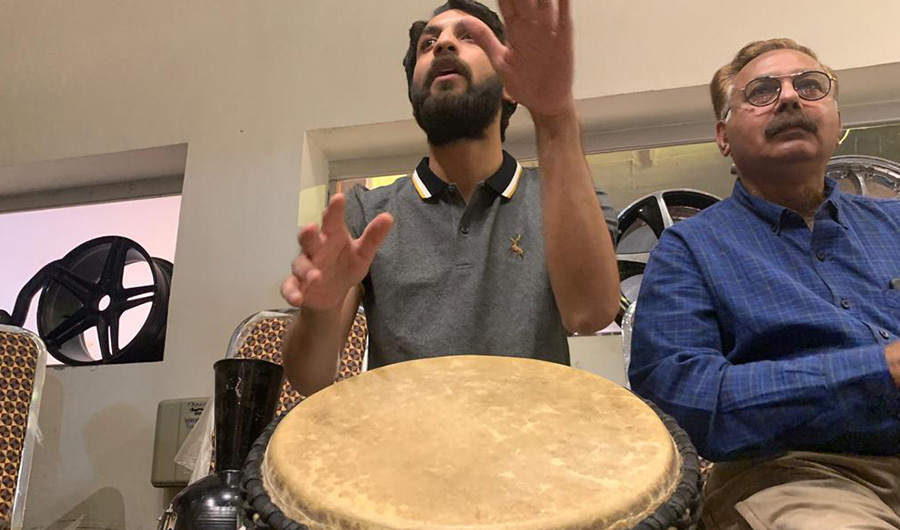


Natiq Ali, one of the co-founders of Drum Circle Islamabad, plays the drums at a gathering of the group on June 12, 2019 (AN Photo)

The aim: to empower participants in the act of celebrating community and life through rhythm and music.
This Wednesday, too, at least 80 people gathered on the ground floor of the Cafe Garage for the drum circle, led by Usman Shakeel, 30, and Natiq Ali, 27, who founded the group in 2017. Since then, the original squad of six has expanded to crowds as large as 500 people playing together in parks, on street corners and at restaurants.



Co-founder of Drum Circle Islamabad, Usman Shakeel, leads the group into a call and response drumming pattern encouraging participants to synchronise their hits with the group on June 12, 2019 (AN Photo)

“Drums have been around since 6000 BC,” Ali told Arab News at this week’s gathering. “It’s communal, it’s communication, it’s therapy and it brings a lot of people together. It’s about being a part of something bigger than yourself.”
At Wednesday’s session, men and women of all ages, teenagers and even toddlers, poured into the cafe and settled into chairs arranged in a wide circle; many sat on the floor. No introductions were made; only the beats were counted and then everyone began to play, smiling and laughing at each other and performing in harmony as the sun went down in the city outside.
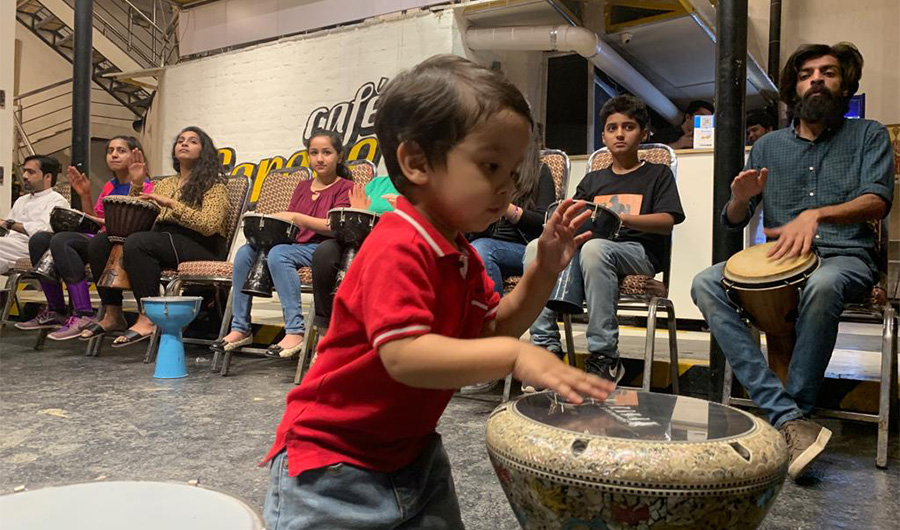


Mohammed Usman, the son of Usman Shakeel who co-founded Drum Circle Islamabad, joins the drummers on June 12, 2019 (AN photo)

“The vision was to facilitate people with an activity which creates a positive impact for society,” said Shakeel, a teacher and lead singer of the Sufi rock band Saakin. “We were playing drums together in parks, in streets and on roads. Wherever we played people would gather around and respond to what we were doing.”
“It allows us to channel our energies into something productive; the people of our country do not have outlets where they can express themselves, this is the community for that,” said Sheikh Mohammad Ahmed, one of the original members of the drum circle. “Here you are so many people with different rhythms in your mind but playing just one together — it’s very therapeutic.”
“I’ve come here more than ten times,” said Sara Abid, a young bespectacled project manager. “I come here every Wednesday. It’s not something I think about it, I just have to come.”


Pakistan seafood exports rise 22 percent in last six months on strong Gulf, Asia demand

Updated 5 sec ago
Follow

Pakistan seafood exports rise 22 percent in last six months on strong Gulf, Asia demand

  • Fisheries is a vital pillar of the national maritime economy that supports livelihoods of millions of Pakistanis, particularly in coastal communities
  • Maritime Affairs Minister Junaid Anwar Chaudhry stresses the need for strict regulatory compliance, sustainable fishing to protect marine biodiversity

KARACHI: Pakistan’s seafood exports climbed 22% over the past six months buoyed by strong demand from Gulf and Asian markets, the country’s Press Information Department said, citing official data.

KARACHI: Pakistan’s marine fisheries sector posted strong growth as its seafood exports rose to 122,629.11 metric tons, valued at $253.24 million, between July and December 2025, the Press Information Department said on Friday, citing Maritime Affairs Minister Junaid Anwar Chaudhry.

Pakistan’s exports stood at 102,942.05 metric tons worth $208.25 million during the corresponding period of the previous year, according to the Marine Fisheries Department data. The sector recorded a year-on-year increase of 19.1% in volume and 21.6% in value.

Fisheries is a vital pillar of the national maritime economy that supports livelihoods of millions of Pakistanis, particularly in coastal communities along the Arabian Sea in Sindh and Balochistan provinces, according to the maritime affairs minister.

Historically contributing around 1% to GDP, the sector has rebounded from pandemic-era disruptions through expanded processing capacity, improved cold-chain logistics, and stricter certification aligned with international standards.

“The performance reflects the growing competitiveness of Pakistan’s marine fisheries in global markets,” Chaudhry, who noted sustained export momentum from July till December, was quoted as saying by the PID.

According to the data, frozen fish remained the leading export category, accounting for 26,669.37 metric tons valued at $53.33 million. Shrimps and prawns followed with earnings of $40.46 million, while frozen cuttlefish generated $36.13 million. Other products, including shrimp meal, crabs, sardines, mackerel, flatfish species and fish meal, also contributed to higher export receipts, underscoring diversification and growth in value-added processing.

“China retained its position as Pakistan’s largest export destination, importing more than 83,602 metric tons worth $149.2 million — nearly 59% of total seafood exports— driven by steady demand for high-quality frozen products,” PID said.

“Thailand ranked second with imports valued at $31.3 million, mainly shrimps and prawns, supported by Pakistan’s HACCP-certified (Hazard Analysis and Critical Control Point-certified) processing standards.”

The United Arab Emirates, Malaysia, and Japan followed, with rising shipments of cuttlefish and fish meal.

Chaudhry said that market diversification efforts have also expanded exports to the European Union, Saudi Arabia, Vietnam, Kuwait, and the United States.

Monthly export figures showed consistent growth, peaking at $56.42 million in November and $55 million in December, aided by seasonal demand and logistical improvements. Non-tax revenue from the fisheries sectors also increased to Rs127.7 million (approximately $460,000), up from Rs118 million a year earlier.

Chaudhry attributed the gains to government initiatives such as collaboration with the International Maritime Organization (IMO) on sustainable fishing practices and investments in port infrastructure in Karachi and Gwadar.

“These developments signal the fisheries sector’s rising contribution to foreign exchange earnings and economic stability,” he said, stressing the need for strict regulatory compliance and sustainable fishing to protect marine biodiversity.