

In Pakistan’s capital, a community drum circle where everyone is welcome

Participants at a session of the Drum Circle Islamabad on June 12, 2019 (AN photo)
Short Url
Updated 25 July 2020
Follow

In Pakistan’s capital, a community drum circle where everyone is welcome

  • Drum Circle Islamabad has expanded from six people in 2017 to groups of 500 people playing percussion instruments together
  • "It’s about being a part of something bigger than yourself," founder Natiq Ali said at Wednesday’s session

ISLAMABAD: A rhythmic thump and thrum reverberated out into the streets surrounding the Cafe Garage in the Pakistani capital of Islamabad.
It is a familiar sound every Wednesday as the Drum Circle Islamabad — an informal group of people who play percussion instruments together — meets at a new venue to partake in community drumming.
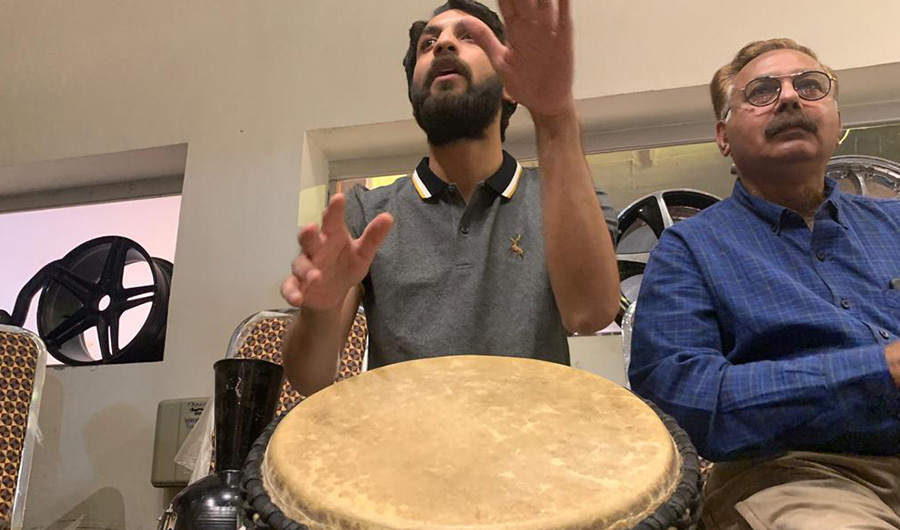


Natiq Ali, one of the co-founders of Drum Circle Islamabad, plays the drums at a gathering of the group on June 12, 2019 (AN Photo)

The aim: to empower participants in the act of celebrating community and life through rhythm and music.
This Wednesday, too, at least 80 people gathered on the ground floor of the Cafe Garage for the drum circle, led by Usman Shakeel, 30, and Natiq Ali, 27, who founded the group in 2017. Since then, the original squad of six has expanded to crowds as large as 500 people playing together in parks, on street corners and at restaurants.
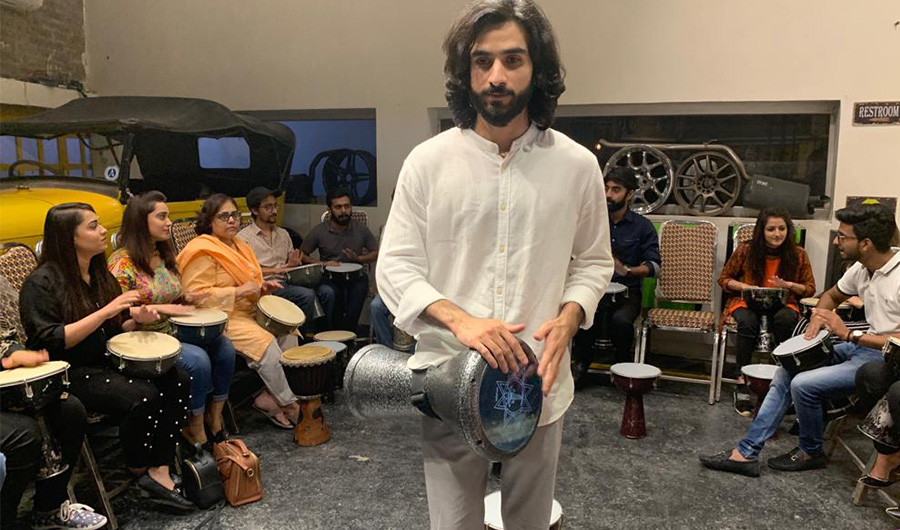


Co-founder of Drum Circle Islamabad, Usman Shakeel, leads the group into a call and response drumming pattern encouraging participants to synchronise their hits with the group on June 12, 2019 (AN Photo)

“Drums have been around since 6000 BC,” Ali told Arab News at this week’s gathering. “It’s communal, it’s communication, it’s therapy and it brings a lot of people together. It’s about being a part of something bigger than yourself.”
At Wednesday’s session, men and women of all ages, teenagers and even toddlers, poured into the cafe and settled into chairs arranged in a wide circle; many sat on the floor. No introductions were made; only the beats were counted and then everyone began to play, smiling and laughing at each other and performing in harmony as the sun went down in the city outside.
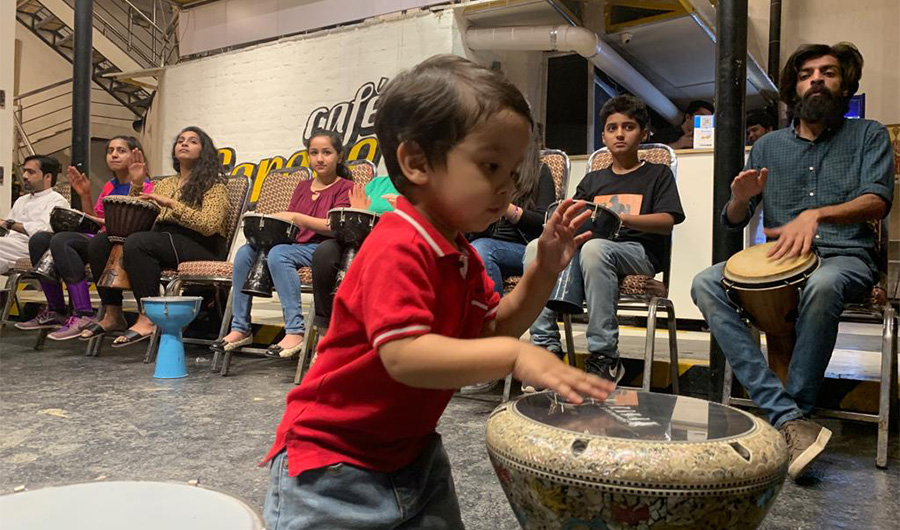


Mohammed Usman, the son of Usman Shakeel who co-founded Drum Circle Islamabad, joins the drummers on June 12, 2019 (AN photo)

“The vision was to facilitate people with an activity which creates a positive impact for society,” said Shakeel, a teacher and lead singer of the Sufi rock band Saakin. “We were playing drums together in parks, in streets and on roads. Wherever we played people would gather around and respond to what we were doing.”
“It allows us to channel our energies into something productive; the people of our country do not have outlets where they can express themselves, this is the community for that,” said Sheikh Mohammad Ahmed, one of the original members of the drum circle. “Here you are so many people with different rhythms in your mind but playing just one together — it’s very therapeutic.”
“I’ve come here more than ten times,” said Sara Abid, a young bespectacled project manager. “I come here every Wednesday. It’s not something I think about it, I just have to come.”


Curfew extended in Gilgit-Baltistan, probe ordered after deadly Khamenei protests

Updated 03 March 2026
Follow

Curfew extended in Gilgit-Baltistan, probe ordered after deadly Khamenei protests

  • At least 15 people were killed in clashes with law enforcement agencies over the weekend in Gilgit-Baltistan
  • Government also announces a de-weaponization campaign, crackdown on hate speech and cybercrime in region

ISLAMABAD: The government in Pakistan’s Gilgit-Baltistan (GB) region on Tuesday extended a curfew in Gilgit district and ordered a judicial probe into violent protests over the killing of Iranian Supreme Leader Ali Khamenei in US-Israeli strikes last week, an official said.

At least 15 people were killed in clashes with law enforcement agencies over the weekend in GB, where protesters torched and vandalized several buildings, including United Nations regional offices, an army-run school, software technology park and a local charity building.

The violence prompted regional authorities to impose curfew in Gilgit and Skardu districts on March 2-4 as officials urged people to stay indoors and cooperate with law enforcers, amid widespread anger in Pakistan, particularly among members of the Shiite minority, over Khamenei’s killing.

On Tuesday, the GB government convened to review the situation and announced the extension of curfew in Gilgit among a number of security measures as well as ordered the establishment of a judicial commission to investigate the weekend violence in the region.

“The government has made it clear that the law will strictly take its course against elements involved in vandalism at government institutions, private properties and incidents of vandalism in Gilgit and Skardu and no kind of mischief will be tolerated,” Shabbir Mir, a GB government spokesperson, said in a statement.

“In view of the security situation, curfew will remain in force in Gilgit, while the decision to extend the curfew in Skardu will be taken keeping the ground realities and the changing situation in view.”

The statement did not specify how long the curfew will remain in place in Gilgit.

Besides the formation of the judicial commission to investigate the violent clashes, the government also decided to launch a large-scale de-weaponization campaign in the entire Gilgit district, for which relevant institutions have been directed to immediately complete all necessary arrangements, according to Mir.

In addition, a crackdown has been ordered on hate speech, spread of fake news and cybercrime.

“The aim of these decisions is to ensure the rule of law, protect the lives and property of citizens and crack down on miscreants,” he said. “Approval has also been given to immediately survey the affected infrastructure and start their restoration work on priority basis.”

Demonstrators in Pakistan’s southern port city of Karachi also stormed the US Consulate on Sunday, smashing windows and attempting to burn the building. Police responded with batons, tear gas, and gunfire, leaving 10 people dead and more than 50 injured.

Pakistani authorities have since beefed up security at US diplomatic missions across the country, including around the US consulate building in Peshawar, to avoid any further violence.