

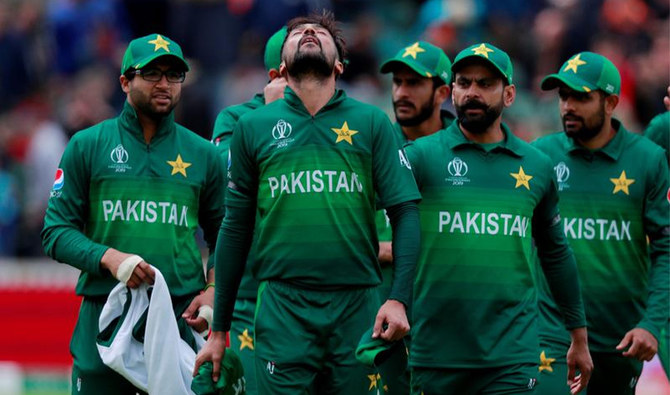

KARACHI: The man stood right near the boundary, alone, as the camera zoomed in on him. From his clothes, it wasn’t immediately clear which side he was supporting.
He wasn’t wearing the signature greens of the Pakistani cricket fan -- just jeans and a flannel shirt and sleeveless windbreaker. But eventually, it wasn’t his outward appearance that gave away his allegiances; it was his stance, and his look of complete dismay: both hands on his hips as he turned away from the camera in the unceasing disappointment of a Pakistani cricket fan wondering why he had, yet again, made the questionable decision of supporting the Pakistani cricket team.
On the first ball of the 37th over of Australia’s innings in their match against Pakistan -- which Australia won by 41 runs on Wednesday evening -- their opener David Warner slashed a wide ball straight to Asif Ali’s hands.
Asif, returning to the team after the tragic death of his infant daughter to cancer, had already dropped one catch earlier in the day. He spilled this one too, and as he did, the camera zoomed in on the fan described above, and one disappointed believer out of millions of disillusioned Pakistani devotees was catapulted out of obscurity to become an instant meme-legend.
The fan didn’t look angry; he wasn’t cursing, or being boisterous. He wasn’t waving his arms, stamping his feet or shaking his head -- the usual gesticulations of panicked fans of the Pakistan team. He just stood there silently, his lips pursed, his gaze fixed, and his soul broken as he turned away from the camera.
That utter disappointment, in that made-for-TV-and-internet moment, wasn’t reserved for his favoured team alone. His disillusionment, a rude awakening, was very personal. Because even though Pakistan Cricket lets you down so consistently, the fans still believe in it. And even when the fans try and have the lowest expectations, such as their team being able to take simple catches in international matches, the squad still finds a way to disenchant them. And inevitably, the fans ask themselves: why do we even bother showing up? Maybe that’s why, perhaps, this fan didn’t look angry -- because he knew that at some level that it was his own fault for continuing to believe in his team.
To be fair to Pakistan superfans, few other teams that lose so regularly do so while looking like they might win each of the lost matches. During Wednesday’s engrossing encounter at Taunton, there were several times when Pakistan looked like they had the upper hand, only to throw it away almost immediately -- and doing so without any inspiration from their opponents, but of their own remarkable ability to self-implode.
Indeed, once again, the Pakistan team’s selection belied belief. Shadab Khan, a consistent threat both on the field and with the ball, was dropped for newcomer Shaheen Afridi in a four-pronged pace attack. Pakistan also continued to go without all-rounder Imad Wasim and instead retained veteran Shoaib Malik who yet again fell for a cheap score in what has been a wretched run of form.
The greenness of the pitch and overcast skies suggested that going without both these spinners would have been acceptable, but either the pitch didn’t offer much or Pakistan just bowled poorly.
Australia’s Warner, who had been struggling for fluency earlier in the tournament, scored his first international century since serving a year-long ban for his part in a ball-tampering scandal. From a man who struggled in Sunday's defeat by India, he made his way to 107.
Prior to Wednesday’s game, Australian captain Aaron Finch had defend Warner’s selection, arguing that “every evidence suggests he'll be back to his dangerous best. And when you give good players an opportunity, [there] might be just a little mindset change.”
The Pakistani bowlers provided just that mindset change as the beleaguered opener played his most fluent innings of the World Cup. But just when Australia looked poised to post a huge total, Pakistan’s bowling pulled off a remarkable comeback, somehow conceding under run-a-ball in the final fifteen overs while picking up eight wickets to bowl Australia out.
A target of 308 felt like a completely gettable one. Just last Monday, Pakistan had beat England, the World Cup favourites, in a crucial encounter at Trent Bridge in Nottingham. But then on Wednesday, Pakistan immediately made life difficult for itself when opener Fakhar Zaman got out for a duck. Babar Azam, their most important batter on the Pakistani side, played perhaps the most delightful innings of 30 you would see, before getting out as well. Pakistan had dug themselves into a hole already, but Imam-ul-Haq and Mohammad Hafeez had other ideas. Batting sedately yet almost always in control, the two wrested the team back to a position of hope.
And hope is perhaps the most seductive option for Pakistan cricket. In the space of half an hour, Pakistan lost four wickets to lapses in concentration rather than good bowling.
The two set batters, Imam and Hafeez, fell to particularly poor deliveries, while Malik continued his wretched run with the bat. With under half the target still left to chase, this should have been the match. But of course, the Pakistan cricket fan had one more spell of exquisite torture to undergo.
First Hasan Ali and then Wahab Riaz -- two bowlers who aren’t meant to lead batting chases -- both played sparkling cameos, slapping the ball around the park and picking up boundaries for fun. But just when Pakistan were close enough for it to get exciting, they lost their last three wickets for two runs. That intoxicating hope had immediately brought about its own hangover.
“I’m very disappointed. We lost three wickets in 15 balls [in the middle order] and that’s why we lost the match,” Pakistani skipper Sarfaraz Ahmed said. “We conceded too many runs at the start of the innings … the other bowlers did not bowl well with the new ball.”
Speaking on the upcoming match against India, he added that “India as you know is a strong team and we can never get a chance to win a match if we make small mistakes. We are playing well, but unfortunately we are making small mistakes because of which we are losing matches.”
In a previous article, I described Australia as bullies and this was yet another bullying performance from a team that performs much worse than its results, reputation, and attitude indicate.
Much like against Afghanistan and West Indies, Australia never truly dominated Wednesday’s game against Pakistan. The clincher was that like so many times before, their opponents seemed to lose their nerve against the idea of Australia the bullies rather than the effort and skills of its players. This was perhaps why India, the only strong side the defending champs have faced so far, was able to beat them so convincingly on June 9. But such observations don’t matter to the points table, where Australia are now second.
For Pakistan, they now have to go face arch-rivals India in an encounter that their team has never won in a World Cup. With all the media hype and historical context, their fans will still go in with some semblance of hope. But at some point on Sunday, they might find themselves standing hands on hips, that same disappointed, desolate look on their faces that the lone fan on Wednesday wore when Asif Ali dropped a catch Warner threw straight into his hands.


