Sudan’s military blames protest leaders for escalation

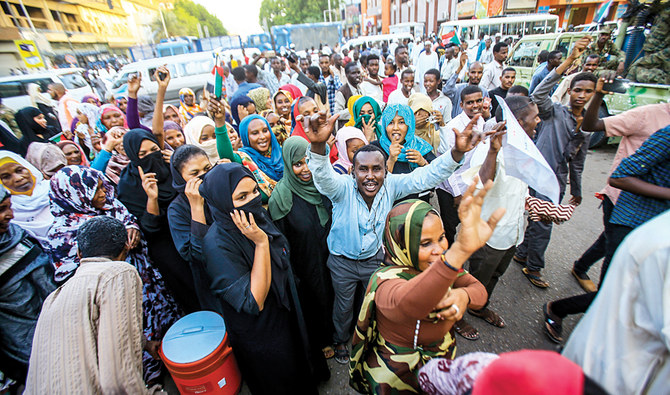
Supporters of the Sudan’s ruling Military Council rally in Khartoum. It has been two months since the army ousted former ruler Omar Al-Bashir. (AFP)
Updated 10 June 2019
Follow

Sudan’s military blames protest leaders for escalation

  • Actions by the demonstrators are doing major harm to country's security, says military

KHARTOUM: Sudan’s ruling military blamed the country’s protest movement for an escalation as the second day of the opposition’s general strike kicked in on Monday.

For the second day, shops and businesses were closed in the capital, Khartoum, though there was visibly more traffic in the streets than on Sunday, when the strike began.

The military said actions by the protest movement as doing major harm to Sudan and its security.

It has been two months since the military ousted Sudan’s former ruler, Omar Al-Bashir, on April 11, following months of protests against his government. The generals put Bashir behind bars and took over the country, promising free elections following a transitional period.

The protesters, however, remained in the streets demanding the generals relinquish power right away. The standoff lasted until troops moved in last Monday and broke up opposition sit-ins, including the main encampment outside the military headquarters in Khartoum.

Over 100 people have been killed in the violence since then. The Health Ministry disputes the death toll, saying the official total tally of those killed in the violence stands at 61, including three members of the security forces.

On Sunday, the military council said it was willing to return to the talks with what looked like a concession on a plan offered by the Ethiopian Prime Minister Abiy Ahmed who visited Khartoum last week trying to revive negotiations between the generals and the protest leaders.

The opposition said it accepts Aby as mediator but put forth several conditions.

The protest leaders urged people to close up roads again, rebuild dismantled barricades across the country, and avoid clashes with the paramilitary Rapid Support Forces. In a video posted late Sunday, Mohammed Al-Asam, a protest leader, urged the Sudanese to continue the campaign.

Security forces on Sunday removed barricades from main roads and reopened the sit-in area outside the military’s headquarters.

“The solution is to get life paralyzed,” the protest leaders said.

Lt. Gen. Jamaleddine Omar, from the ruling military council, said late Sunday that by closing roads and setting up barricades, the protesters committed a crime.

“The technique of closing the roads and building barricades ... is a full-fledged crime as it deprives people from being able to go about their normal life,” he said.

Omar said the Forces for Declaration of Freedom and Change, which represented the protesters in negotiations with the military council that went on for weeks till the generals suspended the talks earlier this month, are to blame for “all the regrettable events” of the past days.


Israel’s Supreme Court suspends govt move to shut army radio

Updated 29 December 2025
Follow

Israel’s Supreme Court suspends govt move to shut army radio

  • Israel’s Supreme Court has issued an interim order suspending a government decision to shut down Galei Tsahal, the country’s decades-old and widely listened-to military radio station

JERUSALEM: Israel’s Supreme Court has issued an interim order suspending a government decision to shut down Galei Tsahal, the country’s decades-old and widely listened-to military radio station.
In a ruling issued late Sunday, Supreme Court President Isaac Amit said the suspension was partly because the government “did not provide a clear commitment not to take irreversible steps before the court reaches a final decision.”
He added that Attorney General Gali Baharav-Miara supported the suspension.
The cabinet last week approved the closure of Galei Tsahal, with the shutdown scheduled to take effect before March 1, 2026.
Founded in 1950, Galei Tsahal is widely known for its flagship news programs and has long been followed by both domestic and foreign correspondents.
A government audience survey ranks it as Israel’s third most listened-to radio station, with a market share of 17.7 percent.
Prime Minister Benjamin Netanyahu had urged ministers to back the closure, saying there had been repeated proposals over the years to remove the station from the military, abolish it or privatise it.
But Baharav-Miara, who also serves as the government’s legal adviser and is facing dismissal proceedings initiated by the premier, has warned that closing the station raised “concerns about possible political interference in public broadcasting.”
She added that it “poses questions regarding an infringement on freedom of expression and of the press.”
Defense Minister Israel Katz said last week that Galei Tsahal broadcasts “political and divisive content” that does not align with military values.
He said soldiers, civilians and bereaved families had complained that the station did not represent them and undermined morale and the war effort.
Katz also argued that a military-run radio station serving the general public is an anomaly in democratic countries.
Opposition leader Yair Lapid had condemned the closure decision, calling it part of the government’s effort to suppress freedom of expression ahead of elections.
Israel is due to hold parliamentary elections in 2026, and Netanyahu has said he will seek another term as prime minister.

Grendizer at 50
The anime that conquered Arab hearts and minds
Enter
keywords