ISLAMABAD: Pakistan’s National Accountability Bureau (NAB) arrested opposition leader Hamza Shehbaz on Tuesday on money laundering charges after a two-member bench of the Lahore High Court rejected his interim bail plea.
Shehbaz, who is the leader of the opposition in Punjab Assembly and son of former Chief Minister Punjab Shehbaz Sharif, is a veteran Pakistan Muslim League-Nawaz (PML-N) leader.
Dozens of PML-N workers gathered outside the court protesting the arrest and briefly blocked the roads.
The country’s anti-graft body arrested former President Asif Ali Zardari after Islamabad High Court (IHC) rejected his bail plea in a separate graft case.
Prime minister’s adviser on information Firdous Ashiq Awan hailed the move and said that the two arrests showed the law was equal for everyone.
Earlier, in April this year, an accountability court indicted Shehbaz and his father in graft cases and for misuse of public funds and authority.

Pakistan’s opposition leader Hamza Shehbaz nabbed in graft case
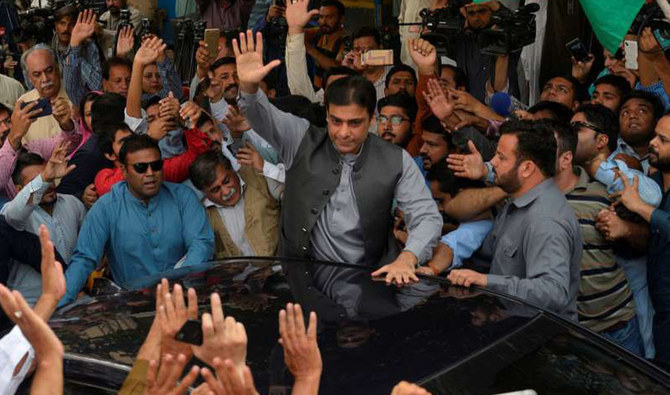
- Dozens of PML-N workers protested the arrest in Lahore
- PML-N supremo and ex-premier Nawaz Sharif is already in jail over graft charges
Pakistan’s deputy PM speaks with Iran, Türkiye after UN rights vote on Tehran
- Pakistan voted against UN rights council resolution seeking to expand scrutiny of Iran
- Dar discusses regional issues with Türkiye’s Hakan Fidan after World Economic Forum
ISLAMABAD: Pakistan’s Deputy Prime Minister Ishaq Dar held separate phone calls on Saturday with the foreign ministers of Iran and Türkiye, highlighting Islamabad’s growing diplomatic engagement on regional crises after backing Tehran at the United Nations Human Rights Council and amid wider discussions on Middle East stability.
Dar, who also serves as Pakistan’s foreign minister, spoke with Iran’s Seyed Abbas Araghchi after Islamabad voted against a resolution at the UN rights council in Geneva that sought to expand international scrutiny of Iran following a crackdown on anti-government protests that began last month and continued for several days.
“Foreign Minister Araghchi thanked DPM / FM for his strong support and Pakistan’s position at the United Nations Human Rights Council in Geneva,” the foreign office said in a statement after the phone call.
While the resolution was adopted, Iran rejected it as “politicized” and described the council’s action as interference in its internal affairs.
Dar later spoke by phone with Türkiye’s Foreign Minister Hakan Fidan, with the two leaders reviewing developments following the World Economic Forum in Davos and agreeing to remain in close contact on key regional and international matters, the foreign office said.
Pakistan and Türkiye have increasingly coordinated diplomatic positions on regional issues, including Middle East tensions, as Islamabad positions itself as an active interlocutor in multilateral forums addressing conflict and humanitarian crises.
Iran’s foreign minister also conveyed appreciation to Pakistan’s prime minister, government and people for what he described as Islamabad’s principled stance, the statement added.