Iran revokes New York Times correspondent’s accreditation

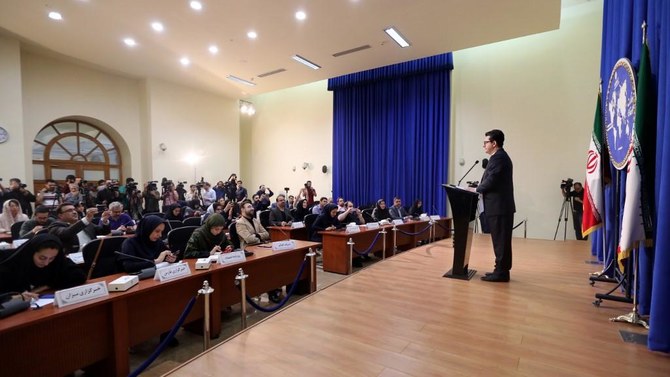
Abbas Mousavi, spokesman for Iran’s Foreign Ministry, gives a press conference in Tehran on May 28, 2019. (AFP)
Updated 11 June 2019
Follow

Iran revokes New York Times correspondent’s accreditation

  • Journalists in Iran face harassment from security services, while others have been imprisoned for their work

DUBAI: Iran has revoked the press accreditation for The New York Times’ correspondent based in Tehran without explanation, the newspaper reported Tuesday.
While the newspaper said it remained hopeful Thomas Erdbrink soon would be allowed to work again, the revocation comes amid heightened tensions between the US and Iran stemming from President Donald Trump’s withdrawal from Tehran’s nuclear deal with world powers a year ago.
Iran pulled Erdbrink’s government-required authorization to work as a journalist four months ago, the Times said. He’s been unable to work since February and the Times said it decided to go public with his situation “after recent speculation and comments on social media.”
“Officials of Iran’s Foreign Ministry have repeatedly assured The Times that Mr. Erdbrink’s credential would soon be restored but have offered no explanation for the delays or for why it was revoked,” the Times reported, quoting international editor Michael Slackman. “He added that there are some indications this will be resolved soon.”
Iran’s mission to the United Nations did not immediately respond to a request for comment. There was no immediate response in Iranian state-run media.
Erdbrink, a Dutch national, previously worked as a correspondent for The Washington Post as well. He’s married to Iranian photographer Newsha Tavakolian, who is represented by the Magnum photo agency.
Both he and Tavakolian were the focus of “Our Man in Tehran,” a 2018 documentary about his work and life as a Western journalist in Iran.
Journalists in Iran face harassment from security services, while others have been imprisoned for their work. While local journalists face the brunt of that, foreign journalists in Tehran, especially those with Western ties, have been imprisoned as well.
The last major case involved Iranian-American reporter Jason Rezaian of the Washington Post, who was convicted in an internationally criticized, closed-door espionage trial in 2015. A 2016 prisoner swap negotiated between Iran and the US amid the start of the nuclear deal freed Rezaian and three other Iranian-Americans in exchange for pardons or charges being dropped against seven Iranians. That deal also saw the US make a $400 million cash delivery to Iran.


Israel arrests 2 Turkish CNN journalists over live broadcast outside IDF HQ

Updated 03 March 2026
Follow

Israel arrests 2 Turkish CNN journalists over live broadcast outside IDF HQ

  • Police said reporter Emrah Cakmak and cameraman Halil Kahraman were detained on suspicion of filming a sensitive security facility
  • Since the Gaza war began, restrictions have expanded significantly, including tighter limits on filming soldiers on duty and sensitive or strategic sites

LONDON: Israeli police have arrested two Turkish CNN journalists who were broadcasting live outside the Israel Defense Forces’ headquarters in Tel Aviv.

Police said the pair were detained on suspicion of filming a sensitive security facility, according to the Israel Police Spokesperson’s Unit.

Reporter Emrah Cakmak and cameraman Halil Kahraman, from the network’s Turkish-language channel, had been reporting near the IDF’s Kirya military headquarters on Tuesday after Iran launched another missile barrage at Tel Aviv and other parts of central Israel.

During the live broadcast, two men believed to be soldiers approached the crew and seized the reporter’s phone, according to initial reports and a video circulating online that could not be independently verified.

Police said officers were dispatched after receiving reports of two people carrying cameras and allegedly broadcasting in real time for a foreign outlet.

Israel’s long-standing military censorship system, overseen by the IDF Military Censor, has long barred journalists and civilians from publishing material deemed harmful to national security.

Since the Gaza war began, restrictions have expanded significantly, including tighter limits on filming soldiers on duty and sensitive or strategic sites.

After a series of similar incidents involving foreign media — most of them Palestinian citizens of Israel working for Arab-language and international media, along with foreign journalists — during the 12-Day War, Israeli police halted live international broadcasts from missile impact sites, citing concerns that exact locations were being revealed.

The Government Press Office later imposed a blanket ban on live coverage from crash and impact areas.

Communications Minister Shlomo Karhi and National Security Minister Itamar Ben-Gvir subsequently ordered that all foreign journalists obtain prior written approval from the military censor before broadcasting — live or recorded — from combat zones or missile strike locations.

Police said that when officers asked the CNN Turk crew to identify themselves, they presented expired press cards and were taken in for questioning.

Burhanettin Duran, head of Turkiye’s Directorate of Communications, condemned the arrests as an attack on the press and said Ankara is working to secure the journalists’ release.