



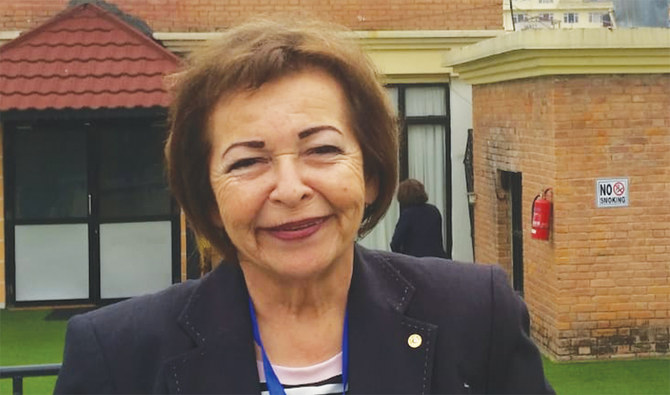


DUBAI: “The need is so great for the work we do in this field.” This comment, by Rana Sidani Cassou of the International Federation of Red Cross and Red Crescent Societies (IFRC), sums up the state of her occupation as a female humanitarian worker in the Middle East and North Africa (MENA).
The phenomenon of women in the region devoting their lives to helping people affected by wars, natural disasters and humanitarian crises is scarcely new. But what is different now is the gap between the availability and demand for female volunteers and staff.
Cassou, based in Lebanon, has witnessed her fair share of tragedies while working on the frontlines for various aid organizations since 2004.
As the IFRC’s head of communications for 21 countries, it is her responsibility to keep the world’s attention focused on MENA’s humanitarian needs, and “to give a voice to local communities.”
Cassou has vivid memories of her deployment in the ancient city of Bam, in Iran’s Kerman province, following the devastating earthquake in 2003. “I was in Bam within 48 hours of the earthquake,” she told Arab News. “The whole city had been destroyed. Everything was gone: Homes, schools, villages. It was a city of rubble.”
She especially remembers the rescue of an elderly woman from underneath the rubble 11 days later.
“She explained that she’d been in a state of partial paralysis and therefore confined to her bed. Her son would visit her every day to make sure she had an adequate stock of food and other necessities,” Cassou said.
“When the earthquake hit, she was protected by a block of wood that sheltered her. She survived by rationing out the food, medicine and water that her son had left with her,” Cassou added.
“This incident really touched my heart. I realized that when your time isn’t over, it isn’t over. It made me into a person who believes I have to do my best to help people like this, regardless of war, disease, outbreaks or earthquakes.”
Of course, not all stories have a happy ending. Cassou was sent to Tunisia after several migrants drowned when their boat — which had started out from the Libyan port of Zouara in the direction of Italy — capsized in the Mediterranean Sea. “I met a mother whose story haunts me to this day. She was on the boat with her 5-year-old son and 3-year-old daughter. She could tell the boat was going to capsize, and so asked another passenger to hold on to her son while she held on to her daughter when the vessel overturned,” Cassou said.
“Rescue teams managed to save the mother and daughter and took them to Tunisia, while rescue helicopters were taking the survivors to Rome to a refugee camp there. The mother arrived in Tunisia with no idea if her son was dead or in some camp for refugees,” Cassou added. “I tried to find the little boy, but I still don’t know what happened to him. This is one of the downsides of the job. It hurts to be weighed down with questions without answers, to not be able to help everyone.” 
Salma Bahgat is another Arab woman who has devoted her working life to helping those in need of humanitarian assistance.
As director of the Egyptian Red Crescent’s (ERC) department in charge of tracing and restoring family links, Bahgat’s job is to find and reunite people, especially those separated from their families due to events beyond their control.
“When I got to do fieldwork, it changed my life. It’s a two-way job, where you get to see the real impact of your efforts,” she told Arab News from Cairo.
Bahgat joined the ERC barely 24 hours before Egypt’s political upheaval of 2011. “So I pretty much participated as a humanitarian worker in the aftermath of the violent events,” she said. “A stand-out moment for me early on in my career was during the evacuation of a camp. Helping many people belonging to different groups from the same place was overwhelming. For me, the best moment was when a young man published a Facebook post a year later describing how I saved his life. That day, I came to know how one could be touching people’s lives without even realizing,” she added.
“My job is to reunite separated family members, but it also involves offering protection and support to children, women and elders,” Bahgat said.
“Recently, I was present during the reunification of several children with their families at the airport after years of separation. The hugs and tears of joy were very moving for everyone present there, but what moved me most was the sight of a stern security official looking at his own child’s photo on his phone as he watched a girl being reunited with her aunt.”
Bahgat said she would like to see more women in MENA pursuing a career in humanitarian work.
“Arab women are strong and caring at the same time, which is a perfect combination for a humanitarian worker,” she said.
“Their work will have a huge impact on the upbringing of a new generation. I encourage women of the region to get exposure to humanitarian work. Any woman who joins this field will be following her heart.”
One woman who has been doing so for more than three decades is Laila Toukan, director of training at the Jordan Red Crescent.
Having been raised in a household where “humanitarian volunteering is a habit and a way of life,” Toukan, a Palestinian, said she had no doubt about her career choice.
As part of her job, she runs a vocational training center which strives to empower women and young girls with a view to improving their economic status and self-esteem.
“We give them training in sewing, handicraft skills, beauty and hair care, culinary art and literacy,” Toukan told Arab News from Amman. “We teach them computer skills to enable them to access social media, as well as knowledge of business enterprise.”
Toukan said she has given socially and economically useful training to hundreds of young women every year. “We have many success stories,” she added. “For instance, two young women who met while doing a course together have launched a successful business from home together.”
Looking back on her life as a humanitarian worker, Toukan said she would not only like to see more Arab women in the profession, but also more of them in decision-making roles. “We need volunteers, committed volunteers, those who’ll stay and make a difference. Together, we can help girls and women in need,” she added. “If you give women cash or an in-kind donation, this eventually goes away. But once you teach them a skill, it stays with them for life.”
Toukan’s views are echoed by Cassou, who said there is a desperate need for dedicated female humanitarian workers in the region. But Cassou cautioned that anyone wanting to do humanitarian work has to be “realistic about their expectations” and realize they “can’t save the entire world.” Nevertheless, “there’s a real need for Arab women in our field. We’re based in a region where most countries have experienced wars, disasters, crises and upheavals, so there’s a need for more hands, especially in the form of Arab women,” she added. “We have empathy, we understand the culture and we speak the language. It makes a big difference.”


