‘In a zoo’: Pakistan’s Kalash battle tourism deluge

1 / 3
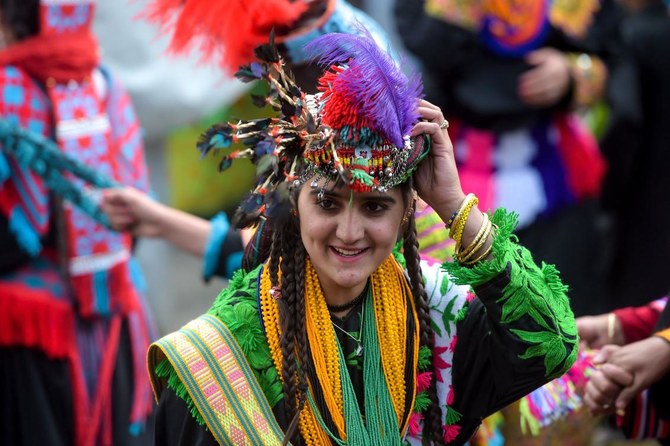
In a remote valley in Pakistan dozens of Kalash minority women dance to celebrate spring’s arrival. (AFP)
2 / 3
The community warns an influx of domestic tourists is threatening their unique traditions. (AFP)
3 / 3
Kalash women celebrate ‘Joshi’, a festival to welcome the arrival of spring. (AFP)
Updated 10 June 2019
Follow

‘In a zoo’: Pakistan’s Kalash battle tourism deluge

  • Every year the Kalash greet the new season with animal sacrifices, baptisms, and weddings at a festival known as “Joshi”
  • As celebrations kick off, tourists with phones jostle to get close to Kalash women

BUMBURATE, Pakistan: In a remote valley in Pakistan dozens of Kalash minority women dance to celebrate spring’s arrival — but as a gaggle of men scramble to catch them on camera, the community warns an influx of domestic tourists is threatening their unique traditions.
Every year the Kalash — a group of less than 4,000 people confined to a handful of villages in the north — greet the new season with animal sacrifices, baptisms, and weddings at a festival known as “Joshi.”
As celebrations kick off, tourists with phones jostle to get close to Kalash women, whose vibrant clothing and headdresses contrast starkly with the more modest attire worn by many in the conservative Islamic republic.
“Some people are using their cameras as if they were in a zoo,” said local tourist guide Iqbal Shah.

Known for their pale skin and light-colored eyes, the Kalash have long claimed ancestral links to Alexander the Great’s army — who conquered the region in the fourth century BC.
They worship many gods, drinking alcohol is a tradition and marriages of choice are the norm — unlike in the rest of Pakistan where unions are often arranged.
However, the community is far from a liberal beacon. Members of the community often wed in their teens, with women poorly educated and expected to perform traditional roles in the home.
Stories about the Kalash are nonetheless frequently fabricated, and this has been amplified in recent years by the proliferation of smartphones and social media.

One video viewed 1.3 million times on YouTube, proclaims the Kalash “openly have sex” with partners of their choosing “in the presence of their husbands.”
Another calls them “beautiful infidels,” saying “anyone can go and marry any girl there.”
“How could that be true?” asks Luke Rehmat, a Kalash journalist.
“People are systematically trying to defame the community. They are fabricating stories... when a tourist comes with such a mindset, he will try to experience [it].”
In the main Kalash village of Bumburate a hotel manager estimates that about 70 percent of Pakistani tourists visiting his establishment are young men, who often inquire about where to “find girls.”
According to tourists who spoke to AFP — most of whom were men traveling in groups — their primary interest in exploring the Kalash Valley was to learn about a new culture.
“We want to be part of this festival but it doesn’t mean that we want to mix up with girls,” says tourist Sikander Nawaz Khan Niazi from Lahore.
But friction has been increasing in recent years.
In Bumburate, posters now call on visitors to seek permission from villagers before photographing and signs warn tourists not to harass women.
“If they don’t respect us, we don’t need tourists,” says Yasir Kalash, the vice president of the local hotel association.
“If they respect... our culture and traditions, we must welcome [them].”
Regulating tourism is a cumbersome but vital task for the Kalash, with money from the industry increasingly providing an important source of revenue for the community.
The Kalash — who once inhabited a vast territory stretching from the Himalayas in Kashmir to northern Afghanistan — are now one of the smallest religious minorities in Pakistan, according to Akram Hussain, the director of a local museum.
A recent survey put their number at just 3,872, living in three remote valleys.
“We are going to die if we are not supported,” says Hussain.
Kalash traditions, Hussain argues, can be expensive. Weddings and funerals require families to kill dozens of animals for the festivities, driving them into debt, forcing them to sell off land and leave their ancestral homes.
Cases of forced conversions to Islam of Kalash women have also been reported, while the increase in tourism has pushed some in the community to shun traditions like Joshi, according to several residents who spoke to AFP.
Others have begun wearing veils to hide their faces from the prying eyes of outsiders.
“We don’t wear veils as it is not our custom, but some wear them because people take pictures of them from all sides and it makes them feel ashamed,” says Musarrat Ali, a high school student.
The ongoing erosion of the culture at the hands of outside forces is tragic, says Sayed Gul, an archaeologist from Bumburate.
“They don’t want to participate just because of these cameras and this insensitivity,” says Gul.
“If these things are continuously happening ... maybe in a few years, there are only tourists, there are no more Kalashis to participate and dance in the festivals.”


Afghan barbers under pressure as morality police take on short beards

Updated 57 min 9 sec ago
Follow

Afghan barbers under pressure as morality police take on short beards

KABUL: Barbers in Afghanistan risk detention for trimming men’s beards too short, they told AFP, as the Taliban authorities enforce their strict interpretation of Islamic law with increasing zeal.
Last month, the Ministry for the Propagation of Virtue and Prevention of Vice said it was now “obligatory” to grow beards longer than a fist, doubling down on an earlier order.
Minister Khalid Hanafi said it was the government’s “responsibility to guide the nation to have an appearance according to sharia,” or Islamic law.
Officials tasked with promoting virtue “are obliged to implement the Islamic system,” he said.
With ministry officials patrolling city streets to ensure the rule is followed, the men interviewed by AFP all spoke on condition of anonymity due to security concerns.
In the southeastern province of Ghazni, a 30-year-old barber said he was detained for three nights after officials found out that one of his employees had given a client a Western-style haircut.
“First, I was held in a cold hall. Later, after I insisted on being released, they transferred me to a cold (shipping) container,” he said.
He was eventually released without charge and continues to work, but usually hides with his clients when the patrols pass by.
“The thing is that no one can argue or question” the ministry officials, the barber said.
“Everyone fears them.”

 This photograph taken on February 11, 2026 shows an Afghan barber trimming a customer's hair along a sidewalk in Kabul. (AFP)

He added that in some cases where both a barber and clients were detained, “the clients have been let out, but they kept the barber” in custody.
Last year, three barbers in Kunar province were jailed for three to five months for breaching the ministry’s rules, according to a UN report.

‘Personal space’

Alongside the uptick in enforcement, the religious affairs ministry has also issued stricter orders.
In an eight-page guide to imams issued in November, prayer leaders were told to describe shaving beards as a “major sin” in their sermons.
The religious affairs ministry’s arguments against trimming state that by shaving their beards, men were “trying to look like women.”
The orders have also reached universities — where only men study because women have been banned.
A 22-year-old Kabul University student said lecturers “have warned us... that if we don’t have a proper Islamic appearance, which includes beards and head covering, they will deduct our marks.”

 This photograph taken on February 11, 2026 shows an Afghan barber trimming a customer's hair along a sidewalk in Kabul. (AFP)

In the capital Kabul, a 25-year-old barber lamented that “there are a lot of restrictions” which go against his young clients’ preference for closer shaves.
“Barbers are private businesses, beards and heads are something personal, they should be able to cut the way they want,” he said.
Hanafi, the virtue propagation minister, has dismissed such arguments, saying last month that telling men “to grow a beard according to sharia” cannot be considered “invading the personal space.”

Business slump

In Afghanistan, the majority are practicing Muslims, but before the Taliban authorities returned to power in 2021, residents of major cities could choose their own appearance.
In areas where Taliban fighters were battling US-backed forces, men would grow beards either out of fear or by choice.
As fewer and fewer men opt for a close shave, the 25-year-old Kabul barber said he was already losing business.
Many civil servants, for example, “used to sort their hair a couple of times a week, but now, most of them have grown beards, they don’t show up even in a month,” he said.
A 50-year-old barber in Kabul said morality patrols “visit and check every day.”
In one incident this month, the barber said that an officer came into the shop and asked: “Why did you cut the hair like this?“
“After trying to explain that he is a child, he told us: ‘No, do Islamic hair, not English hair’.”