Despite disruption, consular services in Kabul continue: Pakistan embassy

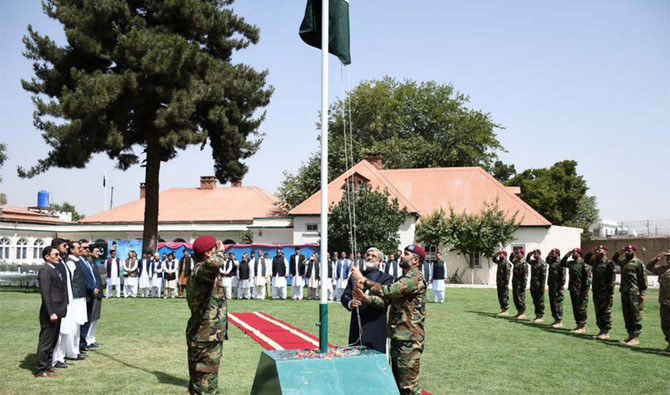
In this March 23, 2016 file photo, Pakistan’s ambassador Syed Ibrar Hussain can be seen hoisting his country’s national flag at the embassy in Kabul. Pakistan’s diplomatic mission in Afghanistan has requested for more facilities to entertain growing number of people who want to visit Pakistan. (Courtesy Embassy of Pakistan in Kabul)
Updated 09 June 2019
Follow

Despite disruption, consular services in Kabul continue: Pakistan embassy

  • Afghan protesters blocked roads leading to the diplomatic facility on Sunday
  • More resources required to deal with increasing number of visa applicants, says an official

KARACHI: Pakistan’s mission in Kabul has requested Islamabad to “construct purpose-built consular hall” and provide “adequate human resource” to deal with the overwhelming number of visa applicants who created an uproar outside the embassy earlier in the day, said a foreign ministry official while talking to Arab News on Sunday.
“Consular services of Pakistan embassy in Kabul are continuing smoothly,” Radio Pakistan announced, adding that officials of the Pakistan embassy in Kabul were in close contact with Afghan authorities after some visa applicants created law and order situation by blocking roads leading to the diplomatic facility.
“There was no incident involving the Pakistan embassy premises as claimed in some [media] reports,” the state-owned radio station continued.
A similar protest took place outside the embassy last year on August 18, with protesters demanding a smooth visa process.
Pakistan hosts 1.39 million Afghan nationals who left their country due to decades of conflict, according to the United Nations High Commissioner for Refugees. Many Afghans also visit their eastern neighbor for trade and better health care facilities.
Regarding Sunday’s protest, Pakistan’s diplomatic mission in Kabul has informed Islamabad that it took place on the first working day after Eid Al-Fitr since the embassy was dealing with more than the usual number of visa applicants who had to form long queues.
“Few elements at the rare of the queues blocked the road leading to the embassy and started protesting. In response, police arrived and dispersed the crowd,” an official in Islamabad told Arab News on condition of anonymity as he was not authorized to speak to the media.
“The embassy may increase the number of visa applications collected every day. It may also increase time and number of windows to collect these requests. Other than that, it may also provide more facilities to medical visa applicants,” he continued, adding these were also the three demands protesters conveyed to the embassy officials.
He also claimed that Pakistan’s diplomatic mission always tried to accommodate maximum number of visa applicants. However, it was not always possible to entertain all of them due to the growing number of people seeking to travel to Pakistan since the embassy had limited resources.
“Our diplomatic mission has reiterated that the only possible solution to this chronic problem is the construction of a purpose-built consular hall and provision of adequate human resource,” the official said while quoting the embassy’s communication with the foreign office in Islamabad.


UN torture expert decries Pakistan ex-PM Khan’s detention

Updated 12 December 2025
Follow

UN torture expert decries Pakistan ex-PM Khan’s detention

  • Khan’s party alleges government is holding him in solitary confinement, barring prison visits
  • Pakistan’s government rejects allegations former premier is being denied basic rights in prison

GENEVA: Pakistan’s former prime minister Imran Khan is being held in conditions that could amount to torture and other inhuman or degrading treatment, the United Nations’ special rapporteur on torture warned Friday.

Alice Jill Edwards urged Pakistan to take immediate and effective action to address reports of the 73-year-old’s inhumane and undignified detention conditions.

“I call on Pakistani authorities to ensure that Khan’s conditions of detention fully comply with international norms and standards,” Edwards said in a statement.

“Since his transfer to Adiala Jail in Rawalpindi on September 26, 2023, Imran Khan has reportedly been held for excessive periods in solitary confinement, confined for 23 hours a day in his cell, and with highly restricted access to the outside world,” she said.

“His cell is reportedly under constant camera surveillance.”

Khan an all-rounder who captained Pakistan to victory in the 1992 Cricket World Cup, upended Pakistani politics by becoming the prime minister in 2018.

Edwards said prolonged or indefinite solitary confinement is prohibited under international human rights law and constitutes a form of psychological torture when it lasts longer than 15 days.

“Khan’s solitary confinement should be lifted without delay. Not only is it an unlawful measure, extended isolation can bring about very harmful consequences for his physical and mental health,” she said.

UN special rapporteurs are independent experts mandated by the Human Rights Council. They do not, therefore, speak for the United Nations itself.

Initially a strong backer of the country’s powerful military leadership, Khan was ousted in a no-confidence vote in 2022, and has since been jailed on a slew of corruption charges that he denies.

He has accused the military of orchestrating his downfall and pursuing his Tehreek-e-Insaf (PTI) party and its allies.

Khan’s supporters say he is being denied prison visits from lawyers and family after a fiery social media post this month accusing army leader Field Marshal Asim Munir of persecuting him.

According to information Edwards has received, visits from Khan’s lawyers and relatives are frequently interrupted or ended prematurely, while he is held in a small cell lacking natural light and adequate ventilation.

“Anyone deprived of liberty must be treated with humanity and dignity,” the UN expert said.

“Detention conditions must reflect the individual’s age and health situation, including appropriate sleeping arrangements, climatic protection, adequate space, lighting, heating, and ventilation.”

Edwards has raised Khan’s situation with the Pakistani government.