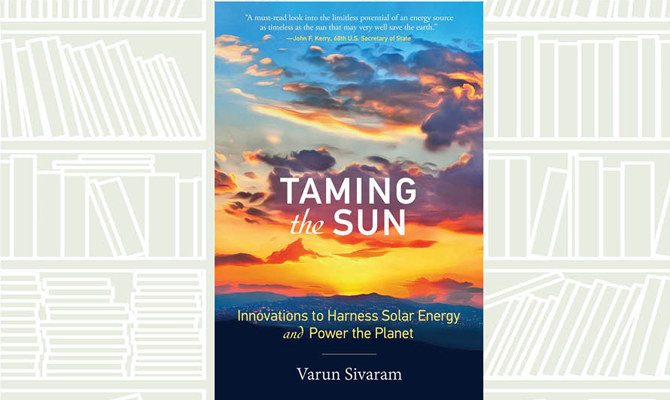
What We Are Reading Today: Taming the Sun by Varun Sivaram

Updated 09 June 2019
Follow

What We Are Reading Today: Taming the Sun by Varun Sivaram

Solar energy, once a niche application for a limited market, has become the cheapest and fastest-growing power source on earth. What is more, its potential is nearly limitless —every hour the sun beams down more energy than the world uses in a year. 

But in Taming the Sun, energy expert Varun Sivaram warns that the world is not yet equipped to harness erratic sunshine to meet most of its energy needs, says a review published on goodreads.com.

Innovation can brighten those prospects, Sivaram explains, drawing on firsthand experience and original research spanning science, business, and government. Financial innovation is already enticing deep-pocketed investors to fund solar projects around the world, from the sunniest deserts to the poorest villages. Technological innovation could replace today’s solar panels with coatings as cheap as paint and employ artificial photosynthesis to store intermittent sunshine as convenient fuels. 

Systemic innovation could add flexibility to the world’s power grids and other energy systems so they can dependably channel the sun’s unreliable energy.

Unleashing all this innovation will require a visionary public policy. Although solar cannot power the planet by itself, it can be the centerpiece of a global clean energy revolution.


UK entrepreneur says people who disagree with his Palestine solidarity should not shop at his stores

Updated 22 December 2025
Follow

UK entrepreneur says people who disagree with his Palestine solidarity should not shop at his stores

  • Mark Constantine shut all British branches of cosmetics retailer Lush earlier this year in solidarity with Gaza
  • ‘I don’t think being compassionate has a political stance,’ he tells the BBC

LONDON: A British cosmetics entrepreneur has told people who disagree with his support for Palestine not to shop at his businesses.

Mark Constantine is the co-founder and CEO of the Lush chain of cosmetic stores, which temporarily closed all of its UK outlets earlier this year in an act of solidarity with the people of Gaza.

He told the BBC that people should be “kind, sympathetic and compassionate,” that those who are “unkind to others” would not “get on very well with me,” and that anyone who disagrees with his views “shouldn’t come into my shop.”

He told the “Big Boss Interview” podcast: “I’m often called left wing because I’m interested in compassion. I don’t think being compassionate has a political stance.

“I think being kind, being sympathetic, being compassionate is something we’re all capable of and all want to do in certain areas.”

In September, every branch of Lush in the UK, as well as the company’s website, were shut down to show solidarity for the people of Gaza.

A statement on the page where the website was hosted read: “Across the Lush business we share the anguish that millions of people feel seeing the images of starving people in Gaza, Palestine.”

Messages were also posted in the windows of all the shuttered stores, stating: “Stop starving Gaza, we are closed in solidarity.”

Constantine was asked if he thought his views on Gaza could harm his business, and whether people might decide not to deal with him as a result.

“You shouldn’t come into my shop (if you don’t agree),” he said. “Because I’m going to take those profits you’re giving me and I’m going to do more of that — so you absolutely shouldn’t support me.

“The only problem is, who are you going to support? And what are you supporting when you do that? What is your position?”