

Syrian rebel town buries goalkeeper who became ‘singer of the revolution’

1 / 6
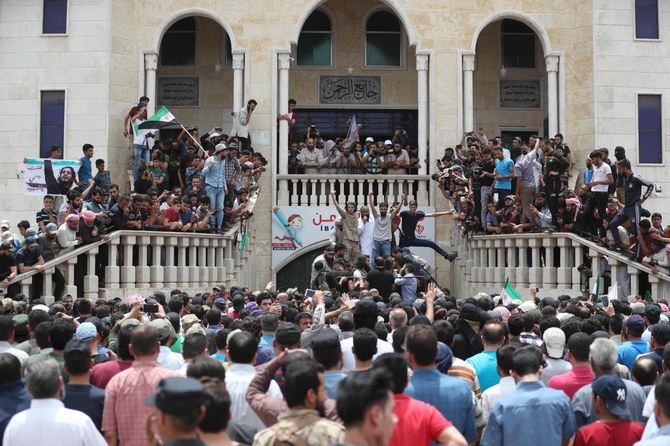
Syrians waving rebel flags and portraits of Abdelbasset Al-Sarout during the rebel fighter's funeral in Al-Dana, Idlib region, near the border with Turkey. (AFP)
2 / 6
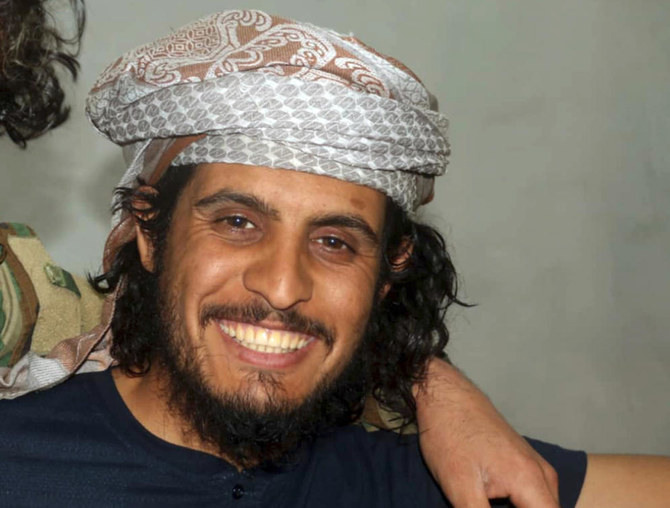
Abdelbasset Al-Sarout the former Syrian national soccer goalkeeper turned anti-government fighter. (AP)
3 / 6
Syrians waving rebel flags and portraits of Abdelbasset Al-Sarout during the rebel fighter's funeral in Al-Dana, Idlib region, near the border with Turkey. (AFP)
4 / 6
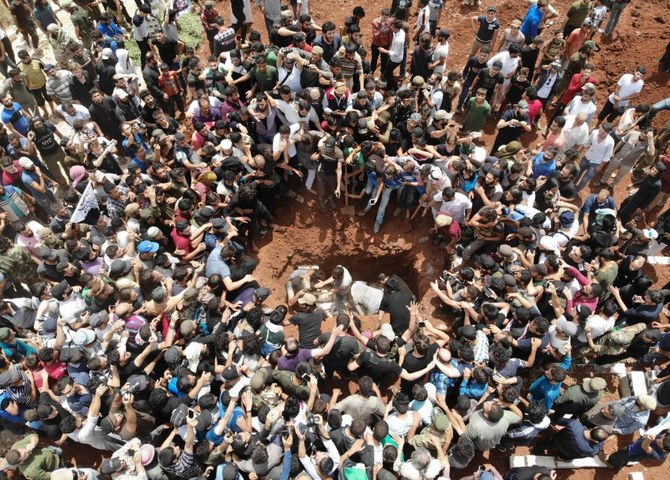
The funeral of Abdelbasset Al-Sarout, the former goalkeeper turned rebel fighter, in Al-Dana, Idlib. (AFP)
5 / 6
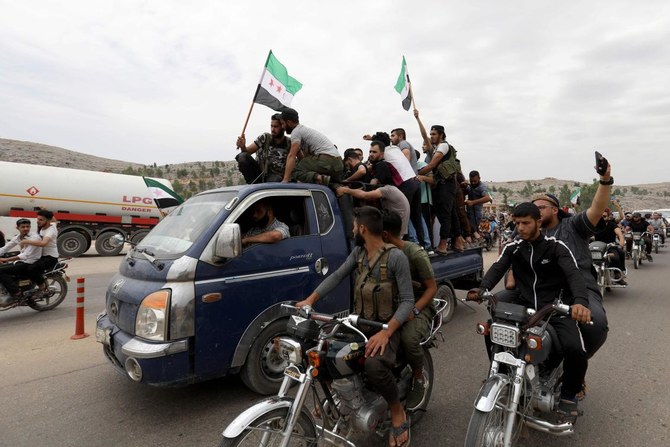
A convoy of Syrians follow the truck carrying the coffin of late rebel fighter Abdelbasset Al-Sarout, near the Syrian border with Turkey. (AFP)
6 / 6
The funeral of Abdelbasset Al-Sarout, the former goalkeeper turned rebel fighter, in Al-Dana, Idlib. (AFP)
Updated 09 June 2019
Follow

Syrian rebel town buries goalkeeper who became ‘singer of the revolution’

  • Abdelbasset Al-Sarout, 27, died on Saturday from wounds he sustained in northwest Syria
  • Known as the 'singer of the revolution' for chanting ballads that eulogized slain activists and vilified Bashar Assad

AL-DANA, Syria: Thousands of people flocked to the funeral on Sunday of a Syrian soccer star turned fighter who became an icon of the revolt against President Bashar Assad.
Abdelbasset Al-Sarout, 27, died on Saturday from wounds he sustained in northwest Syria, where an army offensive has pounded the last major rebel bastion for weeks.
Once a well-known goalkeeper from the city of Homs, Sarout gained a new kind of fame when the popular uprising against Assad’s rule erupted in 2011. He was dubbed the “singer of the revolution” for chanting ballads at rallies that eulogized slain activists and vilified the president.


After Assad’s iron-fisted crackdown on the protests, Sarout took up arms and became a wanted man. His path mirrored the uprising’s spiral into an armed fight to the death between Damascus and the myriad militias and guerrilla bands that the conflict spawned.
Sarout was moved from a hospital in Turkey, which backs the opposition, across the border on Sunday, with a convoy of cars and motorcycles following the coffin into Syria.
People chanted, honked and waved rebel flags on the way to the funeral in the border town of Al-Dana, where one of Sarout’s brothers is buried.
Four of Sarout’s brothers and his father had already died fighting pro-government forces.


Crowds stood on the roofs to watch Sarout’s body, wrapped in white, being carried through the town. Rebels from his faction, Jaish Al-Izza, fired into the air.
In the mosque, men including fighters in combat uniform kneeled in front of his body to pray, some of them weeping.
“We all know Sarout’s songs and golden vocals. Today is a big loss, a sad day for the Syrian revolution. We lost one of its icons,” said Ali Al-Zajel, an activist at the funeral.
With Russian and Iranian help, Assad’s military has reclaimed much of Syria by crushing opposition enclaves in recent years.
Sarout was among hundreds of thousands of civilians and insurgents shuttled to the northwest under surrender deals as the army reconquered their hometowns.
Sarout, who fought government forces in his home city, left under such a deal in 2014 after a bitter two-year siege.
As rebel factions struggled with infighting and the growing influence of Muslim jihadists, Sarout was accused of switching his allegiance to Islamic State, which he denied in a video in 2015.


Gaza fuel running short after Israel closes borders amid Iran war

Gaza is wholly ‌dependent on fuel ‌brought in by trucks from Israel ​and ‌Egypt.
Updated 57 min 46 sec ago
Follow

Gaza fuel running short after Israel closes borders amid Iran war

  • Israel’s military closed all Gaza border crossings on Saturday after announcing air strikes on Iran carried out jointly with the US
  • Israeli authorities say the crossings cannot be operated safely during war

CAIRO/JERUSALEM: Gaza is rapidly running out of its limited fuel supply and stocks of food staples may become tight, officials say, after Israel blocked the ​entry of fuel and goods into the war-shattered territory, citing fighting with Iran.
Israel’s military closed all Gaza border crossings on Saturday after announcing air strikes on Iran carried out jointly with the United States. Israeli authorities say the crossings cannot be operated safely during war and have not said how long they would be shut.
Few days’ worth of supplies
Gaza is wholly ‌dependent on fuel ‌brought in by trucks from Israel ​and ‌Egypt ⁠and a ​lack ⁠of fresh supplies would put hospital operations at risk and threaten water and sanitation services, local officials say. Most Palestinians in Gaza are internally displaced after Israel’s two-year war with Hamas militants.
“I expect we have maybe a couple of days’ running time,” said United Nations official Karuna Herrmann, who directs fuel distribution in Gaza.
Amjad ⁠Al-Shawa, a Palestinian aid leader in Gaza, ‌who works with the UN and NGOs, ‌estimated fuel supplies could last three or ​four days, while stocks ‌of vegetables, flour, and other essentials could also soon run out ‌if the crossings remain shut.
Reuters was unable to independently verify those estimates.
Israel’s COGAT military agency, which controls access to Gaza, said that enough food had been delivered to the territory since the start of ‌an October truce to provide for the population.
“(The) existing stock is expected to suffice for ⁠an extended period,” ⁠COGAT said, without elaborating. It declined to comment on potential fuel shortages.
The truce was part of broader US-backed plan to end the war that involves reopening the Rafah border crossing with Egypt, increasing the flow of aid into the enclave, and rebuilding it.
Hamada Abu Laila, a displaced Palestinian in Gaza, said the closures were stoking fear of a return of famine, which gripped parts of the enclave last year after Israel blocked aid deliveries for 11 weeks.
“Why is it our fault, in ​Gaza, with regional wars ​between Israel, Iran, and America? It is not our fault,” Abu Laila said.